A 72-hour workweek sounds heroic until you try it: This professional's story tells you why
Infosys co-founder Narayana Murthy's call for a 72-hour workweek faced a viral rebuttal on Reddit. A professional's account of improved productivity and well-being after switching to a five-day week challenged the notion that longer hours equate to greater output. This highlights a generational divide in Indian work culture, questioning endurance over efficiency.

One professional’s story exposes why endless hours don’t equal productivity—and why India’s workforce is choosing smarter work.
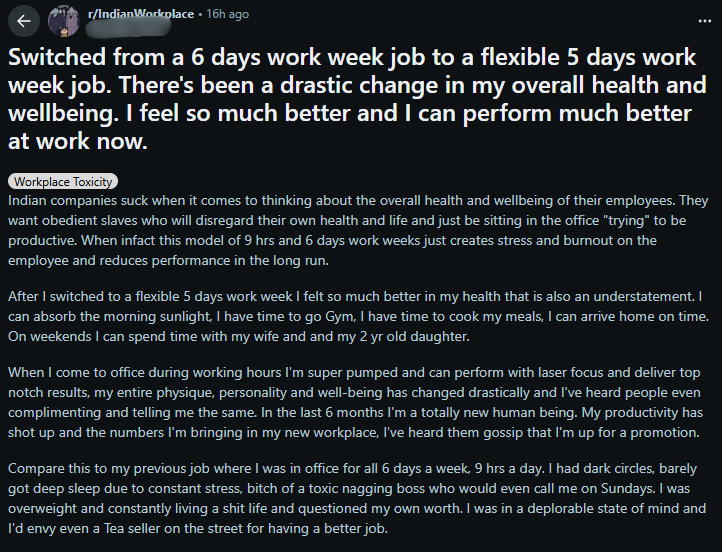
When Infosys co-founder Narayana Murthy suggested that young Indians should work 72 hours a week to help the nation compete globally, he likely did not expect his argument to be dismantled—not by a policy paper or an economist—but by a tired Indian professional on Reddit.Yet that is exactly what happened.A new Reddit post describing the author’s switch from a six-day, nine-hour workweek to a flexible five-day schedule has struck a nerve across India’s working population. Not because it was eloquent or academic, but because it was brutally familiar—and quietly damning of the idea that more hours automatically equal more productivity.
Two visions of productivity, one very tired workforce
Murthy’s argument, made in late 2025, was clear and unapologetic: India needs discipline, sacrifice, and long hours.
Drawing inspiration from China’s infamous “9-9-6” work culture—9 a.m. to 9 p.m., six days a week—he argued that work-life balance is a luxury, not a priority, in a country still chasing economic dominance.The subtext was unmistakable: sleep later, relax later, live later.The Reddit post, meanwhile, offers an inconvenient counterpoint. The author describes life under a six-day work regime as a slow collapse—dark circles, poor sleep, weight gain, constant stress, and a boss who believed Sundays were merely a suggestion.
Productivity existed, but only in the way a drained battery still shows one bar before dying.Then came the five-day, flexible job—and the plot twist Murthy’s model rarely accounts for.
What happened when the workweek got shorter
Instead of collapsing into laziness, the Redditor reports the opposite. Mornings with sunlight. Time for the gym. Home-cooked meals. Evenings that did not end in exhaustion. Weekends spent with a spouse and a two-year-old child—an activity rarely mentioned in productivity metrics.At work, performance improved. Focus sharpened. Output increased. Numbers went up. So much so that office gossip now includes the word “promotion.”In other words, the worker became exactly what corporate India claims to want: healthier, motivated, and effective. Just not exhausted.