‘A hell of a smell’: Villagers kick up stink over King’s fertiliser plan
SOURCE:Sydney Morning Herald|BY:Emily Retter
Many in Flitcham are too nervous to discuss their royal neighbour’s council application but as one says, who would want a wafting stench to ruin a summer’s evening?
London: When your next-door neighbour is the King, it’s a good idea to keep your head down, hints Roger Young, a Flitcham villager. Otherwise, it might just be a case of off with it.
“You can expect to see me hung,” the 87-year-old says after he agrees, following some hesitation, to stop and talk. “Hung, drawn and quartered,” adds his wife, Patsy, 86.
They are not the first people in this pretty Domesday Book village, which forms part of the monarch’s Sandringham Estate in Norfolk, whom we approached in the hope of a brief chat.
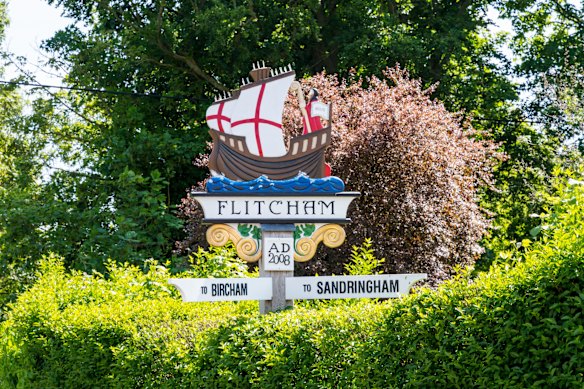
The village of Flitcham, which forms part of the monarch’s Sandringham Estate in Norfolk. Credit: Alamy Stock Photo
But there is a distinct sense of nervousness. Most decline to speak at all, politely swinging wreathed doors closed, or leaving us standing on doormats that are adorned with pheasant motifs.
“They’ve got lawyers that would tie us up in knots,” says one chap ominously, before scurrying up a lane and disappearing into the winter gloom. “Call me Richard,” he calls back enigmatically, when asked for a name.
What is prompting this unsettling whiff of nervous energy amid the village’s sedately mulched front gardens and its orderly, boot-stacked porches?
Fear of a stink is what. In October, villagers caught wind of a proposed organic fertiliser storage lagoon 3956 square metres in size (including screening).
It is set to hold nearly 10,000 cubic metres of farm digestate, the matter left after anaerobic digestion, usually of animal manure as well as crop waste.
If approved, it will be built about 1.5 kilometres away from the village on farm land, which is also less than 1.5 kilometres from Anmer Hall, the Norfolk home of the Prince and Princess of Wales.
Many residents have concerns, principally about odours and gases drifting across the local primary school and homes, compounded by disappointment that they had to stumble upon the proposals.
The plans are contained in a Lawful Development Certificate application, rather than a planning application that would be considered by the borough council’s planning committee, bypassing much of the accompanying formal discussion and hoops of the latter. Including, it seems, any odour impact assessment.
If granted, the project will not need planning permission.
But voicing concerns about the plans seems a sensitive matter because of the regal status of the applicant, not least because many of the residences here have matching turquoise blue front doors. The colour identifies them as estate-owned, and such properties are often rented to its workers. (“The Queen Mother wanted them blue,” is one thing “Richard” will tell us.)
“It’s the name of the game with the royal family. They don’t discuss their actions with the serfs,” says Roger Young, drily. “I think it would have been a far better thing to come and let us know,” adds his wife, more diplomatically.
The couple, who have lived here for 46 years, are phlegmatic about the lagoon. “I’m not looking forward to it, but it’s just part of the thing about living in the countryside,” Roger says.
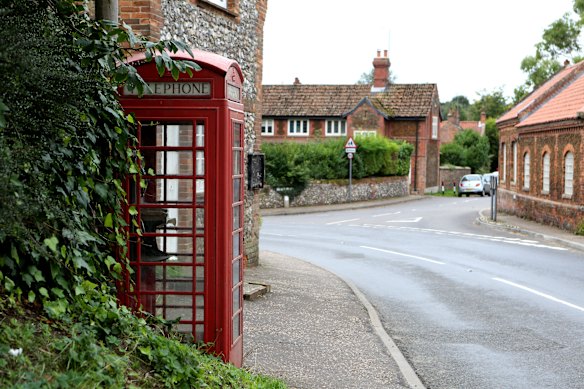
There’s a whiff of nervous energy in Flitcham.Credit: Alamy Stock Photo
Among other villagers, the upset is more pungent.
“I’m pretty sure you will be able to smell it. It’s no different to when they fertilise the fields and, to be honest, [that] makes a hell of a smell,” Mark Donaldson, 57, says as he sets out in gaiters on the five-kilometre walk to the next village’s pub.
“I think anyone would prefer not to have the chance of a smell drifting across your property and ruining your afternoon or a summer’s evening.”
He is just thankful the caravan park he runs is further away. “They should have handed out [letters]. It would have been nice, a round robin wouldn’t have cost a lot of money.”
‘We weren’t taken into consideration’
Paul Jassies, 56, fears the smell will be “constant” and that house prices could be affected. “What remains to be seen is what this will do for the community. There’s a lot of elderly people here; there’s a primary school. If you’ve got a north-east wind, then we’re right in the thick of it,” he said.
Jassies regularly works at his job in IT from his beautiful home. He thinks the estate has approached the plans through a “back door” – pointing to the blue-painted front ones. “Those people may not want to say anything against the estate,” he says.
King Charles and Queen Camilla wave to the public at Sandringham Estate on Christmas Day.Credit: Getty Images
“King Charles is a big eco-warrior, that’s great, but you’ve got to listen to the effects of what you’re going to do. Everyone wants the best for the environment and to do things as eco-friendly as possible but we weren’t taken into consideration.”
The parish council declines to comment, but it did write to express its “very valid concerns” when the proposal was first spotted.
“In particular, there are concerns regarding safety issues and unpleasant odours affecting the village if the wind were blowing toward the village,” wrote parish clerk Gill Welham. She also asked whether the lagoon would be covered, how the odour would be managed and if there were “possible safety issues”.
A cover would, confirms odour consultant Michael Bull, potentially reduce emissions of odours and gases from a lagoon by 80 to 90 per cent, and it would “demonstrate good environmental standards” but there is no obligation to install one.
Agriculture and Horticulture Development Board lead environment specialist David Ball says covers are also effective in keeping out rainwater and therefore reducing volume, but they typically cost about £16 ($32) per square metre. “The cost can be £20,000 to £30,000, depending on size. The vast majority are built without a cover because of cost and a poor acknowledgement of the benefits,” he says.
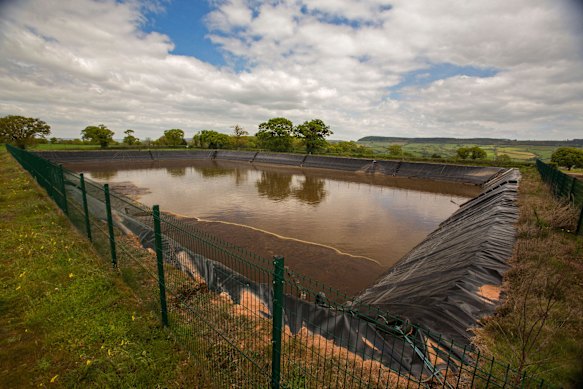
A slurry lagoon on a farm in Devon, England, that is similar to the fertiliser lagoon Sandringham Estate seeks.Credit: Alamy Stock Photo
‘Put a lid on it’
Jassies firmly believes the estate should “put a lid on it”. “What happens in the summer months as well, when it’s not being used? What if it attracts flies, vermin? How is it going to be checked, managed?” he says.
The Sandringham Estate’s application says the lagoon will serve about 2700 hectares “farmed to grow crops, including modern and traditional wheat, barley, beans, and oat varieties, plus a range of heritage grains”. The site would be close to a “network of farm tracks” allowing ready transportation, and fertiliser would no longer need to be ferried in externally, reducing vehicle movements.
The proposal for the land, which also grazes Aberfield sheep and Beef Shorthorn cattle, is “part of the estate’s ongoing conservation management”, it says, stressing it would be “visually contained by the mature vegetation”.
It also describes a screen encompassing a “landscaped bund that will be approximately 2.5m in height, which will be seeded with creeping bent (Agrostis stolonifera) and rough meadow grass (Poa trivialis) or similar to prevent erosion, as well as a range of wild flowers”.
Loading
Organic fertiliser is increasingly seen as an eco-friendly alternative to chemical fertilisers, improving soil structure and therefore crop yields, and capturing carbon. A lagoon, they say, will allow the fertiliser to be stored out of season before spreading in spring, making the distinction that it will not contain “slurry or sewage sludge”, although it would be usual for digestate to emit ammonia and odours.
We visit Flitcham the morning after the initial consultation date of December 16. There had been a busy question and answer session the evening before in the social club, attended by the land agent, the farm manager and the environmental adviser from the estate.
A decision on the application has been deferred until January 9, as the council has requested additional information, principally concerning ammonia emissions.
Senior planner Lucy Smith said the proposal “exceeds the thresholds in the Natural England Air Quality Standing Advice” and that it therefore is “likely to have a significant effect”. If the effect cannot be ruled out, a Regulation 77 application would be required, or the applicant might choose to submit a full planning application.
Bull says protected buildings are officially further away than the 400 metres that might call for an odour impact assessment, although correspondence in the borough council’s planning portal from senior community safety and neighbourhood nuisance officer Suzi Pimlott says: “An assessment of the impacts of odour would have been beneficial to establish the levels of impact and highlight what mitigation may be required.”
Bull says an assessment of potential ammonia emissions is important, especially as there are designated habitat sites nearby. “Some plant species are incredibly sensitive to ammonia,” he says.
“The effects can be found quite a long distance from the source … screening distances are usually between [five and 10 kilometres].”
An ammonia report has now been supplied to the council by the applicant for consideration.
‘The townies haven’t got a clue’
But not everyone in the village is worried.
Val Blackmur, an 82-year-old retired hairdresser, cycles the lane in a red coat and white fluffy hat, a fiery Mrs Christmas. She has lived here for 44 years and trusts the King.
“Would anybody in their right senses put a smelly hole in a quarter of a mile of their son’s house?” she says. “Or within half a mile of Sandringham house, which earns them a fortune? I don’t think so.”
Blackmur says she is not one of the dissenters. “That’s the townies; haven’t got a clue,” she says. “They complain about the cockerels crowing, they complain about the cows mooing, for goodness sake.” (That was in another village, she caveats.) “This is the countryside.”
Ball believes a lagoon of this type should not pose a worry. “There is no reason for concern at all. The material sitting in [a] lagoon is not doing any harm,” he says. “There might be some ammonia coming off it,” which is a “harmful gas”, he says, “but we are not talking about high concentrations in open countryside”.
“It’s not intrusive. You wouldn’t know it was there. When there is recognition of it is when it gets stirred up and spread.”
But many of the villagers agree there is more exploration to be done. The meeting gave some reassurances, they say – that extra heavy-vehicle traffic will not come through the village, for example. But not enough.
Loading
Former primary school teacher Helen Chapman, 57, believes villagers were told a cover had been ruled out. “When I asked them about it, they said they did understand having a cover minimised the odour, but it’s a monetary consideration,” she says. She is “grateful” a meeting finally happened, but that hasn’t undone the sense that the estate’s initial silence smelled off.
However, although she is worried about the health of the village, and doesn’t live behind a blue door, she’ll agree to be photographed only from the back as she walks away with her labrador.