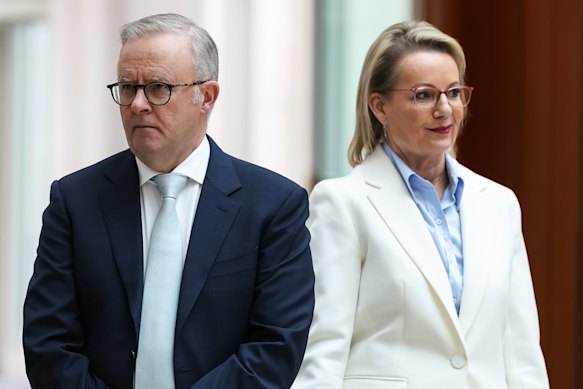
Prime Minister Anthony Albanese’s decision to call a royal commission after the Bondi attack is a huge concession to cap a politically damaging chapter. It finally satisfies calls from the victims’ families, the Jewish community and public figures who have been pushing for a federal commission since December.
It’s also a political win for the federal Coalition and Opposition Leader Sussan Ley, who championed the royal commission early and were unrelenting in their attack on the government.
But the politics must now be set aside, if the royal commission is to have a fair chance of meeting the manifold public expectations of it that have coalesced during the past three weeks. Distilled most simply, Commissioner Virginia Bell is being asked to deliver accountability for families and chart the pathway for a more cohesive country after its worst terrorist attack.
Is there room for unity? Prime Minister Anthony Albanese and Opposition Leader Sussan Ley.Credit: Alex Ellinghausen
Albanese’s most vociferous critics won’t want to let him off the hook, but the commission will struggle to meet its duty if the political noise continues and Bell’s work is undermined.
The government has made its U-turn in establishing this royal commission, and now it moves on to the thornier requirements of that task. Deciding on the commissioners who lead it is one; defining the terms of reference is the other. Bell’s appointment, when it leaked on Wednesday night, quickly became another debate. Where it goes from here will be the next test of Australia’s political leadership.
Loading
The royal commission has been handed a weighty task. It involves illuminating any security or intelligence failures that contributed to the Bondi attack, and revealing what the targeting of Jews celebrating Hanukkah tells us about the spread of antisemitism in Australia.
The first is uncontroversial. It includes questions about how someone flagged by ASIO years ago travelled to the Philippines unnoticed, and how his father accumulated six guns before they shot innocent people at a beach in broad daylight.
The second will be much more complex. It inevitably brings into focus subjects that Australia has struggled to grapple with since October 7, 2023: the rise of antisemitism in this country, whether the war in Gaza or resulting protests played a part in its festering, the role of cultural institutions and universities in this mix, and the way our society balances free speech and discrimination.
These are deeply contested issues, and will continue to be. Perhaps distinguished legal minds, with a bird’s-eye view and independence, will become Australia’s best opportunity to arrive at moral clarity about how and why our social fabric has worn so thin and what we can do about it.
But this will require clean air and public trust – both of which continue dissolving.
On Wednesday evening, news broke that Albanese was considering Bell, a former High Court justice, for the job of commissioner. By the end of the night, former Coalition treasurer Josh Frydenberg said the Jewish community had “serious concerns” about her appointment.
Jewish leaders involved in discussions with the government wanted a commissioner who’d shown they understood the deep fear and despair that has gripped the community as antisemitic firebombings and graffiti undermined their sense of safety before Bondi shattered that altogether. They did not feel Bell had done so.
Some sources who spoke to this masthead also pointed out Bell was part of a High Court ruling on protest laws, which was directly cited as part of the NSW Supreme Court’s decision to overturn the Minns government’s ban on a pro-Palestine march across the Sydney Harbour Bridge.
The trust of Jewish Australians and victims’ families in this process is crucial: if they’re not comfortable, the commission will be compromised from the outset. But for the commission to deliver on its broader purpose, its commissioner must also have the respect of the wider community. As my colleague Paul Sakkal reported, Jewish leaders privately acknowledge they risk blowback if they appear to make political attacks against the commission now that the prime minister has yielded.
Loading
Albanese on Thursday afternoon said Bell was “the most qualified person we could possibly consider”. The Executive Council of Australian Jewry said it would co-operate with her. The opposition’s response will be instructive. On Thursday morning, Ley refused to comment on Bell as an individual. But her home affairs spokesman, Jonno Duniam, said: “What kind of a government goes and appoints someone that may potentially be in complete opposition to community views?”
Any public conversation from here must be had cautiously and thoughtfully. Undermining the judiciary will further destabilise a fragile faith in institutions. Whimpers of politicisation will not allow any commissioner to run a process with the independence people expect.
Ditto when the debate comes to the inquiry’s terms of reference. It is in Australia’s interest that they are carefully calibrated and carry bipartisan support.
A range of views were canvassed in the debate: some Jewish Australians suggested probing the government’s recognition of Palestine, while others warned against inquiring into protest movements and migrant policy. The prime minister rebuked the Coalition’s wide-ranging proposal to interrogate everything from the Australian Human Rights Commission to the media.
Loading
On Thursday afternoon, Albanese outlined his terms. One, investigating antisemitism and its key drivers, including religious extremism. Two, bolstering law enforcement and immigration to respond to antisemitic conduct. Three, examining the circumstances of the Bondi attack. Fourth, anything else that strengthens social cohesion and counters extremism.
The government had to be careful that its terms were not too narrow, thereby inviting further accusations it was running from scrutiny, but Albanese’s terms are sufficiently broad. Crucially, they name antisemitism, religious radicalisation and immigration protocols as explicit topics that Bell must investigate – key issues for the Coalition.
Ley can move in one of two directions. She has repeatedly said she is willing to work with the government, but hasn’t yet shown it. Her approach as opposition leader, so far, has been combative.
The 2½-page statement she issued on Thursday evening continued in that vein: she reserved the Coalition’s support for the royal commission’s terms, and instead lashed out at Albanese’s leadership. “Caving under pressure does not absolve this prime minister or his government of their failures,” she said.
But she has previously proffered a royal commission as a bipartisanship opportunity. Ley can accept the political win graciously and move to soothe divisions by accepting Bell’s appointment and giving the Coalition’s backing to the terms of reference, even if they don’t tick all the opposition’s boxes. Or she can keep pulling apart points of difference when they appear, ensuring that debate remains the default setting.
The fault lines widened by Bondi, when it comes to multiculturalism and immigration, could draw her party into a tougher position on these fractious debates. It may find that resonates among Australians hardened by the attack. But it won’t do much to bring the country together.
The Albanese government has lost face and given ground. If it acts reasonably, the opposition should follow suit.
Natassia Chrysanthos is federal political correspondent.