Anti-Zionism does not have an issue with what Israel does but its very existence
Last weekend, I was in Sydney for a 48-hour visit, three weeks after the massacre at Bondi. It was immediately clear that something had shifted.
Opinion
January 8, 2026 — 7.00pm
January 8, 2026 — 7.00pm
Last weekend, I was in Sydney for a 48-hour visit, three weeks after the massacre at Bondi. My son and I went to the beach. Bondi is not merely iconic; it is the site of my childhood summers, a place that once represented ease, openness and belonging.
It was immediately clear that something had shifted.
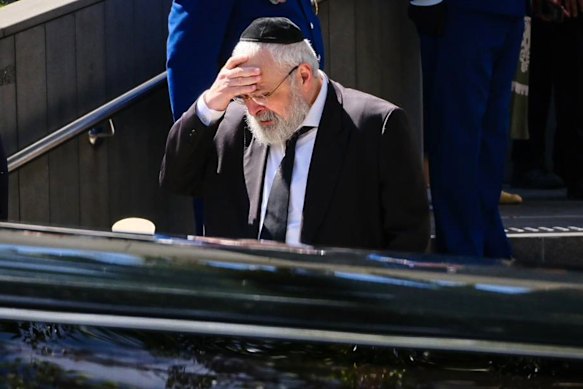
A coffin containing the body of Rabbi Eli Schlanger arrives at the Chabad of Bondi Synagogue during his funeral last month. Credit: Getty Images
The pedestrian bridge from Campbell Parade to the grassy area above the beach – once unremarkable – is now inseparable from footage of the alleged attackers moving deliberately towards crowds of innocent Jewish Australians, gathered to mark the first night of Hanukkah. Bondi, long assumed to be insulated from the world’s darker currents, no longer feels so.
That feeling followed us onto a bus back to our hotel. A lone passenger boarded, clutching a tote bag tightly to his chest, visibly tense. I felt my body react instinctively – scanning, calculating exits, preparing. For a moment, I panicked.
I recognised the sensation immediately.
I spend significant time in Israel. There, vigilance on public transport is not paranoia but a lived reality. Since the Second Intifada – and especially since October 7 – buses, cafes and street corners carry an ambient awareness of risk. Sirens, shelters and security checks are woven into daily life.
What unsettled me was not the fear itself, but where I felt it.
This was Bondi – the adopted home of countless Jewish families after the war, including my own. More than a surf beach, it has long been a civic common: layered with migration, aspiration and trust. And yet, in that moment, the reality of Israeli daily life had followed me home.
That dissonance did not arise spontaneously. It is the downstream effect of a moral climate that has been cultivated, normalised and indulged.
“Israel is a genocidal enterprise.”
“All Zionists are baby killers.”
“Israel is the new Nazis.”
These are no longer fringe slogans. They have become familiar features of protests, campuses and social media since October 7. They are not critiques of policy. They are accusations designed to confer absolute moral guilt – and, in doing so, to dissolve restraint.