Take a deep breath, because Artbank recently turned 45.
Festivities to mark the occasion took place in the form of exhibitions in Melbourne and Sydney, and a new glossy coffee table book.
You could be forgiven for not knowing who or what Artbank is, and for wondering why an organisation you have never heard of celebrated what nobody seems to think is a milestone.
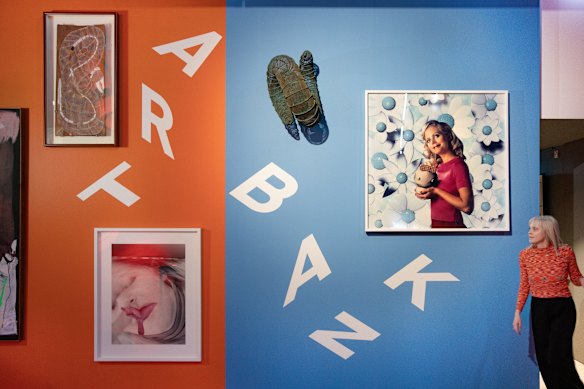
Artbank is now 45 years old. Credit: Simon Schluter
Stay with me. Artbank is a publicly owned collection of 11,000 Australian artworks worth $42 million that was conceived to support local artists by buying and promoting their work through a vast leasing program to individuals and public and private workplaces.
It was launched in 1980 by the conservative Fraser Government after it was decided the then new National Gallery of Australia wasn’t the right body to manage a Lending Collection assembled to supply art to Australia’s international embassies and consulates.
Artbank was modelled on the Canada Council Art Bank and had an annual acquisition budget but was intended to eventually become self-sustaining.
Artbank has always sat within the federal arts department, despite being an odd fit, on account of it having commercial aspirations, and its occasional forays into public view, with exhibitions and publications. Unlike our publicly-funded state and federal galleries and museums, Artbank had previously not – until the past few years – published annual reports.
So why the flurry of exhibitions and a 300-page corporate history for such an odd anniversary?
Artbank director Zoë Rodriguez, who was appointed in 2019, says the organisation’s plan to celebrate the 40th birthday was stymied by COVID shutdowns, so they pivoted to the next best thing.
“45 is arbitrary in many ways but it’s principally a way of celebrating the artists and the collection,” she says.
Rodriguez has also been busy tackling various issues raised over the years. An excoriating report published by the Australian National Audit Office in April 2023, building on a 2006 report and 2014 review, found Artbank had been coasting for decades without a strategy, and that its art acquisitions failed to meet both Commonwealth Procurement Rules and its own collection plan.
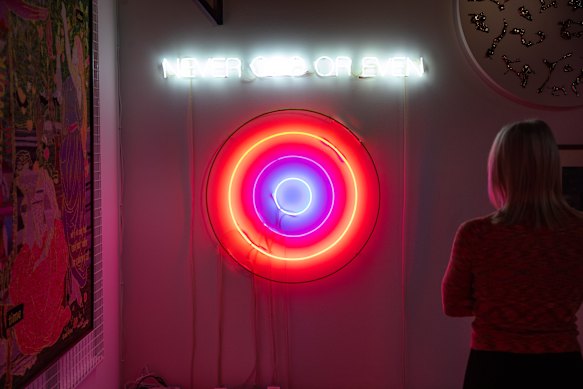
Harry Newell’s Circle/s in the round: NEVER ODD OR EVEN, is showing in Melbourne. Credit: Simon Schluter
The ANAO report found collection management was so substandard the integrity of the collection was under threat, it found the leasing scheme at the heart of the business was not fit for purpose and that Artbank’s entire approach to the task of acquiring, managing and leasing art was substandard.
It found that the 2006 ANAO report made seven recommendations for improvements, which the department at the time agreed to undertake, but a departmental review in 2014 found those issues remained.
Then in June last year, a cross-parliamentary probity and ethics inquiry doubled down and demanded Artbank seriously raise its game.
In a report poetically titled The Never-ending Quest for the Golden Thread, the Joint Committee of Public Accounts and Audit expressed alarm at the degree of ineptitude revealed by the Audit Office report.
For example, Artbank had essentially been pirating videos, it held 15 duplicate copies of 14 digital artworks and had leased those duplicate copies to six separate clients across 22 agreements.
The committee refused to accept Artbank’s attempt to justify the duplicates under a broad interpretation of the terms of its ownership.
Artbank occasionally sells or gives artworks away, through a process called deaccessioning but the reviews revealed a system so slipshod that in one case approval for 70 artworks was obtained four years after they were deaccessioned, with the paperwork concealing the fact the works had long left the collection.
Other artworks were approved but then languished in the collection for years.
This wild recent history for a tiny team within Minister Tony Burke’s Department of Infrastructure, Transport, Regional Development, Communications and the Arts certainly gives Artbank a reason to flick the switch to a celebration for its illustrious 45th.
Just don’t expect to read about any of it within the 300-page, exhaustively referenced tome.
Rodriguez counters that by celebrating Artbank’s history of influence on the visual arts in Australia, the book fills in the picture of the agency’s impact.
Also, to the immense credit of the current leadership, Artbank has begun publishing annual reviews, as demanded by the reports and business is looking up.
From having 390 clients at the time of the audit, Artbank’s most recent review for 2023/2024 reveals it has 601 clients who hired 4793 artworks from the 11,000-strong collection.
The latest review includes a full list of new works, including prices paid and which gallery they were bought from.
“The numbers answer just about anything the National Audit Office Report came up with,” Rodriguez says.
Artbank now has more than half the collection on loan each year earning more than $4 million in fees.
Rodriguez wants 70 percent of the collection on loan, as was the case 20 years ago.
“If you do not set ambitious targets, you do not achieve ambitious things,” she says.
The 6,200 artworks languishing in storage is a much lower figure than the more than 90 per cent of artworks that remain in storage at our public galleries, then again, the whole point of Artbank is the art goes on display to the benefit of artists’ careers.
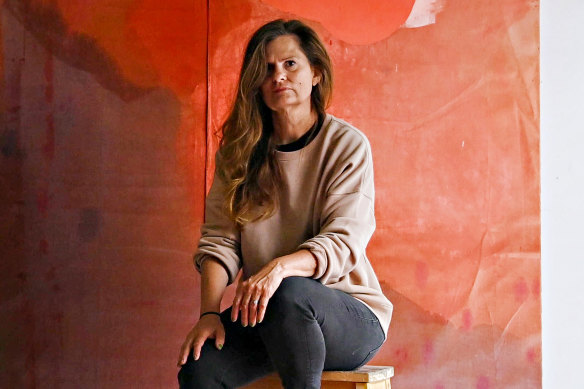
Lara Merrett has had seven of her works acquired by Artbank.Credit: Kate Geragthy
Artist Lara Merrett has benefited from Artbank acquiring seven of her works during the 2000s, in the ensuing years the large-scale abstracts have often been loaned for display in the foyers of bustling city buildings.
“As an emerging artist at that time those loans were a critical opportunity to have my work seen beyond my circle of family and friends,” Merrett says.
Artbank’s patchy recent history has led some art dealers to stop courting it. One says on condition of anonymity that the acquisitions have been unfocussed since the departure of director Geoffrey Cassidy in 2012.
Evan Hughes, art dealer and former NSW Government arts adviser, says, “Artbank has become a perverse quango that has long outworn its purpose or point other than keeping embassies from looking like suburban solicitors’ offices. If DFAT had been allocated $1 million for an art fund 45 years ago they’d have a tremendous collection and a healthy corpus with a better acquisitions budget than most state art galleries have now.”
Rodriguez says in fact legal firms now account for a greater share of Artbank business than DFAT, which nonetheless remains an important client.
The celebratory exhibitions in Melbourne and Sydney are a chance for consumers to get acquainted with the collections and explore how renting art might work for them.
The Melbourne showcase consists of some lesser-known works by A-list artists, among some A-grade works by lesser-known artists. Consider a sweet Jeffrey Smart landscape, a nice Margaret Olley still life, and unusual paintings by Howard Arkley and Sidney Nolan alongside an exquisite tapestry by the late Adelaide artist Pru La Motte and a lovely Robert Campbell landscape.
In Sydney, Artbank has pulled together an exhibition of text-based paintings, prints and drawings that explores how artists play with words.
Artbank’s website is the best way to explore the collection and experiment with ideas for decorating your spaces affordably, albeit impermanently.
The Sydney Artbank exhibition runs until January 30 and the concurrent Melbourne exhibition until January 16. Details: artbank.gov.au/exhibitions
Make the most of your health, relationships, fitness and nutrition with ourLive Well newsletter****.Get it in your inbox every Monday****.