As some boycott Myanmar’s flawed election, others hope for change
Voting is almost sure to favour the ruling military junta, which is stage-managing the polls but some see them as the most pragmatic way to try to improve conditions.
By Sui-Lee Wee
December 28, 2025 — 5.36pm
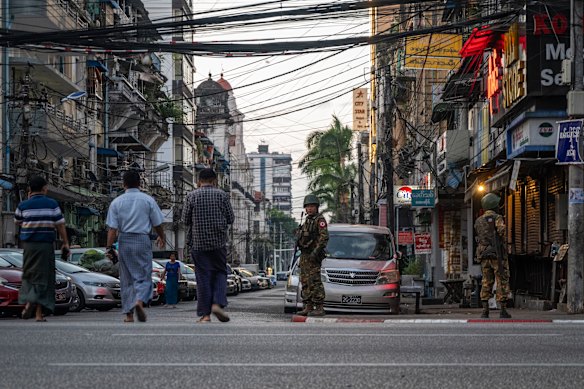
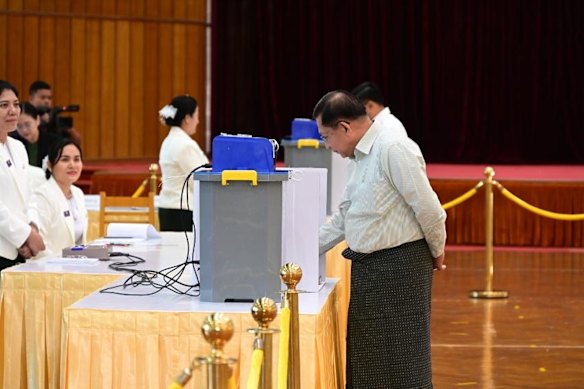
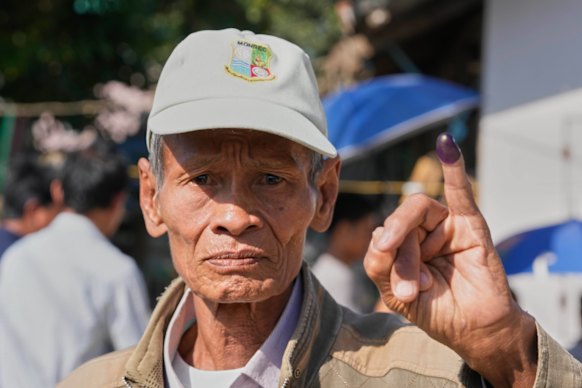
Yangon: As voters started going to the polls on Sunday for the first round of a heavily stage-managed election in Myanmar, the outcome was all but assured. The military junta that has ruled the country since seizing power in 2021 was almost certain to maintain its iron grip on power.
But some still hoped there was room for change.
“We have to do something,” said Nant Khin Aye Oo, chair of the Kayin People’s Party, one of the few parties that was not barred from fielding candidates. “We can’t live under this any more.”
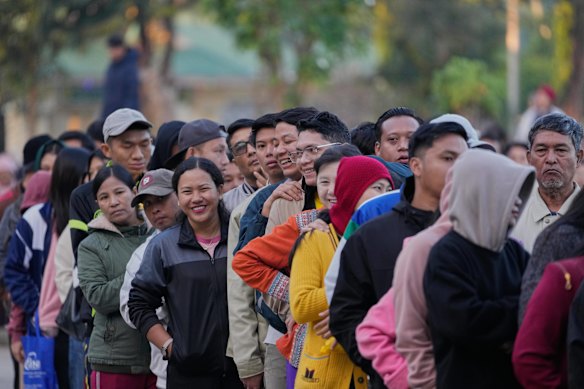
Voters line up to cast their ballots at a polling station in Naypyidaw, Myanmar.Credit: AP
The military has governed Myanmar for most of the country’s history since it gained independence from Britain in 1948. For about a decade starting in 2010, the country was seen as an exemplar for democracy after the military handed some power to a civilian government led by Aung San Suu Kyi, who had long been the country’s beloved opposition leader.
That ended in 2021 when the army announced that it would not recognise the 2020 election victory by Suu Kyi’s party. There is a widespread feeling in Myanmar that the generals have severely mismanaged the country since then.
Loading
For the junta, the elections are in part to placate neighbouring China, which has pressured it to hold the polls as a way out of a four-year civil war. The military also hopes that the elections, which will determine the next parliament, will give it an air of legitimacy that may give other countries an opening to embrace what is now largely a pariah state.
With voting unfolding over three days, it will be difficult to draw quick conclusions. Results are not expected until late January.
Despite its firm hold on power, the junta has left nothing to chance. It disbanded 40 political parties, including the country’s main opposition party, the National League for Democracy. The military’s proxy party, the Union Solidarity and Development Party, is in effect running uncontested in many areas. More than 100 people have been arrested since July for violating a new law that makes it a crime to criticise the election.
Still, some members of the country’s dwindling opposition said they were determined to make their voices heard. Ko Ko Gyi, a veteran pro-democracy activist, who is running for a seat in Yangon under the People’s Party, acknowledged that there were issues with the elections, but he said they were the most pragmatic way forward. “What’s the better alternative?” he asked.