As U.S. debt soars past $38 trillion, the flood of corporate bonds is a growing threat to the Treasury supply
"The significant increase in hyperscaler issuance raises questions about who will be the marginal buyer of IG paper."
As the Treasury Department looks to ensure investors continue absorbing the fresh supply of debt it must sell, growing competition from companies issuing their own bonds could send rates higher, according to Apollo Chief Economist Torsten Slok.
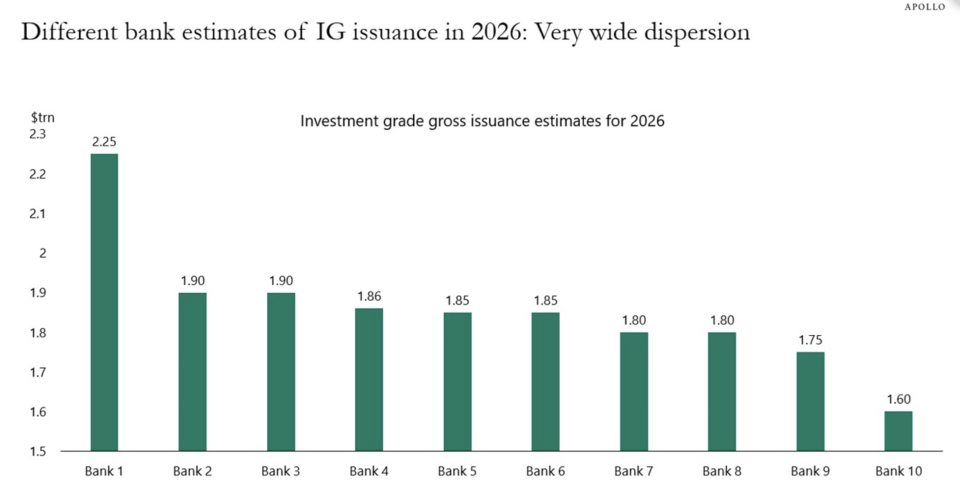
In a note on Saturday, he pointed out that Wall Street estimates for the volume of investment grade debt that’s on the way this year reach as high as $2.25 trillion.
That’s as the AI boom increasingly sends companies, including hyperscalers and adjacent firms, to the bond market to fund massive investments in data centers and other infrastructure.
“The significant increase in hyperscaler issuance raises questions about who will be the marginal buyer of IG paper,” Slok said. “Will it come from Treasury purchases and hence put upward pressure on the level of rates? Or might it come from mortgage purchases, putting upward pressure on mortgage spreads?”
With U.S. debt topping $38 trillion, the federal government has already borrowed $601 billion in the first three months of the 2026 fiscal year, which began in October 2025, according to the latest data from the Congressional Budget Office.
That’s $110 billion less than the deficit during the same period a year earlier as tariffs helped revenue outpace spending. But the Supreme Court could strike down President Donald Trump’s global tariffs soon, and this year’s tax season should see a surge of refunds to account for new tax cuts under the One Big Beautiful Bill Act.
Meanwhile, Trump has vowed to boost defense spending to $1.5 trillion a year from $1 trillion, threatening to further deepen federal budget deficits.
And despite the Federal Reserve’s series of rate cuts this past autumn, Treasury yields remain about where they were in early September, suggesting the government will not see much relief on debt-servicing costs that are also contributing to the overall tally of red ink.
“The bottom line is that the volume of fixed-income products coming to market this year is significant and is likely to put upward pressure on rates and credit spreads as we go through 2026,” Slok said.