ASI preps for deeper digs to trace Krishna's ancient Dwarka
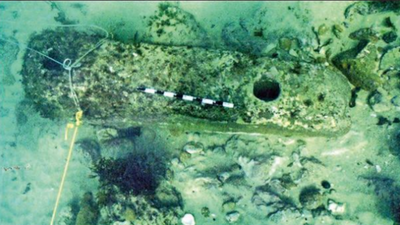
Remains of ancient settlement off the Dwarka coast in the Arabian Sea
AHMEDABAD: Dwarka, the ancient Gujarat coastal town closely associated with the legend of Lord Krishna and home to the revered Dwarkadhish Temple, is set to witness renewed rounds of archaeological excavations, both on land and underwater, senior officials of Archaeological Survey of India (ASI) have said.
The proposed work aims to explore previously unexamined areas using modern technology to gain a deeper understanding of the region's historical and cultural past, reports Parth Shastri. Underwater archaeological excavations at Dwarka were last carried out between 2005 and 2007, while limited exploratory studies were conducted again in 2025.Upcoming Dwarka exploration phase to be more extensive: ASIAccording to ASI officials, the upcoming phase will be more extensive and systematic.
Alok Tripathi, additional director-general of ASI, told TOI that new areas at Beyt Dwarka and unexplored underwater zones will be covered by the agency's Underwater Archaeology Wing (UAW). "Dwarka has been under study for nearly 40 years, but the work so far has been limited in scope and objectives. We are now examining the other side of the mouth of the Gomti river," Tripathi said. Experts said modern tools and technology would be deployed to enable larger and deeper excavations in the Arabian Sea.
Tripathi himself was part of the five-member UAW team that conducted underwater exploratory work at Dwarka in Feb last year. During that time, Prime Minister Narendra Modi had also dived underwater off Dwarka coast to view submerged remains discovered on the seabed, drawing national attention to the site. On land, the focus will be on relatively undisturbed areas of Beyt Dwarka. Earlier excavations were largely concentrated near the cliff area.
"We are now going deeper inside the forest area, where we have observed signs of a significant settlement. The site has some remarkable features, and excavations at lower levels could reveal important details about settlement planning, economic activities, arts and crafts, and the way of life of the inhabitants," Tripathi said. The site has attracted attention alike due to the legend of the sunken city of Dwarka, believed to be founded by Lord Krishna.
The ASI website indicates that explorations were carried out to understand the submerged archaeological remains off the coast of Dwarka as sculptures and stone anchors were found during low tide in coastal areas. The excavations so far have yielded many antiquities, including terracotta objects, beads, fragmented bangles, copper rings, iron ingots and pottery among others, according to the ASI website. Apart from Dwarka, the ASI has also initiated excavations at other key sites in Gujarat.
Work has begun at Valabhipur, the ancient capital located in Bhavnagar district, and at Lothal, the Harappan-era site renowned for its water structure believed to be among the world's oldest dockyards. With the upcoming National Maritime Heritage Complex near Lothal, archaeologists are exposing a larger area of the site using advanced tools and techniques.
Tripathi emphasised that archaeology goes beyond excavation.
"Our task is to place findings in perspective and fill gaps in historical understanding," he said, adding that India's use of technology in archaeology is on par with global standards and increasingly relies on interdisciplinary approaches. Gujarat has seen significant archaeological activity over the past decade, including extensive ASI-led excavations at Vadnagar in Mehsana district, PM Modi's hometown, uncovering evidence of continuous habitation over two millennia. The state is also home to major Harappan sites such as Dholavira, now a Unesco World Heritage Site, and Lothal, highlighting Gujarat's rich and layered archaeological heritage.