Astronomers discover the earliest, hottest galaxy cluster in the universe, and it breaks all the rules
The galaxy cluster appears hotter and more mature than it should for its young age, challenging what we think we know about how these cities of galaxies form.
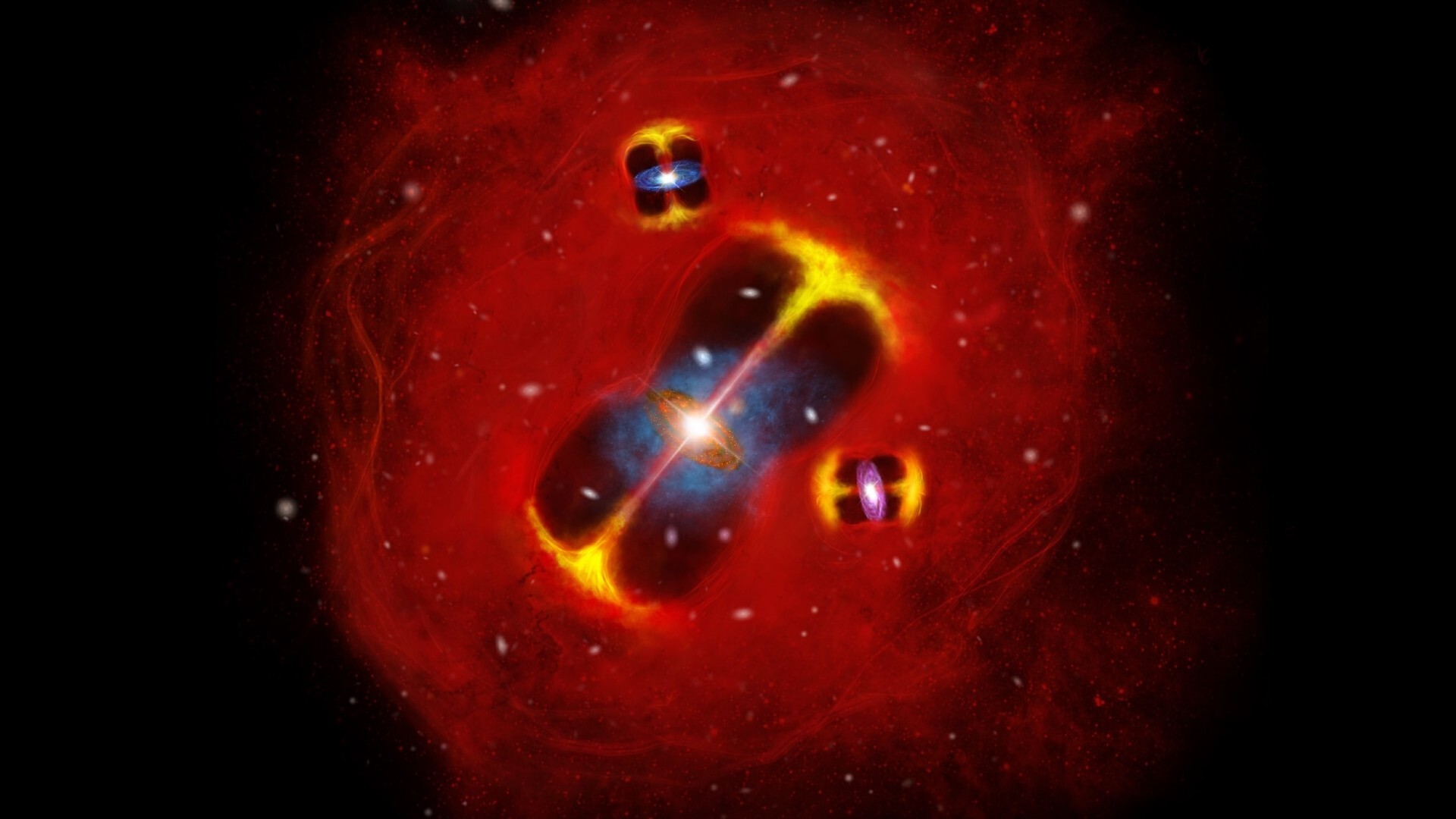
An artist's impression of the galaxy cluster in the very early universe. Containing about 30 galaxies including three with supermassive black holes (depicted here with jets), the cluster is filled with an extraordinarily hot gas (illustrated here in red). (Image credit: Lingxiao Yuan.)
A seemingly impossible cluster of more than 30 galaxies crammed into a volume just 500,000 light-years across has been found in the universe just 1.4 billion years after the Big Bang — and with a temperature that breaks all the rules.
The discovery, by astronomers using Chile's Atacama Large Millimeter/submillimeter Array (ALMA), of the galaxy cluster labeled SPT2349-56 challenges our understanding of how quickly galaxies and galaxy clusters were able to form.
Galaxy clusters are filled with a fog of hot gas that we call the intracluster medium — what Dazhi Zhou, who is a PhD candidate at University of British Columbia in Canada and lead author of the paper describing the findings, refers to as a galaxy cluster's 'atmosphere'. In most clusters, the intracluster medium can reach tens or even hundreds of millions of degrees Celsius.
Astrophysicists thought that it would take many billions of years for the intra-cluster medium to grow so hot, but SPT2349-56 suggests otherwise.
"We didn't expect to see such a hot cluster atmosphere so early in cosmic history," said Zhou. "This gas is at least five times hotter than predicted, and even hotter and more energetic than what we find in many present-day clusters."
The intracluster medium temperature of SPT2349-56 was measured indirectly via what's called the Sunyaev–Zeldovich effect, whereby galaxy clusters leave their mark on the cosmic microwave background (CMB) radiation, which is the leftover heat from the Big Bang. As CMB photons enter the cluster, they gain an energy boost by scattering off electrons within the intra-cluster medium. The hotter the medium, the more the electrons are moving and therefore the greater the energy boost they pass onto the CMB photons when the photons interact with the electrons. This energy boost can then be seen in the CMB corresponding to the location of a given cluster.
Breaking space news, the latest updates on rocket launches, skywatching events and more!
More distant clusters that existed earlier in the universe than SPT2349-56 have previously been discovered. For example, in 2019 astronomers using the Gemini, and Subaru telescopes identified a cluster called z660D (the number in its name refers to its ) that we see as it existed 13 billion years ago, 770 million years after the Big Bang. In 2023 the (JWST) found an even earlier cluster, A2744z7p9OD, at a time just 650 million years after the Big Bang.