Australian sharemarket set to open lower
The ASX will probably greet the new year with a slow start.
By Staff writers
January 2, 2026 — 8.54am
The Australian sharemarket has opened the new year by trading lower as mining companies and info tech sectors weigh on investors.
A slow start was expected. Futures were pointing to a marginal drop, and lower trading volumes are anticipated because of the holiday season. Five of the ASX’s 11 industrial sectors were in the green about 11am AEST, with the index down 6.4 points or 0.07 per cent.
The Australian dollar is up slightly at US66.77¢ mid-morning.
The S&P/ASX 200 closed down 2.8 points at 8714.30 on Wednesday as the market finished trade early for New Year’s Eve. It remained closed on New Year’s Day.
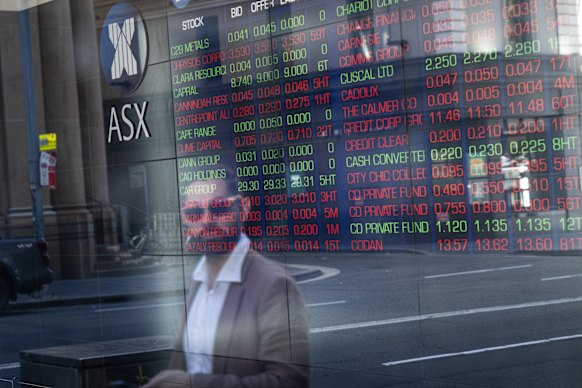
The Australian sharemarket is expected to open lower in its first day of trade for 2026.Credit: Louie Douvis
Energy and financial companies pushed upwards but not enough to offset the downward momentum from materials and information technology.
Mining giant BHP, about 10am AEST, had lost ground (0.2 per cent), while rival Rio Tinto gained 0.48 per cent. Gold miner Northern Star slumped 8.16 per cent and Evolution Mining shed 0.51 per cent.
Northern Star’s slump echoes gold and silver prices’ fall on the last trading day of 2025, though both precious metals remain on track for their best year since 1979, supported by strong demand for haven assets amid mounting geopolitical risks and by interest-rate cuts by the US Federal Reserve. The so-called debasement trade – triggered by fears of inflation and swelling debt burdens in developed economies – has helped supercharge the scorching rally.
In gold, the bigger market by far, those factors spurred a rush by investors into bullion-backed exchange-traded funds, while central banks extended a years-long buying spree. Spot gold hovered about $US4320 ($6473) an ounce, while silver slid toward $US71.
Fuel supplier Ampol gained on the back of a slight lift in crude prices. It was up 0.6 per cent. Crude rose to $US57.51 a barrel Thursday. Over the past month, crude’s price has fallen 1.92 per cent and is down 21.35 per cent compared with the same time last year, according to Trading Economics.
The big banks recorded only slight movements, with the sector up just 0.05 per cent mid-morning. Life360 led the info tech sector lower, falling about 4.09 per cent. WiseTech Global was down marginally and NEXTDC came off 0.88 per cent.
The Australian sharemarket’s marginal gains over 2025 were far below the sharemarkets of most other developed countries. Global stocks are poised for their biggest annual gain in six years, supported by US Federal Reserve interest rate cuts and a surge in enthusiasm for artificial intelligence companies.
Wall Street’s major indexes ended lower in the final trading session of 2025 but notched big annual gains after a rollercoaster year dominated by President Donald Trump’s tariff uncertainties and a euphoria around AI-focused stocks. The S&P 500, Dow and Nasdaq posted double-digit gains this year, their third consecutive year in the green, a run last seen during 2019-2021.
“I do not expect that the last few days will have so much bearing on the performance of the next year, it’s perfectly fine in any bull market to have moments of cost,” said Giuseppe Sette, co-founder and president of Reflexivity, pointing to profit-taking opportunities when liquidity was low.
Wall Street made a stellar comeback from April’s lows when Trump’s ‘Liberation Day’ tariffs sparked a meltdown in global markets, sent investors away from US stocks and threatened growth by clouding the interest rate outlook.
For the year, the S&P 500 gained 16.39 per cent, the Nasdaq rose 20.36 per cent and the Dow climbed 12.97 per cent. The Russell 2000 small-cap index rose 11.26 per cent.
Still the benchmark S&P 500 index’s annual gain trails some global indexes, especially the Asia-Pacific ex-Japan measure, which rallied nearly 27 per cent in 2025, as stock investors diversified.
“We expect this broadening of performance to deepen in 2026, both within the US and across international markets,” said Jitania Kandhari, deputy chief information officer of the solutions and multi-asset group at Morgan Stanley Investment Management.
“The era of narrow winners is giving way to a wider, more globally distributed opportunity set. Equal-weighted S&P looks good relative to cap-weighted S&P.”
With Bloomberg, Reuters