‘Biggest moment in Iran since 1979’: World on edge as protests grow
SOURCE:Sydney Morning Herald|BY:Paul Wallace, Golnar Motevalli, Fiona MacDonald, Ben Bartenstein, Peter Martin
The overthrow of Iran’s Islamic regime would be a seismic event that would transform geopolitics and markets. Analysts say the government has a narrowing window to reassert control.
By Paul Wallace, Golnar Motevalli, Fiona MacDonald, Ben Bartenstein and Peter Martin
January 12, 2026 — 3.30pm
As protesters pour into the streets of Iran night after night, leaders across the region and around the world are grappling with the possibility that the Islamic Republic could be overthrown – a seminal event that would transform global geopolitics and energy markets.
The regime of Supreme Leader Ayatollah Ali Khamenei has weathered bouts of protests many times, but demonstrations that began two weeks ago are spreading. By some accounts, hundreds of thousands defied authorities’ threats and a brutal crackdown to take to the streets over the weekend, from the capital Tehran to dozens of other cities across the nation of 90 million.
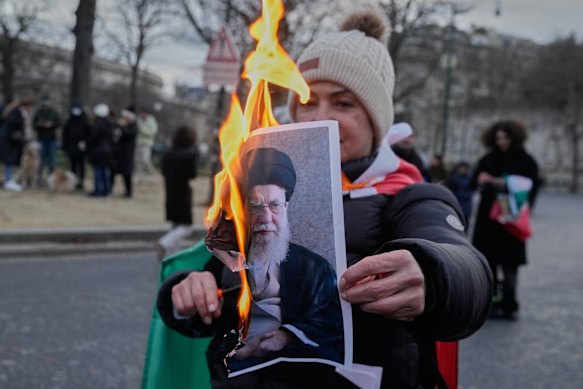
A protester burns an image of Iran’s Supreme Leader Ayatollah Ali Khamenei at a rally in Paris.Credit: AP
They are being cheered on by US President Donald Trump, fresh from the capture of Venezuela’s former president Nicolás Maduro. The US leader has in recent days repeatedly threatened to strike Iran, suggesting that America is back in the regime change business.
World leaders and investors are watching closely. US commanders have briefed Trump on options for military strikes, a White House official said. Brent crude surged more than 5 per cent on Thursday and Friday to over $US63 a barrel as investors priced in the possibility of supply disruptions in OPEC’s fourth-biggest producer.
“This is the biggest moment in Iran since 1979,” former CIA senior Middle East analyst William Usher said, referring to the revolution that gave birth to the Islamic Republic, upended the balance of power in the region and led to decades of rancour between Tehran and the US and its allies.
“The regime is in a very tough spot right now, and the primary driver is the economy. I think they have a narrowing window to reassert control and a diminished tool set to do it.”
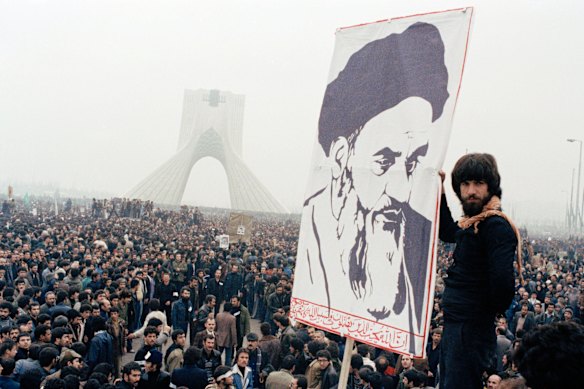
Anti-Shah protesters rally in Tehran in 1978, ahead of the return of Ayatollah Khomeini from exile and the ushering in of the Islamic Republic.Credit: AP
More than 500 protesters have been killed in the past two weeks, according to the US-based Human Rights Activists News Agency, and more than 10,000 have been arrested in demonstrations triggered by the currency crisis and economic collapse, but now also focused on the regime.
Trump’s repeated warnings to Iran that the US will strike if it kills peaceful protesters come as he escalates his assault on the post-World War II global order in a stunning assertion of US power that’s included claiming Venezuela’s oil after seizing Maduro, and threatening to take over Greenland from NATO ally Denmark.
The stakes for oil traders are significant. But it’s unclear if Khuzestan, the main oil-producing province, has seen unrest and, so far, there are no signs of reduced crude exports. On Saturday, Reza Pahlavi, the son of the former shah who is exiled in the US and positioning himself as an opposition leader, urged petroleum workers to strike. Oil strikes in 1978 were one of the death knells of his father’s monarchy because of how they immediately hit the economy.
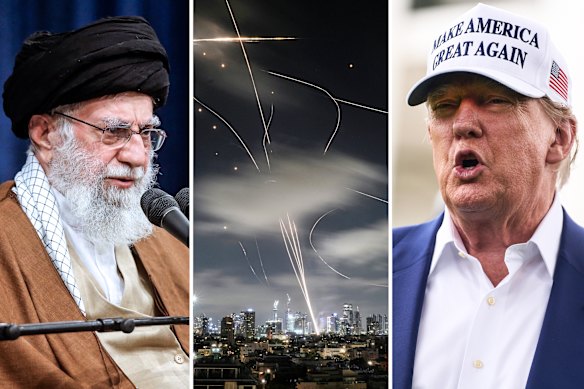
Iranian Supreme Leader Ayatollah Ali Khamenei (left) and US President Donald Trump (right), who ordered US strikes on Iran during Israel’s 12-day war last June.
The market’s “focus has now shifted to Iran”, said Arne Lohmann Rasmussen, chief analyst at A/S Global Risk Management, which helps clients manage volatility in energy markets.
“There is also growing concern in the market that the US, with Trump at the helm, could exploit the chaos to attempt to overthrow the regime, as we have seen in Venezuela.”
The White House is on a high after the tactical success of the operation against Maduro, as well as Trump’s decision to bomb Iranian nuclear facilities at the end of the 12-day war. US officials are also increasing pressure on Denmark to cede control of Greenland, signalling the administration has the appetite for more forays abroad.
‘The best outcome would be a complete change in the government. The worst outcome would be continued internal conflict’.
Mark Mobius, emerging markets investor
Trump may well be tempted, for all the risks, to try to topple a government that’s been an arch enemy to the US and Israel for over 45 years.
Loading
“The balance of power would change dramatically,” veteran emerging markets investor Mark Mobius said of the possible downfall of the Islamic Republic.
“The best outcome would be a complete change in the government. The worst outcome would be continued internal conflict and a continuing rule by the current regime.”
It’s just that kind of potential power vacuum that’s worrying Arab leaders in the Gulf Co-operation Council (GCC), regional officials say.
While the group – which includes Saudi Arabia, the United Arab Emirates and Qatar – has often viewed Iran as an adversary, its members have sought to improve ties in recent years to ensure Tehran doesn’t lash out against any Israeli or US military action by attacking them. The spectre of the Arab Spring, where dictators fell across the region only for chaos to follow, looms large.
‘A collapse appears unlikely for now. Iranians are frightened of chaos, having seen it wreak havoc in neighbouring Iraq and Syria.’
Dina Esfandiary, Middle East analyst
Iran has warned that, if it’s attacked, US assets in the region – where it has deep commercial ties and tens of thousands of troops stationed – and Israel would be “legitimate targets for us”.
The Islamic Republic has been severely weakened in the past two years, thanks to its stagnating economy, rampant inflation and Israel striking both it and its proxies. But it retains a large and sophisticated arsenal of ballistic missiles able to hit targets across the Middle East, from military bases to oil installations, and the regime still has the backing of the country’s myriad security forces, including the all-important Islamic Revolutionary Guard Corps.
For the GCC and the likes of Turkey and Pakistan, the worst outcome would be chaos in Iran, Ellie Geranmayeh, the deputy program director for the Middle East and North Africa at the European Council on Foreign Relations, said. It’s an eventuality made more possible by the sheer diversity of Iranian protesters, who include everyone from urban, secular elites to religious conservatives and lack a unifying leader.
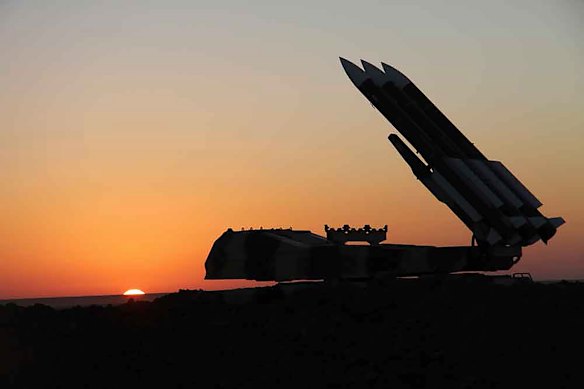
Iran retains a significant arsenal of missiles that it could use against US targets in the Middle East.Credit: AP
“With the GCC reconciliation of the past few years with Tehran, there’s a sense of better the devil you know rather than complete chaos or an unknown power structure that is alien to them,” Geranmayeh said.
US and Israeli strikes might even strengthen the government and reduce the appeal of the protest movement. In June, there was a surge in nationalism as the Jewish state and Washington rained down bombs.
Loading
The Islamic Republic probably won’t survive in its current form by the end of 2026, Bloomberg Economics Middle East analyst Dina Esfandiary said.
The most likely scenario, she said, would be a leadership reshuffle that largely preserved the system, or a coup by the IRGC, which could mean greater social freedom – the organisation is run by generals rather than clerics – but less political liberty and a more militaristic foreign policy.
The chances of a revolution are still fairly low, she said.
“A collapse appears unlikely for now,” she said. “Iranians are frightened of chaos, having seen it wreak havoc in neighbouring Iraq and Syria. More importantly, the government is cracking down hard.”
Collapse ‘would not be pretty’
On Sunday, President Masoud Pezeshkian, a former heart surgeon and a moderate relative to others at the top of the Iranian government, struck a conciliatory note, offering condolences to families affected by the “tragic consequences”.
“Let’s sit down together, hand in hand, and solve the problems,” he said on state TV.
It’s unlikely many protesters will believe him. The supreme leader, a much more powerful figure, as well as members of the security forces, are increasingly bellicose, floating the death penalty and making clear they’re prepared to respond as they always have – with brutal force.
“I don’t think a collapse of the regime would be pretty,” Usher, the former CIA analyst, said. “Short-term, I could imagine some fracturing of the country as ethnic minority groups and some provinces pursue autonomy from Tehran. The IRGC will fight vigorously to save the regime, so I think there’d be a strong possibility for large-scale violence.”