Broadcom announces two dual-band Wi-Fi 8 chips — performance bifurcation introduced with Wi-Fi 7 lives on with the next gen
Wi-Fi 8 will continue the wireless trend of the haves and the have-nots, with dual-band and tri-band products.

(Image credit: Broadcom)
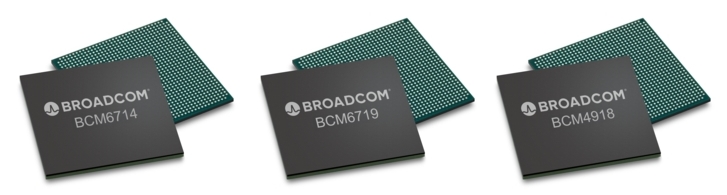
Today at CES, Broadcom is expanding the family with two new dual-band Wi-Fi 8 chips that combine 2.4 GHz and 5 GHz radios into a single chip. The BCM6714 is the lower-end offering, with a 3x4 arrangement. That means it supports three spatial streams on the 2.4 GHz band and four on the 5 GHz band. The BCM6719 ups the ante by delivering four spatial streams across both bands.
And with that news, I can already see the collective eyerolls of the enthusiast community. When Wi-Fi 7 launched, the first devices to hit the market were more expensive tri-band solutions that supported the 2.4 GHz, 5 GHz, and 6 GHz bands. Later, more affordable networking products arrived, supporting only the 2.4 GHz and 5 GHz bands. While this allowed manufacturers to hit a lower price point, it also created confusion in the marketplace – just because a router was labeled Wi-Fi 7 didn't mean it supported the full feature set. That confusion will live on for another generation.
(Image credit: Broadcom)
But that's not all; Broadcom also announced the BCM4918 Wi-Fi 8 APU, which is compatible with the BCM6714, BCM6719, and BCM6718. This system-on-chip is designed for high-performance computing and AI acceleration. Not only does it include an onboard neural engine for on-device AI/ML inference and acceleration, but it also features dedicated network engines to handle wireless and wired traffic, bypassing the CPU. It supports multi-gigabit Ethernet for powering your high-flying wired network. The chip also enabled Edge-AI processing and real-time network optimization.
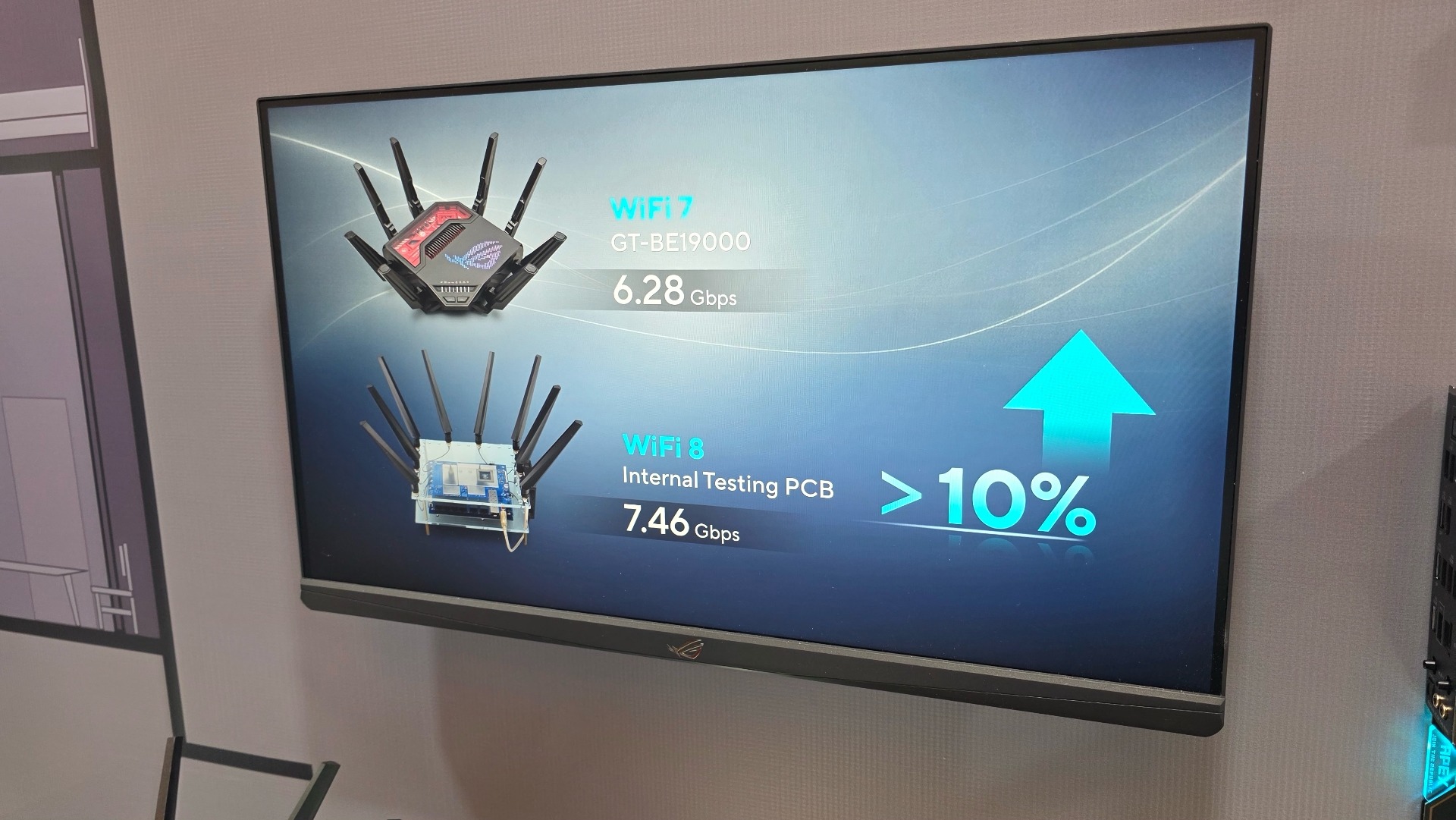
Broadcom says it is already sampling the BCM6714 and BCM6719 to its "early access customers," pointing to general availability in consumer-grade networking products by the end of 2026, a similar timeline to MediaTek's. This seems doable, as we've already seen prototype Wi-Fi 8 hardware this week at CES, and Asus even told us that its first-generation Wi-Fi 8 products will launch later this year, with second-generation hardware coming in 2027.
(Image credit: Future)
Wi-Fi 8 is designed to improve reliability and lower latency rather than deliver a massive uplift in theoretical speeds (as had been the case with previous Wi-Fi iterations). Instead of obscene theoretical speeds that consumers likely won't see in the real world, the IEEE says that Wi-Fi 8 will deliver up to a 25 percent improvement in real-world speeds while reducing latency. Asus specifically highlighted and showcased a 10 percent uplift in throughput over its fastest Wi-Fi 7 router with early prototypes.
