Chief Justice Roberts on the Declaration of Independence
Roberts' year-end report on the federal judiciary includes some notable statements about the Declaration and its relevance to constitutional interpretation and judicial review.
Chief Justice Roberts on the Declaration of Independence
Roberts' year-end report on the federal judiciary includes some notable statements about the Declaration and its relevance to constitutional interpretation and judicial review.
| 1.5.2026 5:47 PM
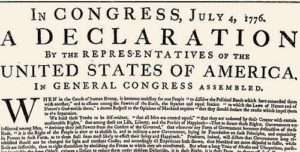
In his year-end report on the state of the federal judiciary, Chief Justice John Roberts makes some notable statements about the Declaration of Independence and its relevance to constitutional interpretation. The relevant section in Roberts' report is occasioned by upcoming 250th anniversary of the Declaration, and much of it reads like standard civics book material. But there are a few noteworthy passages.
First, Roberts notes that the Declaration "sets out a statement of political values
based on Enlightenment principles." This endorsement of the idea that the United States is a "creedal nation" based on universal liberal values may seem obvious. But it's at odds with the insistence of both far-leftists and right-wing ethno-nationalists that the Declaration and the Founding were meant to establish a nation promoting the interests of a specific racial or ethnic group (usually defined as Anglo-Saxon whites). I cannot know for sure. But I suspect that Roberts is aware of this dispute and included this language in the report for that reason.
Roberts rightly notes that the Declaration is "a statement of national aspirations, not a codification of enforceable legal obligations," and that its universalist aspirations were far from fully realized by the original 1787 Constitution. He particularly stresses the continued prevalence of racially based slavery, including its practice by many of the signers of the Declaration itself.
But Roberts also emphasizes that "throughout our history [the Declaration] has played a signal role in the development of the Nation's constitutional, statutory, and common law." He approvingly cites Supreme Court justices who relied on its principles as tools for constitutional interpretation. This is notable in light of the longstanding debate about whether the Declaration is relevant to constitutional interpretation. Roberts appears to agree that, at least in some situations, it is.
It's worth noting that this idea is perfectly consistent with originalism. If parts of the original Constitution and later amendments were intended to enforce the principles of the Declaration and were so understood at the time, this fact is relevant to any originalist interpretation of these provisions. I think it's particularly relevant to claims that the Constitution's structural constraints and protections for individual rights somehow do not apply to immigration restrictions, or apply with much lesser force. The principles of the Declaration of Independence strongly suggest otherwise. These natural rights principles are also relevant to interpretation of a range of other constitutional issues, such as property rights protected by the Takings Clause of the Fifth Amendment.
Finally, Roberts emphasizes that judicial independence was one of the objectives of the Declaration:
In the words of future Justice [James] Wilson during the ratification debates, the key passage of the Declaration's preamble…. "is the broad basis on which our independence was placed," and "on the same certain and solid foundation this system [the Constitution] is erected."
The connection between these two foundational documents could not be clearer when it comes to the judicial branch. The Declaration charged that George III "has made Judges dependent on his Will alone, for the tenure of their offices, and the amount and payment of their salaries." The Constitution corrected this flaw, granting life tenure and salary protection to safeguard the independence of federal judges and ensure their ability to serve as a counter-majoritarian check on the political branches. This arrangement, now in place for 236 years, has served the country well.
In normal times, this statement would be an obvious truism, hardly worthy of note. But it has special significance at a time when Trump and various administration officials have called for judges to be subservient to the executive, and give him sweeping deference on a vast range of important issues, ranging from tariffs to immigration to the domestic use of the military.
Whether Roberts' statements about the Declaration, its principles, and judicial independence portend anything about the Court's jurisprudence on key cases to be decided in the near future, remains to be seen. Roberts cannot control the votes of the other justices, and his own jurisprudence hasn't always lived up to these ideals.
My general take on Roberts is that he's good on some issues (e.g. - freedom of speech and constitutional property rights), but much less so on others (e.g. - some key issues related to immigration and executive power). But what he says in the report about the Declaration of Independence and its principles is both right and encouraging in its potential implications for the future.
Cornell law Prof. Michael Dorf has his own thoughts on the significance of these and other passages in Roberts' year-end report, including an interesting comparison between Roberts' take and Justice Thurgood Marshall's famous 1987 speech on the bicentennial of the Constitution. I agree with some of his points, but differ on others. In particular, I think the above points about the principles of the Declaration are more compatible with originalism than Dorf suggests. But I agree that reliance on those principles is in tension with much of the Court's recent reliance on later traditions. Those traditions often reflect failure to live up to the principles underlying the original meaning.