Confidential advice undercooked climate change to Howard government
Cabinet briefings in 2005 warned of climate change, but did not anticipate the scale and severity of the impacts now playing out.
A previously unreleased briefing on global warming to the Howard government issued a stark climate change warning two decades ago, but even this frank advice failed to anticipate the extreme heat and catastrophic bushfire conditions that swept the eastern seaboard during the week.
Newly released cabinet papers, prepared by the federal public service and experts at the Bureau of Meteorology, were largely ignored by the Howard government, despite telling ministers that the global average temperature rise was “unprecedented in human history”.
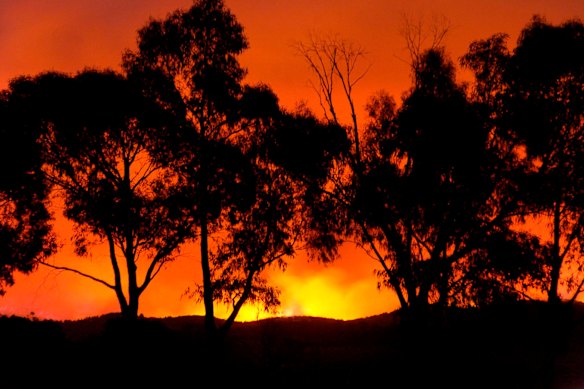
A previously confidential briefing to the Howard government in 2005 warned of climate change, but did not anticipate the scale and severity of the impacts now playing out. Credit: Rob Carew
Australian National University professor of climate science Sarah Perkins-Kirkpatrick commended the briefing for incorporating contemporary scientific advice from the Bureau of Meteorology, but said even this undercooked the alarming rise of Australian heatwaves in the past 20 years.
The briefing said global warming would spur increasing heatwaves, droughts, fires and sea-level rise, which was a result of rising levels of greenhouse gases in the atmosphere that were “in part attributable to human activities”.
Loading
“There is a very close link between increasing global temperature, the increasing regional temperature and the rise in the intensity, frequency, and duration of heat waves,” Perkins-Kirkpatrick said.
“It’s happened at a faster speed than what climate scientists would have thought originally. Each decade has been significantly warmer than the decade prior.”
The bulk of the briefing was prepared by government departments, but included a seven-page primer on climate change science by the Bureau of Meteorology. This said that the global average temperature had risen 0.6 degrees compared to that of the period 1900-1920, but since 2005, warming has accelerated and the global average temperature rise now sits at about 1.2 degrees, a rate of change not anticipated by the briefing.
“We’ve seen changes in heat waves here in Australia and globally that I never thought we would see so quickly,” Perkins-Kirkpatrick said.
The briefing said more intense and frequent bushfires were projected for Australia due to climate change, but noted that “gaps remain in the knowledge” of the timing, location and magnitude of such impacts.