Death and disguises: Meet the artist reviving Ireland's lost laments
County Fermanagh musician Róis draws on the faded Irish tradition of keening to shape her award‑winning album Mo Léan.
Death and disguises: Meet the artist reviving Ireland's lost laments
10 hours ago
Matt FoxBBC News NI

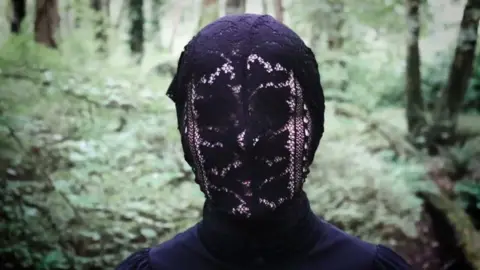 Risteárd Ó hAodha
Mimicking the ancient keening women, who performed mourning rituals, Róis chooses to veil her face for anonymity
There are some communities where death is ingrained in the everyday texture of life.
A fact that you may be reminded of when hearing this on your radio: "Welcome to the death notices, but we are sorry to inform you there will be no death notices this morning."
Acclaimed Irish singer Róis, aka Rose Connolly, is from one such border-hopping, rural community in Northern Ireland and this non-obituary is on her award-winning record Mo Léan.
And while her music, inspired by the Irish mourning tradition, is very dark and intense, that doesn't mean she takes everything so seriously.
"I thought it'd be good craic," she said, of sampling her local radio's death notice reminder.
"Well, that's the actual quote, me and my mum heard it on the radio once. And actually, my brother met the woman who said it," Róis explained.
"She just knew that old people love the death notices, that's why she said it. I imitated it and pitched my voice down to make it sound different.”
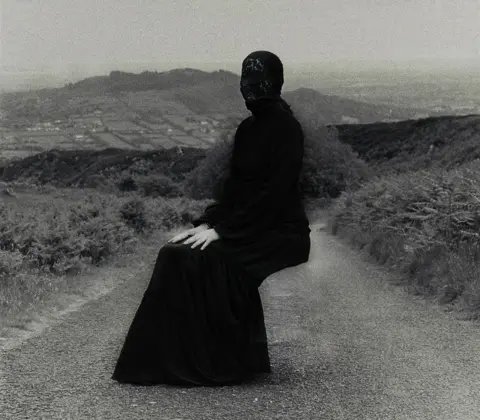 Órlaith Mac Eoin Manus
Raised in a musical household, Róis later studied in Dublin and the Netherlands
This streak of tongue-in-cheek, dark humour offers a rare moment of levity on Mo Léan, cutting through the intensity as Róis delves into death, reinterpreting the forgotten, haunting songs that once split the air above rural wake houses.
Raised in Newtownbutler in County Fermanagh, Róis grew up in a "very musical household", learning Irish traditional music before studying piano, but she was initially reluctant to sing.
"My sister and my father are two very good singers, my brother as well.
“I wanted to be [in] the band... I think I was just quite shy... I knew I could sing but I just kind of wanted to keep that to myself for some reason," she told BBC News NI.
After learning Paul Brady’s rendition of Arthur McBride she realised she could "do all the fancy things".
"I was like, 'oh, I could probably do this', and then I was in the Beauty and the Beast play for school, so that kind of forced me into it."
She later pursued music at university, first at the Royal Irish Academy of Music, an associated college of Trinity College Dublin, before studying at the Royal Conservatoire of The Hague.
Reclaiming the language
Encouraged by her lecturers in the Netherlands, Róis began exploring her Irish heritage more deeply and has since committed to learning and performing in her native language.
A gaeilgeoir [Irish speaker] friend taught her the language in exchange for meals, Kneecap's lyrics also helped her learn, and a growing friendship circle of Irish speakers inspired her further, she explained.
Reflecting on Irish acts, such as the aforementioned rap trio and breakout County Meath star CMAT embracing their mother tongue, Róis said it’s “an amazing thing to see”.
"People are trying to reclaim their heritage and claim the lost language that was taken away from us, basically."
Allow Google YouTube content?
This article contains content provided by
Google YouTube
. We ask for your permission before anything is loaded, as they may be using cookies and other technologies. You may want to read
and
before accepting. To view this content choose ‘accept and continue’.
Merging experimental, electronic production with traditional singing, her last project Mo Léan [my woe] drew inspiration from ancient mourning practices.
Keening, derived from the Irish word "caoineadh", meaning "to cry", is a traditional vocal lament for the dead and was once a central part of funeral rites in Ireland.
Performed in the Irish language, and closely related to sean‑nós singing, the paid-for practice began to decline in the 18th Century, reportedly at the request of the Catholic Church.
Only a handful of authentic keening songs were recorded from traditional singers, which Róis referenced on the record.
"It was the guttural voices of the keeners, there's only three recordings and all three are just so poignant and they're so different," she said.
"The first one by Cití Ní Ghallchóir is so sweet but still so sad and placid... she just seemed really exhausted," she said, noting that the other two felt "disgusting, painful and exaggerated."
"It just sounded to me like a really interesting sound and something that I could incorporate into the cathartic nature of my work."
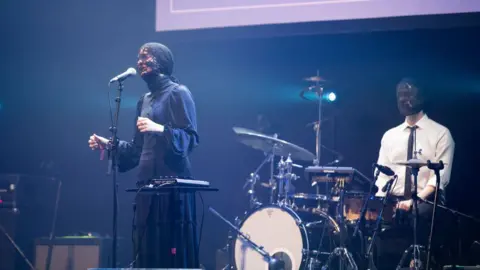 Getty Images
Róis performed at this year's RTÉ Choice Music Prize, where she was nominated for her record Mo Léan
Dr Marian Caulfield from University College Cork has researched the practice and discovered keening had been a "sophisticated, orally-transmitted custom" performed at wakes, burials, evictions, and times of emigration, and was predominantly a women's tradition, who were known as bean chaointe [keening women].
The role was seen as an essential one at each wake, she explained, as it was the keener‘s job to see the soul safely over to “the other side”.
Dr Caulfield said she was "delighted” to see Róis “proudly performing her keens to full houses, with no shame or stigmatisation involved, just audiences loving her bravery and skill".
"Just like the bean chaointe of long ago.”
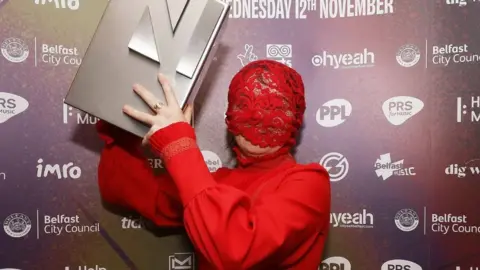 Jim Corr
The record earned Róis two wins at the 2025 Northern Ireland Music Prize in November
The project has been well received by critics, with the Guardian describing the record as an "arresting set" and KLOF magazine stating it is a "masterful album, with incantatory soundscapes that leave you for dead".
It also earned Róis two wins at the 2025 Northern Ireland Music Prize, including for best album, and a nomination for the RTÉ Choice Music Prize.
It's a standout year by any measure, but she insists awards aren't her focus and she doesn't want "to be put on a pedestal", adding she believes in herself for her own reasons.
"Music allowed me to break free of fear so I guess through [the record] I'm kind of subconsciously doing that with death, and for the next project, it's another concept," she said.
"We were all very much in fear all the time and it inhibits growth... I guess I want my music to transcend all of that and realise that it doesn't matter and you just have to get on with it," she added.
"That's really the only thing to it, and just being a bit in love with life, it's very cheesy."