Fantasy football 2025 takeaways: ZeroQB, rookie tight ends on the rise and more
SOURCE:The Athletic|BY:Andy Behrens
From late-round standouts at QB to the lack of injuries atop the RB class, Andy Behrens points out what shaped fantasy football in 2025.
By now, the celebration of your 2025 fantasy championship has been raging for three full days. It’s mostly a blur. Your last distinct memory involves postgame Malört, after which … well, there are some blank spots. Today, you woke up in Vegas with a screaming headache, a fresh tattoo of Cam Little and a deep sense of pride.
You earned it, champ.
Before we conclude the afterparty and close the proverbial book on your 2025 fantasy season, let’s call out a few potential takeaways. We are certainly not committing to any 2026 strategies just yet. Instead, we’re merely offering a partial list of facts that defined the season in which you so spectacularly triumphed.
Late-round QB was the winning approach
In fact, no-round QB would have worked pretty well, too. You could have ignored the position at your draft and later filled it with an elite option from the scrap heap.
At various points during the season, the waiver wire delivered Matthew Stafford, Trevor Lawrence, Brock Purdy (post-injury), Joe Burrow (also post-injury), Jaxson Dart and various other delights. Stafford and Lawrence are currently the overall QB3 and QB4 respectively. Lawrence and Purdy were the top-scoring quarterbacks in the fantasy playoffs — Weeks 15-17.
With all due respect to Josh Allen, none of this year’s second- or third-round quarterbacks can rightly be considered fantasy league-winners. Allen was the best of the bunch, but A) his hiccup in the fantasy semifinals probably ended your season and B) he didn’t separate from the field sufficiently to justify his draft price. If you took Allen at ADP (22.0), it meant passing on truly decisive fantasy assets like James Cook (28.7) and Jaxon Smith-Njigba (33.0). Early-rounders like Lamar Jackson, Patrick Mahomes and Jayden Daniels were simply dead-ends in 2025. Jalen Hurts was adequate but not impactful, outscored by multiple undrafted quarterbacks.
On a purely personal and anecdotal level, I can tell you that avoiding the luxury quarterbacks was particularly effective for me in SuperFlex formats this season. The best and most profitable team I managed to assemble was a ZeroQB roster in which I ignored the position until the closing moments of an auction. When all the vanity quarterbacks were going for $30-plus, I bought an unassailable group of flexes, including JSN, Puka Nacua, Christian McCaffrey, Saquon Barkley and Trey McBride. Eventually, in the closing minutes, I collected Stafford, Dart and Aaron Rodgers for a combined $15.
Back in mid-August, I wrote about that squad in the immediate aftermath of the draft — and not because I was overflowing with confidence. I was fairly sure I’d gotten too greedy with the non-QBs. I was apoplectic and regretful about the Stafford expense. At the time, he seemed much more like a candidate for back surgery than a potential league MVP. I was rattled enough to add Jimmy Garoppolo. Those were dark and perilous times.
Four months later, that team is a league champion. It went 12-2, earned a bye, outscored every other roster by an outrageous margin. In the end, ZeroQB was the best path. Useful quarterbacks were plentiful.
New playcallers unlocked new fantasy stars
Chicago was basically a fantasy wasteland in 2024. This year, Ben Johnson’s offense has delivered the overall QB6 and RB15, along with a collection of playable receivers and flexes. The Bears rank third in total yards per game, third in rushing and 10th in scoring. Suddenly, a franchise that was a longtime punchline is relevant and interesting, both in reality and fantasy.
Liam Coen has accomplished roughly the same thing in Jacksonville, transforming Lawrence into a late-season fantasy monster. It helped in no small way to unleash Lawrence as a runner, because his rushing talent was one of his more impressive traits at the collegiate level. Travis Etienne has been reanimated, too. By the end of the season, three Jaguars receivers and a tight end had found their way into the startable range in the ranks.
Kellen Moore has directed a revival in New Orleans and Klint Kubiak made certain Sam Darnold was something more than a one-hit wonder. The Mike Vrabel-Josh McDaniels collab seems to suit Drake Maye just fine.
We have obviously always known that coaching upgrades can lead directly to fantasy enhancements, but rarely has a season demonstrated the point so emphatically.
Rookie tight ends continued to thrive
As of this writing, Harold Fannin is the overall TE5 for the year and Tyler Warren is the TE7. Over the last five weeks of the fantasy season, Colston Loveland was the TE8. Oronde Gadsden had a convincing month-long run as a must-start player before the Chargers’ passing game fell into disrepair.
We may not have seen a singular undeniable rookie tight end — someone like Sam LaPorta in 2023 or Brock Bowers last season — but several different first-year players at this spot made significant noise. Fannin was an absolute opening-week revelation, as was Warren. This position appears to be in very good hands, post-Travis Kelce.
Many of you will recall that prior to LaPorta’s first-year binge, rookie tight ends were considered toxic in fantasy. Avoiding them was a cherished tradition — ancient fantasy dogma that generally held true. The position had too great a learning curve attached. A traditional tight end’s responsibilities involve multiple position groups and varied skills, so expecting any new arrival to thrive was an insanely low-percentage bet.
But, hey, the game evolves. Dogma eventually cracks. Today, plenty of offensive concepts cross over between college and the NFL. Several schools have become tight end factories — Iowa, Penn State, Oregon and Notre Dame among them. If you cling to old fantasy biases, you are going to continue to miss some of the best bargains at an occasionally messy position.
For the second straight year, elite running backs remained curiously healthy
Most of us considered last season to be a wild outlier in terms of running back health. Pretty much all the upper-tier players at the position remained on the field, McCaffrey being a notable and painful exception. Only three of the top-24 running backs in terms of ADP missed more than three games.
That’s not to say the position didn’t have its share of non-injury disappointments, but it certainly did not suffer from an excess of games lost to strains, tweaks and tears. Twelve months ago, we were all writing about the great RB renaissance of 2024. Very few of us believed it was anything other than a fluke, however — a respite from the usual plague of season-ending, career-altering running back injuries.
Here’s a look at how the top-of-draft backs held up in 2025, listed in order of ADP via FantasyPros:
The 13 players above have combined to miss just eight games to injury this season — seven by Irving, one by Jacobs. It was another shockingly successful campaign for the premium running backs. A single season can be written off as an outlier, but this looks suspiciously like the beginning of a trend.
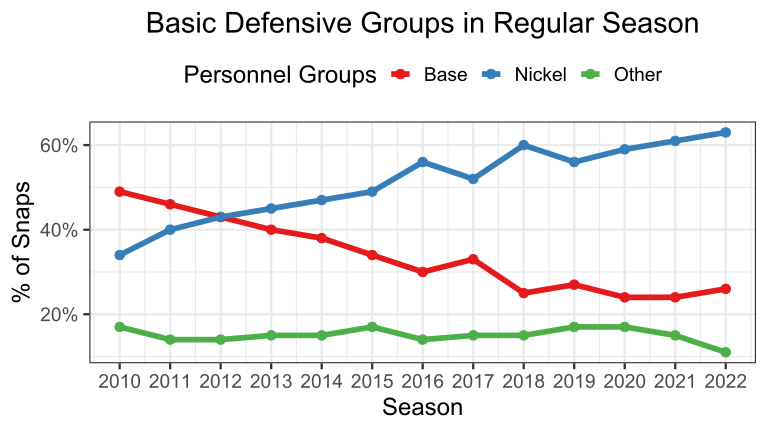
There’s nothing dispositive here, of course. But it’s also not crazy to feel somewhat better about the early-round running backs entering 2026. We are definitely in an era that prioritizes player safety much more than it celebrates collisions. Also, defenses are increasingly living in nickel in recent seasons, removing run-stuffers from the field in favor of smaller and more versatile defensive backs. Not every linebacker in today’s game is a 255-pound mauler, either. Zack Baun is plenty effective at 225.
Again, there’s no hard data here, only speculation. Not even a fully formed narrative. It’s possible the opening rounds of 2026 drafts will be a minefield of running back injuries and busts. We can never get too comfortable in this game, but we also can’t draft scared.