Finding out I've got ADHD has saved my life
The actor says starting ADHD medication has allowed him to put on a one-man show about his life.
12 hours ago
Charlie Jones

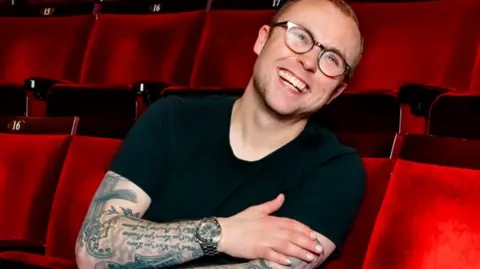 Danny Kaan
Joe Tracini has always struggled with his mental health but feels like he can finally look to the future after starting ADHD medication
Actor Joe Tracini has always felt uncomfortable in his own skin.
Growing up in Great Yarmouth, as the son of comedian Joe Pasquale, he was self-conscious and prone to depressive thoughts.
"I told my first joke on stage at 18 months at one of my dad's gigs," he recalls. "But a lot of my confidence growing up was a front."
The only way he could engage with his peers was through his skill for magic tricks. He was relentlessly bullied at school.
"I was like a little old man. I used to speak like a grown-up. I wore three-piece suits and couldn't converse with other children," the 37-year-old says.
 Getty
Getty
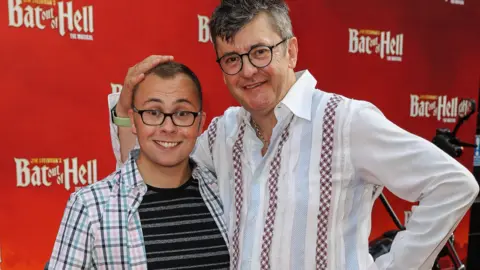
Joe Tracini was born as Joe Pasquale, the same name as his father, but he changed it aged 12
At the age of 11, he changed his surname from Pasquale to Tracini, after narrowly missing out on the role of Harry Potter to Daniel Radcliffe.
"I did six auditions for it. It was a big rejection but I don't think I would have survived making those films. The casting director sent me a letter which I've still got.
"I changed my name because I wanted to do things off my own back, I didn't want to have something to live up to. I love my dad very much and we have a good relationship but I wanted people to like me for me," he says.
Tracini went to musical theatre college and secured various acting and TV presenting roles, including as a series regular on the soap Hollyoaks.
But he turned to drink, drugs and self-harm as a way to quieten the negative voice in his head, that he calls "Mick".
Tracini was diagnosed with borderline personality disorder (BPD) a decade ago, which came as a huge relief.
The diagnosis prompted him to kick his addictions. He has been sober for 10 years, after several trips to rehab.
"I felt less guilty because I knew the drink and drugs were a symptom of my BPD. I thought Mick would go away but the medication made me feel numb and changed my personality so I came off it," he says.
During the pandemic, he gained tens of thousands of social media followers by posting comedy dance routines, dressed in a leotard.
He also went viral for a video about his BPD, describing symptoms including mood swings, impulsiveness, paranoia, fear of abandonment and chronic feelings of emptiness.
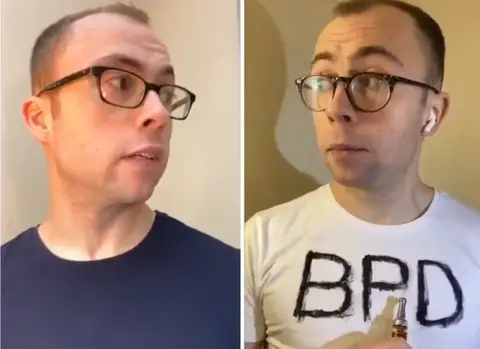
Tracini has filmed several videos representing his BPD as two different people - himself and the negative voice inside his head, whom he calls Mick.
But around the same time, he stopped going to auditions and working because his mental health was so bad.
"I lost so many months where I felt paralysed by fear. I started writing a one-man show called 10 Things I Hate About Me, all about my life.
"But during that period I was so low and I was having so many panic attacks, I thought I'd never be able to perform it," he says.
The turning point came last summer, when he decided to explore the possibility that he might have ADHD.
Tracini looked through his list of followers on social media and found an ADHD psychiatrist who was able to diagnose him and prescribe medication.
"The drugs don't help with my BPD but I feel like I get to start again. It has cleared my brain and I can function again. I can work again and I can write.
"This time last year I thought 'this might be it. This might be who I am for the rest of my life'.
"I had no idea how life changing the diagnosis would be - people don't take ADHD seriously enough - finding out has saved my life."
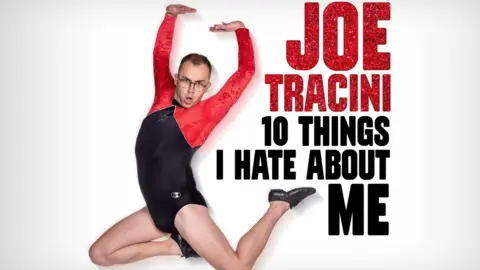
Joe has performed his one-man show in Edinburgh and is taking it on tour after rave reviews
In the summer, Tracini performed his one-man show to rave reviews at the Edinburgh Fringe. He is now taking it on his first ever tour, starting at the Norwich Theatre Playhouse, just up the road to where he grew up.
Tracini spent so many years obsessing over the show that he felt he owed it to himself to perform it.
"Even if it had gone badly, I was doing myself a kindness to put it to rest and gain some closure," he says.
"It covers so many years of my life and so much stuff that I held on to that destroyed me. It's my past but it doesn't have to be a part of me any more."
Mick will always be there, he believes, but he has learned to live with the voice inside his head.
"It has been like getting used to a flatmate. I hope he buggers off one day but we're doing OK.
"I was always living in the past and worrying about things I've done but now I'm looking to the future. I'm looking at weeks and months ahead, which is something Mick can't argue with."
If you have been affected by any of the issues raised in this story, information and support can be found at the BBC's Action Line.