Finnish cops grill crew of ship suspected of undersea cable sabotage
Finnish police have arrested and are interviewing two crew members from a class A cargo ship sailing from Russia after suspected cable sabotage in the Baltic Sea.

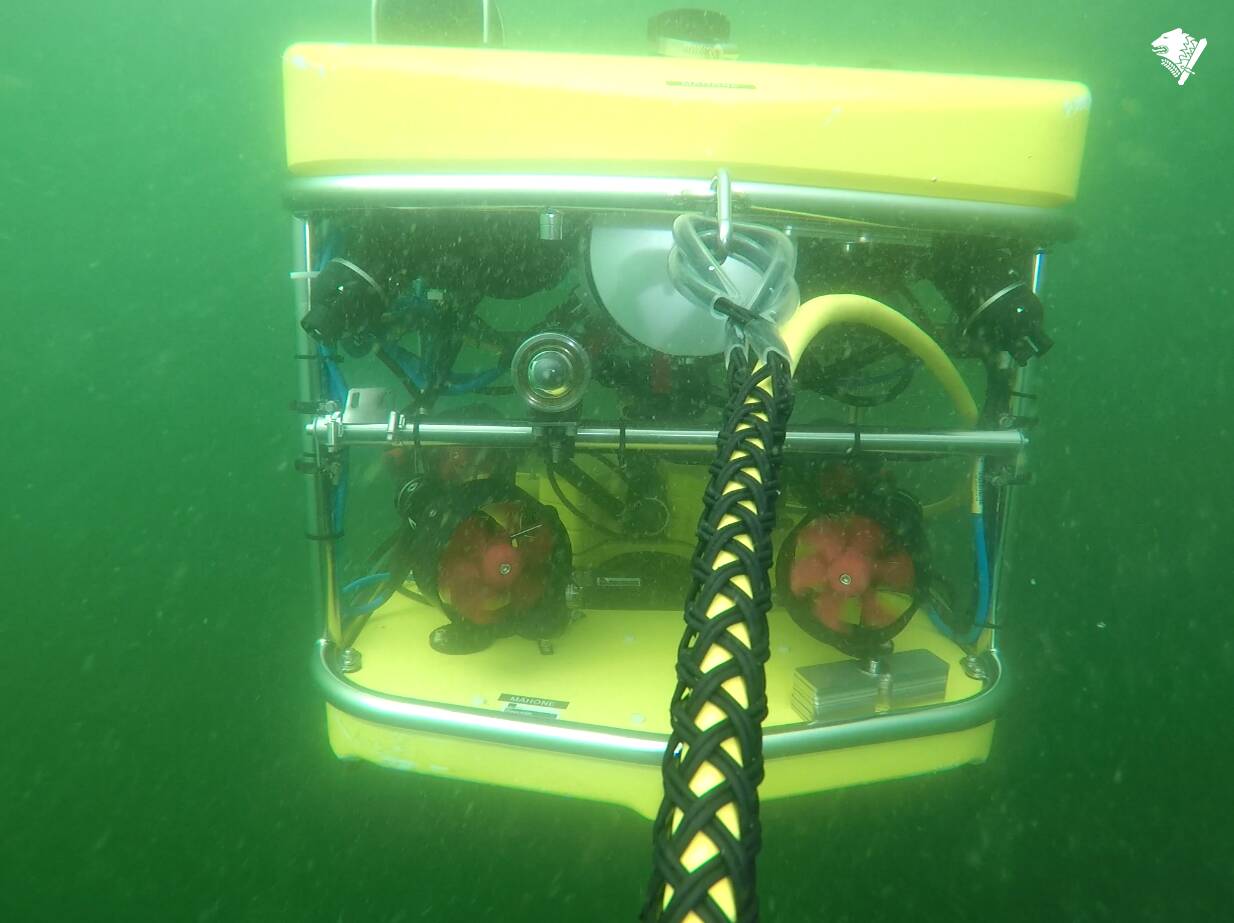
Above: Finnish authorities board seized vessel Fitburg in Kirkkonummi, Finland and Below: one of the Finnish Border Guard's remotely operated vehicles at work along the ocean floor. Pictures: Finnish Border Guard
The cable damage happened in Estonia's EEZ, and Finland said today it had set up a joint criminal investigation with Estonia. At the time of the damage, the Estonian Ministry of Justice says, "a vessel was moving from the Estonian EEZ into the Finnish EEZ and was subsequently detained by the Finnish Border Guard." Crucially, it noted that the ship, cargo vessel Fitburg, had its anchor chain in the water at the time of detention. The vessel was sailing from St. Petersburg in Russia to the port of Haifa, Israel, when Finnish authorities detained it. According to its IMO number, Fitburg is a general cargo ship and sails under the flag of St. Vincent and the Grenadines.
The police released the above pictures, taken by the Finnish Border Guard, as they boarded the vessel Fitburg. Finnish Customs said in a statement that the cargo ship was carrying steel that is subject to sanctions imposed by the EU.
The ship was one of three in the area when operators reported the data cable damage to authorities.
Finnish cops confirmed this morning that they are "investigating the incident as aggravated criminal damage, attempted aggravated criminal damage, and aggravated interference with telecommunications. Criminal offences may change as the investigation progresses."
The Finnish Border Guard appears to be using remotely operated vehicles to look along the seabed for evidence. Finnish cops noted, "The investigation makes use of the Gulf of Finland Coast Guard's diverse underwater equipment, including submersible robots, side-scan sonar, and multi-beam echo sounders. The Defence Forces are also providing assistance in the investigation of the cable damage."
Submarine cable security is all at sea, and UK govt 'too timid' to act, says report
"The interviews have clarified the course of events and the different roles of the crew members," Detective Chief Superintendent Risto Lohi of Finland's National Bureau of Investigation said in a statement.
Finnish cops added that in addition to the two arrests, two other crew members had been banned from traveling.
Vice President of the European Commission Kaja Kallas said of the incident on New Year's Eve: "The Baltic Sea has seen a clear pattern of disruption since the start of Russia's war. Europe's critical infrastructure remains at high risk of sabotage," and thanked Finland for taking "swift and determined action in seizing the ship and crew suspected of damaging subsea cables," adding: "As the investigation continues, Europe remains vigilant and in close contact with Finland and Estonia." Kallas said the EU would continue to fortify its critical infrastructure, invest in new cables, strengthen surveillance, ensure more repair capacity, and move "against Moscow's shadow fleet, which also acts as a launchpad for hybrid attacks."
Shadow
Telco operator Elisa said it detected a "disturbance" in a data cable, which connects Finland and Estonia, at around 5 am local time on Wednesday, December 31, 2025, but reassured the press that it had redundant routes, meaning customers wouldn't experience any disruption.
It said: "The cable damage has not affected the functionality of Elisa's services in any way. Elisa's network is designed and secured with multiple different routes, so services continue to operate normally even if one connection is cut."
Swedish telco Arelion also reported outages on telecom cables, but it is unclear if these were also connected to the suspected sabotage. Estonian authorities confirmed that five undersea cables were damaged close to the time, noting that some of the earlier cuts and faults may have been due to "stormy weather conditions."
Estonia's Ministry of Justice and Digital Affairs said it had received information from the telcos over the past few days confirming faults in four undersea cables connecting Estonia and one cable connecting Hiiumaa to the mainland.
It said: "Specifically, faults have been detected in the CITIC-owned cable between Estonia and Sweden (since December 28), the Telia-owned cable between Läänemaa and Hiiumaa, and the Arelion-owned cable between Hiiumaa and Sweden at two locations (since December 30), as well as in one Arelion-owned cable and one Elisa-owned cable between Estonia and Finland [on Wednesday, December 31]."
The incident is the latest in a string of cables being damaged or cut in or around the Baltic Sea.
- FCC dives in to sink Chinese grip on undersea internet cables
- UK eyes new laws as cable sabotage blurs line between war and peace
- Sweden seizes cargo ship after another undersea cable hit in suspected sabotage
- Chinese ship casts shadow over Baltic subsea cable snipfest
In November 2024, Chinese-flagged cargo vessel Yi Peng 3 dragged its anchor for a full 300 kilometers and cut two cables between Sweden and Lithuania. That same month, the British Navy shadowed Yantar, a Russian research ship spending more time around UK cable infrastructure in the Irish Sea than the government was comfortable with. The Royal Navy sent a Royal Air Force maritime patrol aircraft, along with three vessels – HMS Cattistock, HMS Tyne, and Royal Fleet Auxiliary Proteus – to hulk around in the background tracking Yantar's every movement.
In December 2024, Eagle S, sailing under the Cook Islands flag, damaged one power cable and three data cables linking Finland and Estonia. Then, in January 2025, Swedish authorities seized a vessel – believed to be the cargo ship Vezhen – "suspected of carrying out sabotage" after a cable running between Sweden and Latvia in the Baltic Sea was damaged.
In May 2025, unaffiliated vessel Jaguar approached an undersea cable just off the coast of Estonia and was promptly escorted away from its waters by the country's navy.
Several NATO states have coastlines along the Baltic Sea: Denmark, Estonia, Finland, Germany, Latvia, Lithuania, Poland, and Sweden. This largely NATO-controlled "Baltic Lake" helps regional security and maritime operations, say some security analysts. Russia is the only non-NATO country with a significant chunk of the Baltic coastline.
NATO and its allies have been on their guard since Russia invaded Ukraine in 2022, especially in the waters, as undersea cabling is a critical piece of kit and makes for a vulnerable target. It stretches for over a million kilometers across the ocean floor worldwide, and a big portion of it lies within the territorial waters of NATO member states. It is staggeringly difficult to protect all of it, and hard to confirm whether damage by vessels is deliberate or not.
As tensions with Russia increase, many NATO members are trying to recruit new blood to refresh their national armies and navies, with Germany voting to bring in a voluntary military service for its 18-year-olds, prompting widespread protests at schools across the country. The form assessing interest in serving will be mandatory for men and voluntary for women. Britain, meanwhile, is offering a Gap Year program to give under-25s a "taster" of a military career. ®