From trifold phones to singing lollipops: The best and worst gadgets of CES
SOURCE:Sydney Morning Herald|BY:Tim Biggs
From the world’s biggest consumer tech show, here are the best pocketable gadgets, potentially useful future tech, and the products awarded worst in show.
From genuinely thoughtful futuristic tech to quick-fix disposable novelties, the Consumer Electronics Show in Las Vegas is a reliably dichotomous start to the tech calendar. Of course, in between there are also a lot of interesting normal products but, in the era of AI it feels like things have grown more extreme in all directions.
I’m not physically at CES, but I’ve been keeping a close eye on the mountains of PR hitting my inbox and all the reports from folks on the ground, and here’s what’s caught my eye.
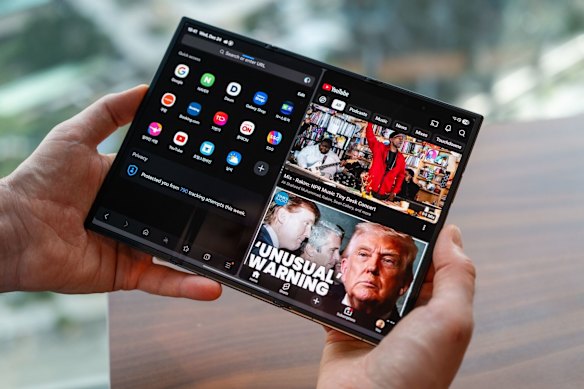
The Galaxy Z Trifold is a smartphone that can become a small tablet.Credit: Bloomberg
Smartphones and other personal gadgets
There are plenty of TVs and cars and industrial robots at CES, but for many people the most exciting devices are the ones you can put in your pocket or take with you anywhere. Phones are, after all, at the core of our tech lives. And CES gave little peek at where they might be going.
Lest you thought the hype for folding phones was waning, Samsung was on hand to show off its previously announced Galaxy Z TriFold, which you can use as a regular phone or as something three times the size. Do you need a phone that’s 20 centimetres wide? Of course not, but one device that can pull double duty as a phone and a tablet could turn some heads.
Motorola also made a big splash at the show, announcing its first book-style folding phone in the Razr Fold. It didn’t give away many specs, but it looks big and flashy enough to challenge Samsung and Google’s offerings. The company also unveiled a new premium phone called Signature, and (strangely) a pendant powered by Lenovo’s Qira AI that can help operate your phone for you.
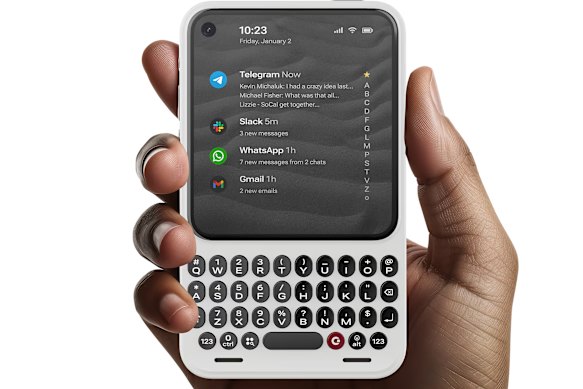
Look familiar? The Clicks Communicator is a new Android phone designed to evoke old Blackberry devices.
It’s not all futuristic handsets at the show though; the Clicks Communicator is a new old-school Android, with a physical keyboard and a close-to-square display, for all you Blackberry fans. It’s up for pre-order at a discounted $600. And if you don’t want to deal with the weird little screen, the company is also selling a magnetic keyboard that should work on all MagSafe and Qi2 phones.
Nearly ten years on, smartwatch maker Pebble is back in business, and in addition to its whimsical watches it demonstrated a smart ring. But unlike all other smart rings, this one does not collect biometric data, never needs to send stuff online, requires no subscription, is super privacy focused and lasts for years without charging. So what is it for? The Pebble Index 01 has one job; capturing your thoughts and storing them for later. You press the button, speak into it, and your thoughts are moved to your phone where they become notes, reminders, alerts or alarms.
And finally, while we wait for true XR glasses to arrive, ASUS and Xreal have partnered for the next best thing; AR glasses you can plug into any device to give you a private virtual 4-metre screen. The R1 has Full HD, 240Hz micro-OLED panels that can stand in for a TV or monitor, no matter where you are. If your device can send video and sound through USB-C (phone, laptop, gaming handheld) it all works with one cable. An included dock lets you connect other devices.
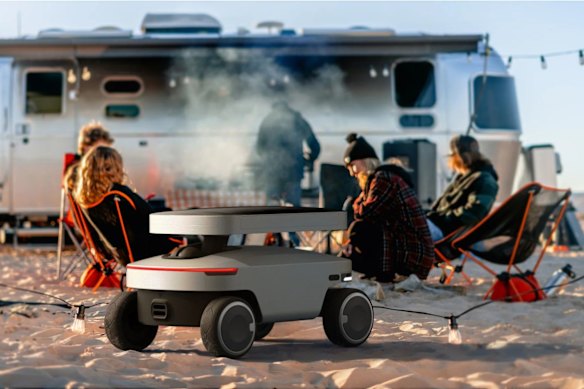
Jackery’s Solar Mars Bot is a portable battery station that can angle its own solar panels and drive around to find the best sun.
Sustainability and future tech
It’s difficult to look at the bulk of AI-powered nonsense and power-sucking luxuries at a show like this and not get techno-dystopia vibes. But as always, there were a number of innovations on display that seem like they could make a genuinely positive difference.
Startup Clear Drop showed off a soft plastic composter for use in homes. You feed in the plastic bags you don’t want or can’t use, and it processes them down, eventually expelling a brick of plastic. At this point, you have to send the waste in the mail to a processing facility, so it hasn’t actually solved the problem. But it could get all those plastic bags out from under your sink and into a form you can realistically recycle.
Elsewhere, a French device from Allergen Alert was shown, which can analyse a food sample in minutes and determine if it contains common allergens. The version at CES is portable enough to stash in a backpack, but it’s being tested in kitchens rather than by consumers carrying it with them to dinner. Right now, it only detects gluten and dairy, but there are plans to expand it.
Loading
In the (vanishingly small) category of good robots, a company called Beatbot demonstrated its RoboTurtle, which is precisely what it sounds like. Designed for environmental research, it swims around reefs and sea creatures collecting data without causing as much of a commotion as a human or submersible. When it needs to charge, it surfaces and soaks up sun with its solar shell.
And speaking of solar, Jackery returned for another year with its Solar Mars Bot, which looks just about ready for sale. It’s a big portable battery on wheels, with outlets to power any appliance, but it also has massive retractable solar panels up top, and some smarts to angle them and drive itself around to find the best sun. There’s also a camera up front, so you can set it to follow you around.
And finally, Finnish company Willo demonstrated a new wireless power technology that promises to deliver electricity as easily as Wi-Fi delivers data. The idea is that you have a transmitter plugged into the wall, and any compatible device within its range will be able to draw power. Even if it’s facing the wrong way, even it’s in somebody’s pocket. Willo has a working prototype, but nothing close to a consumer product, so it’s likely years away.
The worst in show
Of all the various awards and badges handed out at CES, and there are hundreds of them, this is the one vendors hope to avoid. Judged by an independent panel including representatives from Consumer Reports, the Electronic Frontier Foundation and iFixit, the “Worst in Show” goes to products considered invasive, wasteful or fragile. And this year there were a few of those to go around.
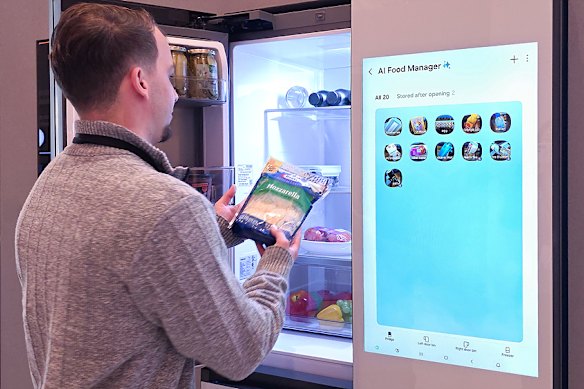
Samsung’s AI-powered fridge – which listens to voice commands and can open and close itself, while also keeping track of everything inside – met with mixed reviews.
Samsung’s Bespoke AI Family Hub is a fridge you talk to, even to open and close the door. It also uses computer vision to track when food items are running low, and can advertise replacements on its massive screen. It won two “worst of” awards — one for repairability, and the overall award — with judges saying its overengineered design adds failure points without delivering meaningful benefits. Specifically, its lack of traditional door handles and apparent difficulty hearing commands on the noisy show floor were a concern.
Bosch also received two nods, one for integrating the subscriptions and enhanced voice assistance of Amazon’s Alexa into its Personal AI Barista espresso machine, and another for a purported anti-theft and battery lock feature on an e-bike app. Judges said the eBike Flow App would allow Bosch to monopolise repairs and remove user control by parts-matching motors and batteries.
Invasive AI products featured prominently in the awards, with Amazon’s Ring ecosystem attracting the “worst of” for privacy — its new announcements include mobile surveillance towers that can be placed anywhere, and an app store for loading new capabilities to its cameras — and an AI treadmill from Merach winning the security award, for admitting it couldn’t protect the mountain of personal information it collected.
Many reporters from the show are talking about the $13 Lollipop Star, which is regular hard candy on a vibrating stick. In your mouth, it uses bone conduction to play music only you can hear. It took out the “worst in show” for environmental impact, as the sticks can’t be recharged or re-used. They also contain batteries, which makes throwing them in the regular garbage problematic.
And finally, the People’s Choice “worst of” award went to an AI companion called Ami, made by Lepro. Ami appears as a female avatar on a curved screen, that tracks eye movements and other emotional signals, and is marketed as “your always-on 3D soulmate.” Judges were unsettled by the idea that an always-online, AI-powered video surveillance device could be anyone’s soulmate.
– with AP
Get news and reviews on technology, gadgets and gaming in our Technology newsletter every Friday. Sign up here.