Goldring's G3 turntable is all about style and convenience, but there's one aspect I wish I could switch off...
SOURCE:TechRadar|BY: Simon Lucas
The Goldring GR3 turntable offers plug-and-play convenience, great value and excellent sound but there's one areas you'll want to turn off
Goldring has managed to enter a tricky area of the turntable market with a player that is distinct enough (where finish, specification and sound quality are concerned) to stand out and make quite a compelling case for itself.
Pros
Detailed, rhythmically adept and confident sound
Excellent pre-fitted cartridge is part of its plug-and-play convenience
Great standard of build and finish
Cons
-
Can sound slightly insubstantial at the top of the frequency range
-
Phono stage really should be defeatable
-
Not short of competition
Why you can trust TechRadar We spend hours testing every product or service we review, so you can be sure you're buying the best. Find out more about how we test.
Goldring GR3 turntable: two-minute review
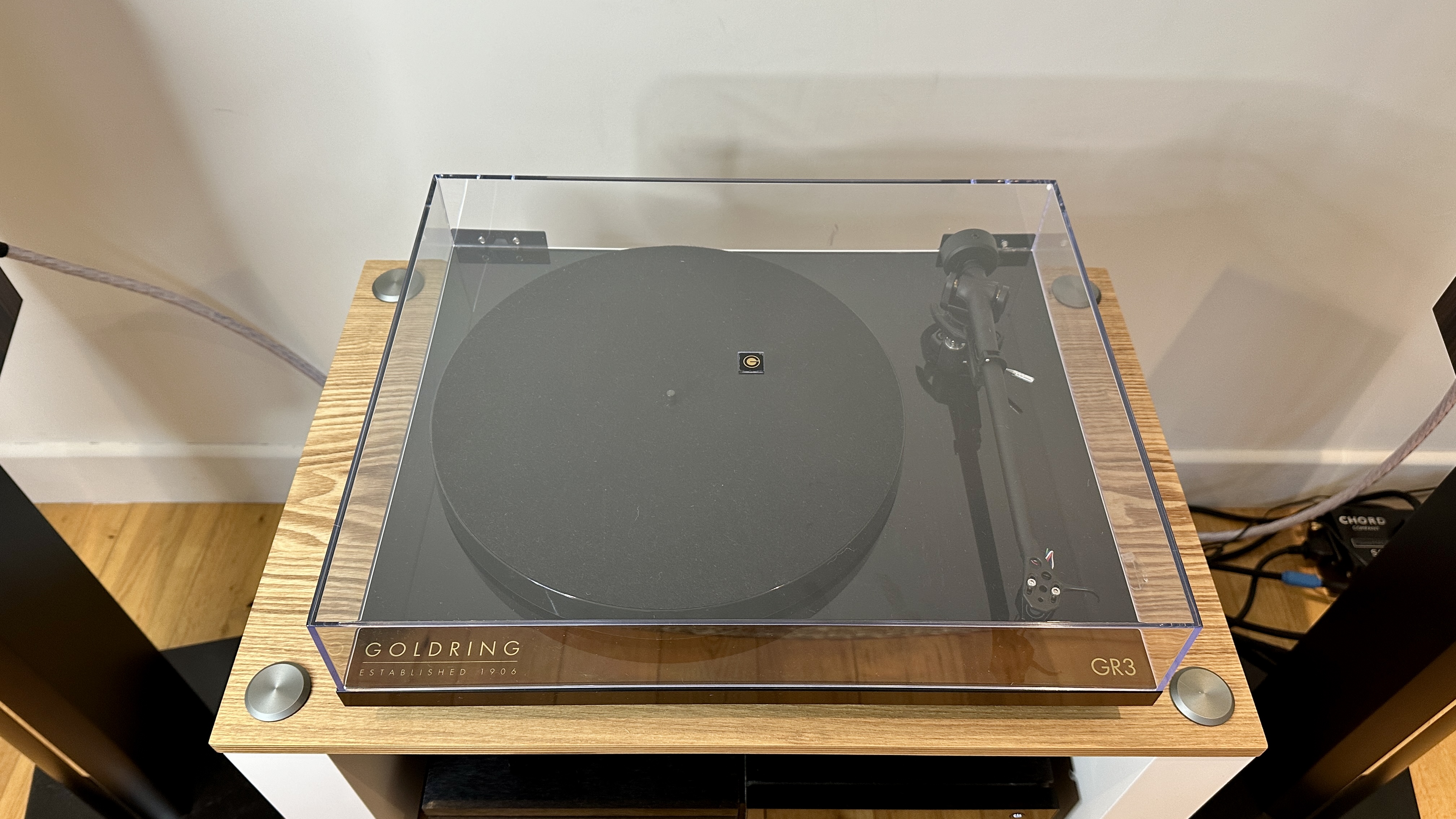
Just two decades or so since it last had a turntable in its product line-up, Goldring is back. The GR3 has been developed in collaboration with acknowledged experts and it really looks the part in a ‘black high-gloss lacquer’ sort of way.
Connected to an appropriate system, the Goldring GR3 is an articulate, informative and confident listen with just enough drive and attack to stop it sounding leisurely. Dynamic headroom, soundstaging and timing all impress, and the amount of detail the GR3 can extract from the groove is also noteworthy.
In a slightly less appropriate system, though, the latent high-frequency stridency the Goldring hints at becomes a little more evident – a minor lack of treble substance can become apparent. When weighed against all the things that are enjoyable about the GR3 sound, though, ‘minor’ is the word to bear in mind and it bears serious consideration to sit among the best turntables available.
(Image credit: Future / Simon Lucas)
Goldring GR3 turntable review: price and release date
$1,299 / £699 / AU$1,599 (approx.)
Launched in October 2025
The Goldring GR3 launched towards the end of October 2025, and in the United States it's priced at $1,299. In the United Kingdom it goes for £699, while in Australia it will set you back around AU$1,599.
The plain fact is that the Goldring GR3 has a few more features than is the norm where a record player costing this sort of money is concerned. So where has that half-a-star gone from the ‘features’ score below? I’ll get to that, but for now let’s establish what’s what.
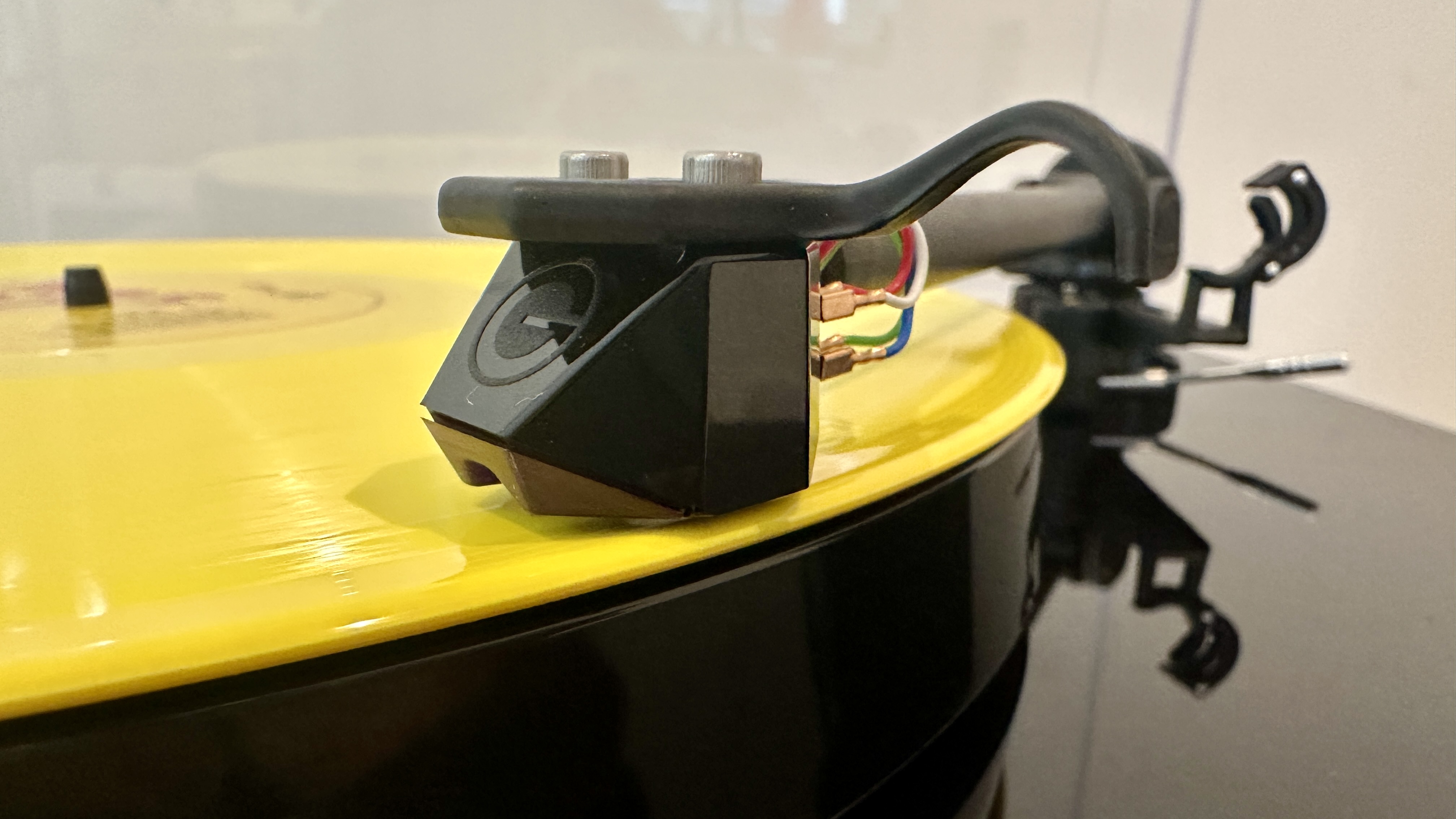
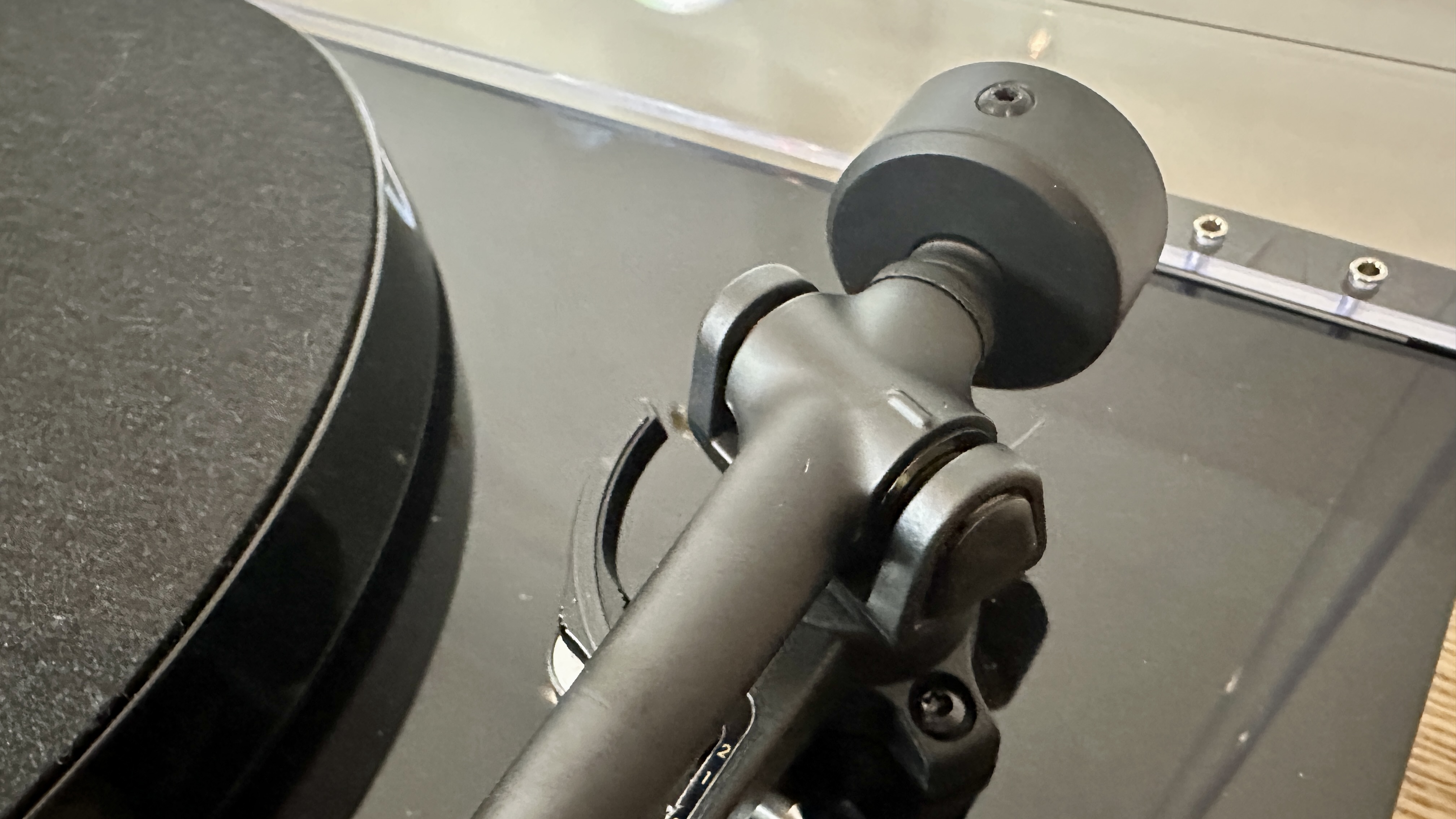
The motor that moves the belt that spins the platter is a low-noise, low-vibration design. The tonearm is a 237mm one-piece aluminum tube with a three-point arm mounting system - and it’s pre-fitted with an extremely well-regarded Goldring E3 moving magnet cartridge, a design that’s well on the way to becoming a classic.
Sign up for breaking news, reviews, opinion, top tech deals, and more.
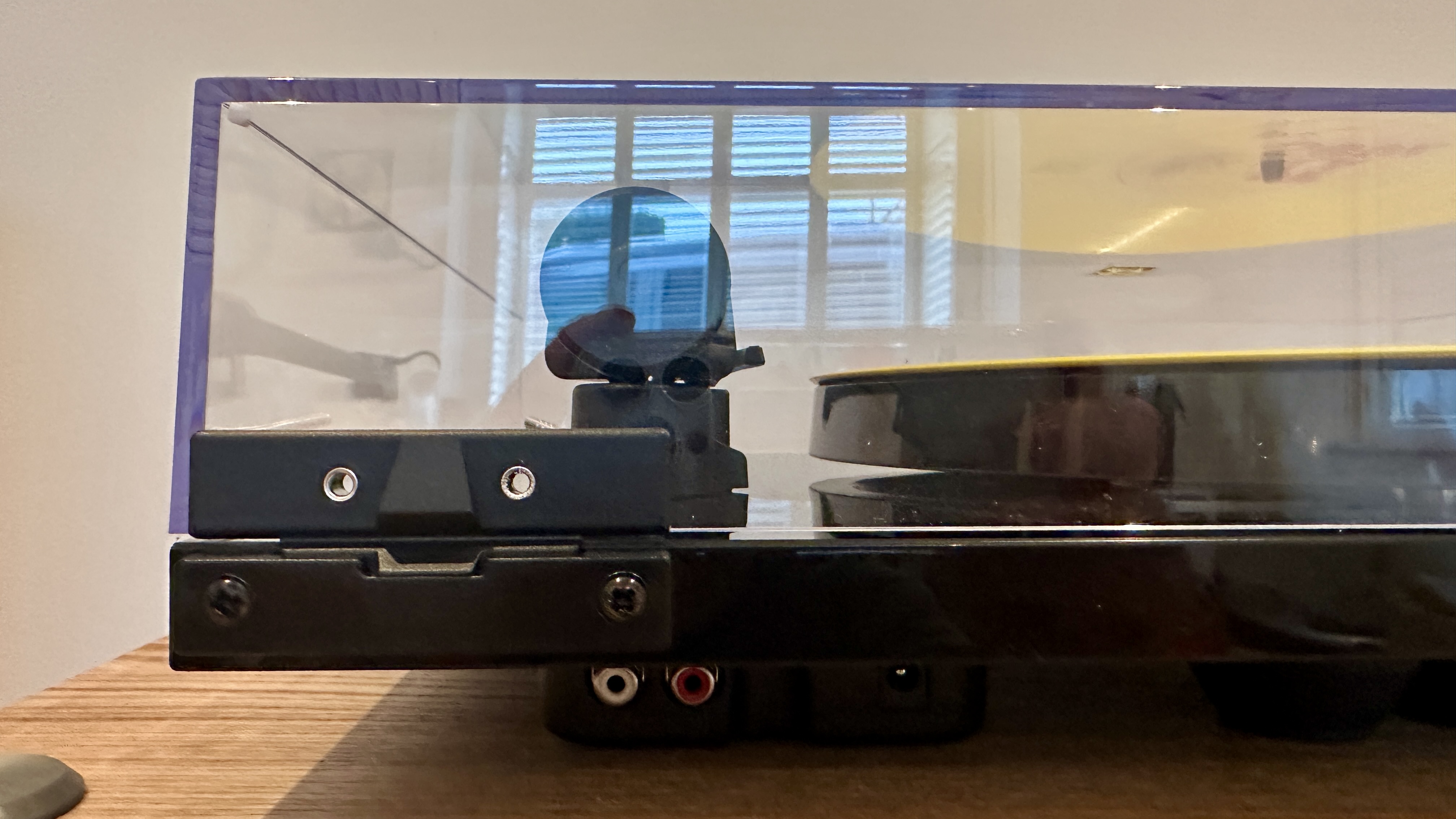
The GR3 is also supplied with two pairs of relatively high-quality interconnects, manufactured by Goldring’s sister company QED. One is a 1.5mm stereo RCA design, the other a 3.5mm / stereo RCA alternative, so connecting the GR3 to a full-size system or a pair of powered speakers should be no problem.
The Goldring’s stereo RCA outputs are fed by an integrated phono stage, and it’s here that the GR3’s final half-a-star goes astray. I’m absolutely in favor of record players with integrated phono stages, don’t get me wrong; it makes for ultimate flexibility, and it means the deck can slot into pretty much any system you care to mention. But the phono stage here is always on and cannot be switched off, so if you own a system with a phono stage of its own (and surely any number of people ready to spend $1,299 on a record player must do), you must avoid your own phono stage for the one fitted here. You don’t even get to compare and contrast.
Just a simple ‘on/off’ switch is all that’s required, Goldring. Is it too much to ask?
Features score: 4.5/5
(Image credit: Future / Simon Lucas)
Goldring GR3 turntable review: Sound quality
Tremendous rhythmic positivity
Extracts plenty of fine detail
Lacks a little top-end substance
There are some aspects of audio reproduction at which well-sorted turntables seem to excel. And the Goldring GR3 is almost a caricature of a record player in this respect; the areas where it’s at its most convincing and most enjoyable are all textbook turntable strengths.
Take rhythmic expression, for instance. The GR3 manages the low frequencies during a listen to Patti Smith’s Horses with absolute confidence, closely observing the attack and decay of individual bass sounds so that rhythms and tempos are described in the most naturalistic, fluent and convincing manner. There’s plenty of variation in the low end here, ample detail regarding tone and texture is available, but it’s the effortlessness with which the Goldring describes even quite tricky, off-kilter rhythms that lets you know you’re in safe hands.
The unity and togetherness with which the GR3 presents the whole recording is another one from the Big Book of Turntable Cliches. Detail levels are high throughout the frequency range, and (with the slight exception of the very top end) tonality is very consistent too – and there’s a real sense of singularity and performance about the way the Goldring handles the entirety of the music. As with rhythmic expression, there’s a complete lack of stress or apparent effort in the way this turntable handles the timing of a recording.
There’s decent dynamic headroom available for when the going gets especially hectic or intense. The GR3 is able to create a large and quite persuasive soundstage and there’s more than enough room available for each strand of a recording to make itself heard. The Goldring communicates eloquently through the midrange, and has just enough positivity to its overall presentation to prevent the words ‘laid back’ seeming like something that might come in useful at some point.
It’s only at the top of the frequency range that the GR3 seems anything less than nicely balanced and assured. Unlike the rest of the frequency range, which is described with quite carefully neutral tonality and a fair amount of substance, the very high end sounds a little thin and malnourished. It stops well short of hardness or edginess, don’t get me wrong, but its relative lack of body puts it at odds with pretty much everything that’s going on beneath it.
In a sympathetically matched system it will hardly be an issue but with carelessly chosen or similarly inclined partners the GR3 could conceivably bare its teeth a little more readily than is ideal.
Sound quality score: 4.5/5
(Image credit: Future / Simon Lucas)
Goldring GR3 turntable review: Design
Belt drive with manual speed change
Phenolic resin platter
High-gloss black plinth
Goldring, up to a point, is being quite open about the fact the GR3 was developed in collaboration with a third party. This is the Goldring’s first turntable in over two decades, after all, so the idea of getting some outside help is probably sensible. “A renowned British hi-fi manufacturer” is how Goldring rather coyly describes its associate.
If you’re in any way au fait with the work of any renowned British turntable brands, the design of the GR3 is going to look pretty familiar – heck, if you’re in a similar line of work to me you’re probably likely to recognize the arrangement of the packaging the GR3 arrives in. But if you’re going to collaborate, then why not collaborate with the best around?
Anyhow, the GR3 is a belt-drive design, and is fitted with a phenolic resin platter. The platter is designed to increase inertia and maximize the flywheel effect (thus maintaining consistent rotational speed) by having the bulk of its considerable mass at the outside.
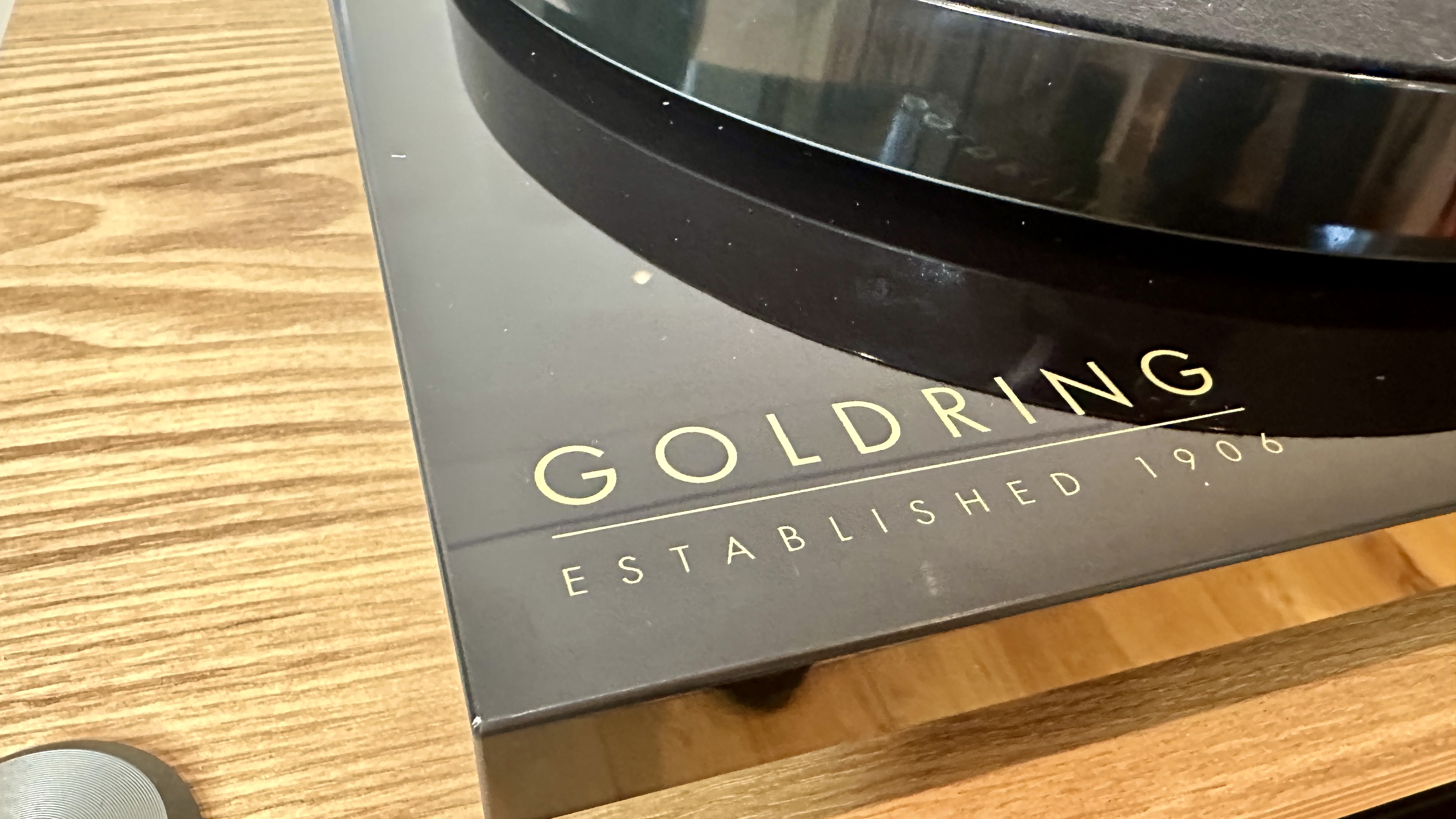
The plinth is built of anti-resonant composite fiber, and is finished in the sort of high-gloss black that collects fingerprints like a particularly zealous scene-of-crime investigator. It stands on three pliant, resonance-suppressing feet, and can be fitted with a supplied clear Perpsex dust cover. With the lid closed, the GR3 is 120 x 450 x 360mm (HxWxD), and weighs around 5.5kg.
Design score: 5/5
(Image credit: Future / Simon Lucas)
Goldring GR3 turntable review: usability and set-up
Cartridge is pre-adjusted for all but downforce
Can easily be connected to many types of system
Manual speed change
The Goldring E3 moving magnet cartridge is fitted to the tonearm before the GR3 leaves the factory, and it’s pre-adjusted for all but downforce. Dial in the recommended 2g and you’re ready to play.
Connecting to a system is very simple, too. Use one of the supplied cables to take line-level left-and-right channel information away from the turntable and into an ‘aux’ or other line-level input on your set-up – anything from a powered speaker to a full-on hi-fi system is fair game.
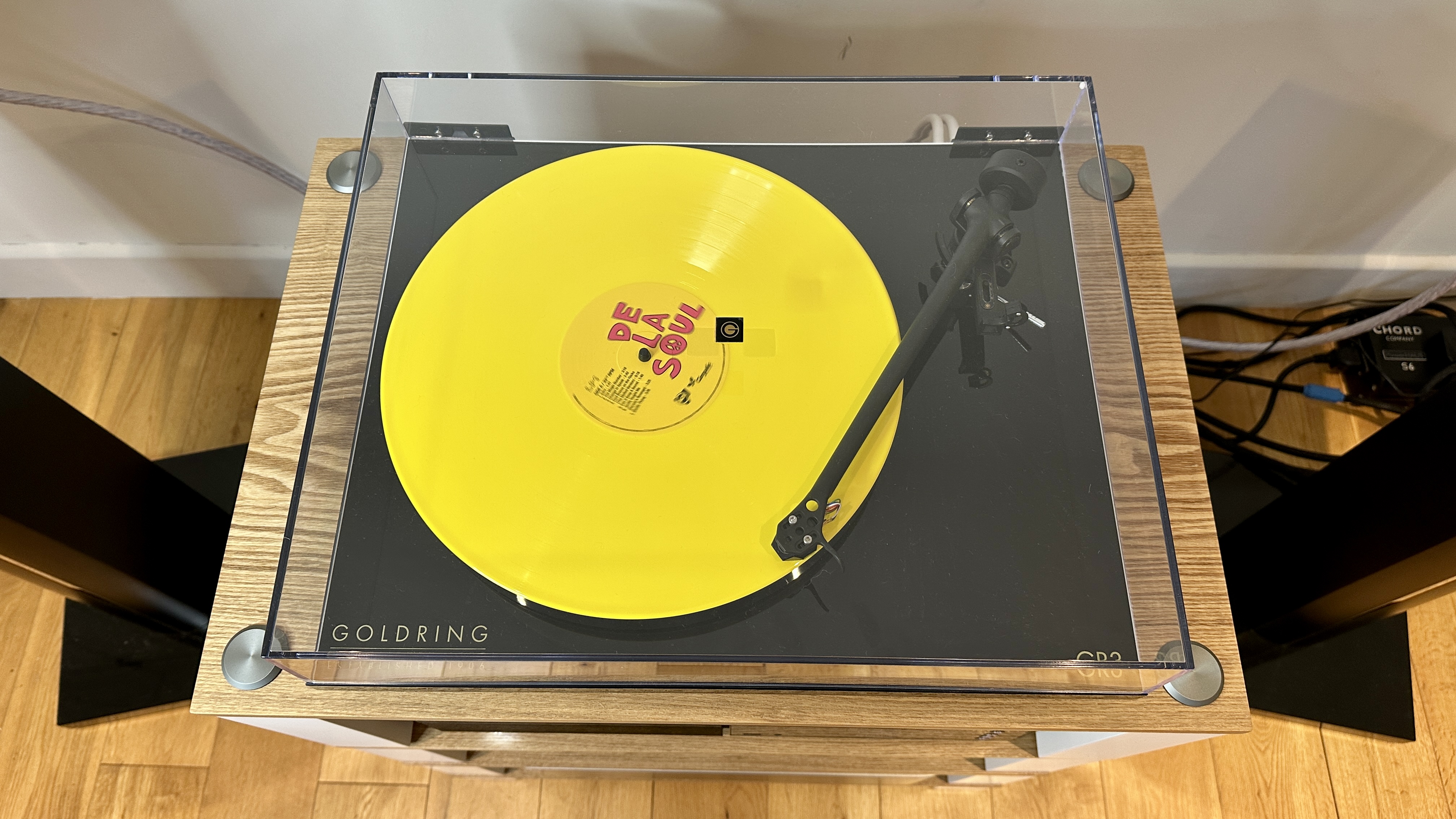
After that, make sure the belt is around the correct part of the pulley in order to get the rpm you need. The power switch is on the underside of the plinth, almost directly beneath the legend ‘Goldring - established 1906’ on the surface. Take the guard off the cartridge and lower the needle onto the vinyl… then sit back and enjoy.
Usability and setup score: 5/5
(Image credit: Future / Simon Lucas)
Goldring GR3 review: Value
Great build and finish
Articulate sound
Very acceptable cartridge
A good standard of build and finish, a very acceptable cartridge thrown in, and specification that makes system-matching the work of a moment all go towards suggesting there’s value for money available here. Add in the confident, articulate way the Goldring GR3 sounds and its case is approaching ‘watertight’.
Value score: 5/5
(Image credit: Future / Simon Lucas)
Should I buy the Goldring GR3?
Swipe to scroll horizontally
Attributes
Notes
Rating
Features
Low-vibration belt drive motor; integrated phono stage but would benefit from an 'off' option.
4.5/5
Sound quality
Excellent level of detail with decent dynamic headroom, but lacks a little top-end substance.
4.5/5
Design
Belt-drive design with a phenolic resin platter, developed in collaboration with a third party.
5/5
Usability and setup
Goldring E3 moving magnet cartridge fitted to the tonearm, though you must set the downforce; otherwise easy to connect to a system.
5/5
Value
Good build and finish, great cartridge, a fine proposition.
5/5
Buy it if...
Don't buy it if...
Goldring GR3 review: also consider
How I tested the Goldring GR3
(Image credit: Future / Simon Lucas)
Tested over the course of two weeks
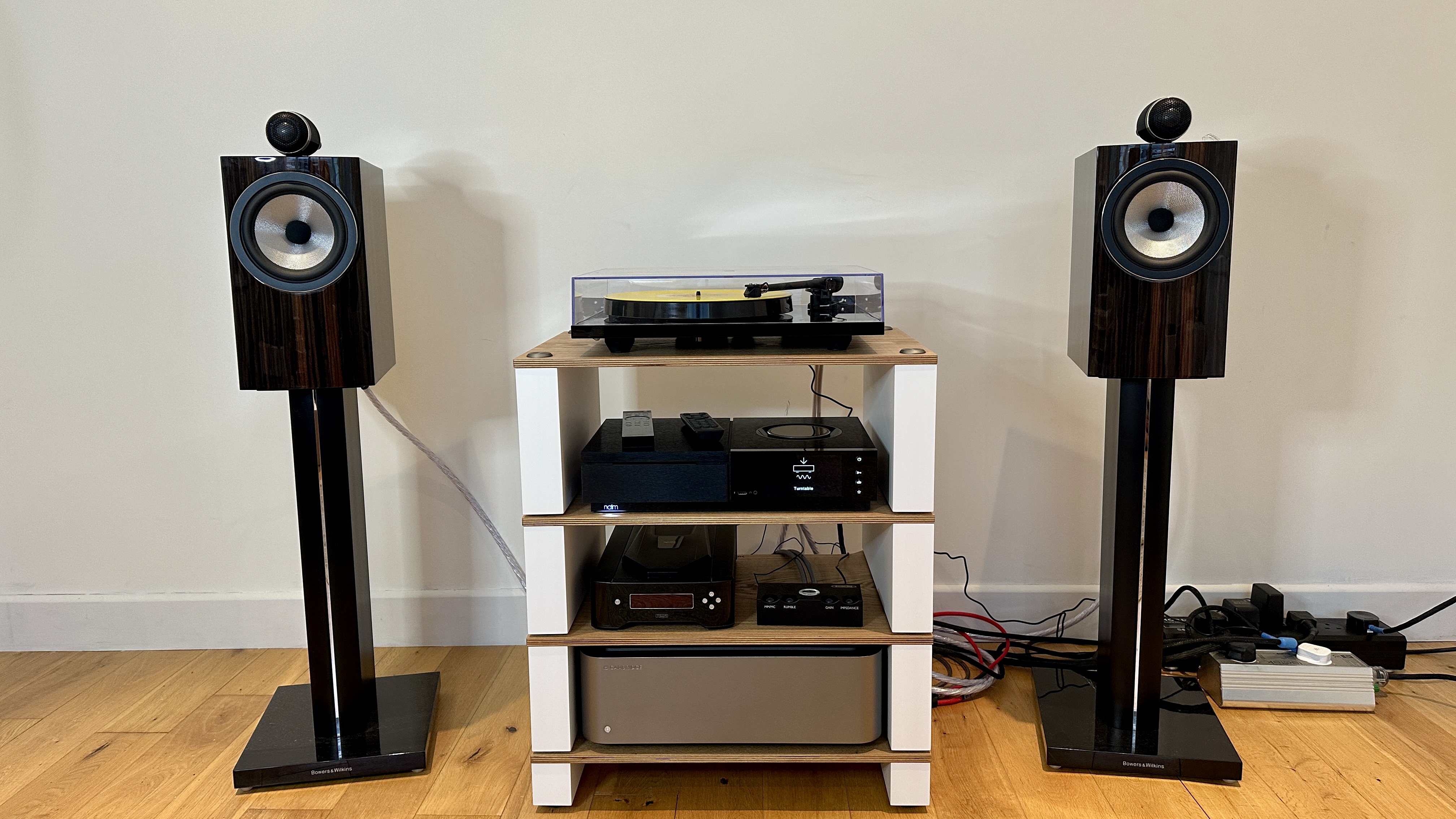
Connected to a Naim Uniti Star network streamer/amplifier and Bowers & Wilkins 705 S3 Signature speakers
Listening to various types of music
I connected the Goldring GR3 to the line-level analog input of my Naim Uniti Star network streamer/amplifier using the supplied QED RCA/RCA cables.
The Naim was connected to a pair of Bowers & Wilkins 705 S3 Signature speakers on FS-700 S3 stands using QED XT50 speaker cable.
And then I listened to a lot of records for quite a long time, which was not the hardship it sounds like, I have to admit. I used a Rega Planar 2 with Carbon MM cartridge and a Technics SL-1300G with Goldring 1042 cartridge as reference devices.
Simon Lucas is a senior editorial professional with deep experience of print/digital publishing and the consumer electronics landscape. Based in Brighton, Simon worked at TechRadar's sister site What HiFi? for a number of years, as both a features editor and a digital editor, before embarking on a career in freelance consultancy, content creation, and journalism for some of the biggest brands and publications in the world.
With enormous expertise in all things home entertainment, Simon reviews everything from turntables to soundbars for TechRadar, and also likes to dip his toes into longform features and buying guides. His bylines include GQ, The Guardian, Hi-Fi+, Metro, The Observer, Pocket Lint, Shortlist, Stuff T3, Tom's Guide, Trusted Reviews, and more.
You must confirm your public display name before commenting
Please logout and then login again, you will then be prompted to enter your display name.