Historic NASA test towers face their final countdown
With less than a month to go until NASA attempts to send astronauts around the Moon, the agency is demolishing facilities that got it there the first time around.
Twenty-five structures at Marshall Space Flight Center in Huntsville, Alabama are slated for removal, with two test stands set for controlled implosion no earlier than sunrise on January 10, 2026.
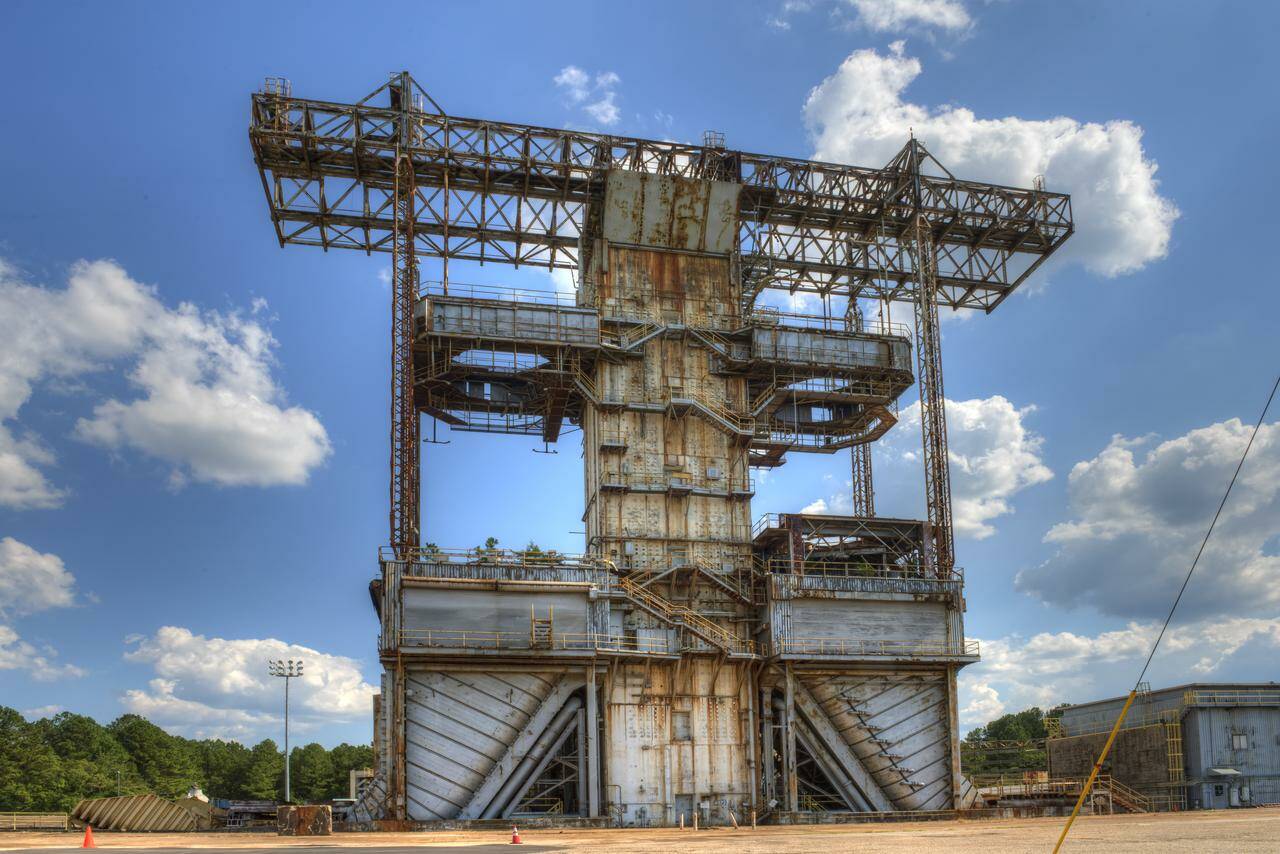
Propulsion and Structural Test Facility (credit: MSFC, photographer: Fred Deaton)
The Propulsion and Structural Test Facility - also known as the T-tower - was built in 1957 by the US Army Ballistic Missile Agency and transferred to NASA in 1960. It played a role in the development of the F-1 engine, which powered the first stage of the Saturn V, as well as the S-IC itself. It was also used to test the Space Shuttle solid rocket boosters.
Also on the chopping block is the Dynamic Test Stand, which, at 360 feet, was tall enough for full-scale tests of the Saturn V rocket and was the first location where all Space Shuttle elements – the external tank, solid rocket boosters, and orbiter – were integrated.
- Congress ctrl-Zs bulk of proposed cuts to NASA science
- Isaacman finally confirmed as NASA boss after Trump derailed first attempt
- We'll beat China to the Moon, NASA nominee declares
- Baikonur's only crew-capable pad busted after Soyuz flight
Crews have already begun demolition of the Neutral Buoyancy Simulator – a 1960s-era underwater facility where astronauts could be dunked to simulate near-weightlessness and test hardware procedures (including those required for servicing the Hubble Space Telescope). It's long been replaced by a facility at Johnson Space Center in Houston.
All three were designated National Historic Landmarks in 1985, but maintaining them is no longer economically viable.
"These structures are not safe," said acting center director Rae Ann Meyer. "By removing these structures that we have not used in decades, we are saving money on upkeep of facilities we can't use."
The facilities have been documented in detail, but it's still a loss of a tangible connection to NASA's past.
NASA warned communities near Redstone Arsenal to expect a "loud noise associated with the demolition on the morning of Jan. 10." ®