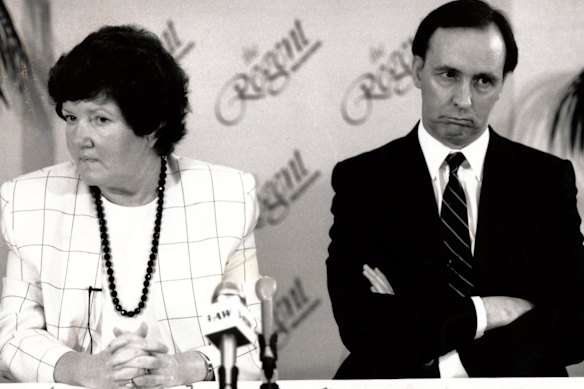
A memorable front page of The Age, published on Monday, August 27, 1990, featured a telling photograph of Victorian Premier Joan Kirner and Federal Treasurer Paul Keating.
Neither appeared willing to even look at the other, as if they were deep into the final property carve-up of a vexatious divorce.
Joan Kirner and Paul Keating appeared less than happy to announce that the State Bank of Victoria was to be sold.Credit: Age archive
They were sitting at the same table – not together, exactly – to announce what had been unthinkable in Victorian circles.
The venerable State Bank of Victoria – the fifth-largest bank in Australia – was being sold by its owner, the Victorian government.
The Commonwealth Bank would buy it, and 30 per cent of the Commonwealth Bank would be privatised to finance the deal.
Victoria lost the lot, and Keating’s push towards privatisation was supercharged.
Bank workers protest the proposed sale of the State Bank of Victoria to the Commonwealth Bank in August 1990.Credit: The Age
The state Labor government – Kirner had been premier for only 17 days – was effectively finished, though the election to formally put it out of its misery and install Jeff Kennett’s Liberals was still two years away.
There was no choice, Kirner said, but to sell the state’s bank, which in one form or another had held the savings of Victorians since 1842, when it began as the Savings Bank of Port Phillip.
It faced collapse because of risky loans, particularly those of its failed merchant arm, the freewheeling Tricontinental.
It would be an ignominious end to a decade of Labor rule, and the memory of it still weighs heavily on the legacy of the governments of John Cain jnr and Kirner.
But as the release of cabinet papers from the administrations of Cain and Kirner prove, the Labor period that began in 1982 was for much of its existence one of wide-ranging reform that changed Victoria’s political and social landscapes in ways that resonate today.
Paul Strangio, emeritus professor of politics at Monash University, described the reform record, particularly of Cain’s eight-year premiership before Kirner inherited its fag-end shortcomings, as remarkable for its range and significance.
“From the outset, Cain professionalised and systematised the hitherto ramshackle and antiquated executive government processes; among other things, establishing a cabinet office for the first time, along with reorganising and invigorating the Department of Premier and Cabinet,” Strangio said.
“The government was pioneering in Australia in creating a director of public prosecutions and in enacting freedom of information laws. It rid Victoria of a malapportioned zonal voting system and instead enshrined the principle of one vote, one value.”
An independent, non-partisan authority established by the Cain government to oversee Victoria’s electoral system was emulated federally when the Hawke Labor government created the Australian Electoral Commission.
The cabinet records from the period, released from the archives of the Public Records Office on January 1, are the first of their type to be opened in Victoria.
The reason is simple: before the Cain government arrived in 1982, Victoria’s governments operated their cabinet deliberations within a sort of everlasting cone of silence.
No formal system of cabinet record-keeping existed in Victoria until Cain was elected in April 1982 – nine years after the Public Records Act was passed.
There were no formal processes for documenting cabinet submissions or deliberations, nor any provisions for access to or closure of cabinet records.
Under the Public Records Act of 1973, cabinet records are closed for 30 years.
The Cain and Kirner governments’ cabinet records were transferred to the Public Records Office in 1996, meaning that their 30-year closure period expired on December 31, 2025.
The Director and Keeper of Public Records at the Public Record Office Victoria, Justine Heazlewood, said the decision to open a government’s cabinet documents for the first time marked a significant moment in Victoria’s archival history, offering a window into the decisions and events that shaped the state.
Those wanting to study the Kennett government’s cabinet decisions will have to wait another six years.
The records for the governments of Kennett (October 1992-October 1999) and Labor’s Steve Bracks and John Brumby (October 1999-December 2010) are due to be opened on January 1, 2032 and January 1, 2041 respectively.
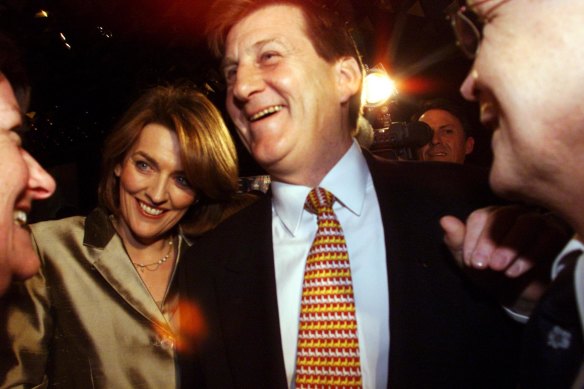
Cabinet documents from Jeff Kennett’s time as premier will be released in 2032.Credit: Craig Sillitoe
In 2042, records from the Liberal government of Ted Baillieu will be opened to the public, marking the beginning of annual releases 30 years after the creation of cabinet records.
Within the 332 boxes of archival material now opened to historians, the media and the public are cabinet decisions covering the introduction of poker machines to Victoria; changes to liquor laws that transformed Melbourne’s previously staid nightlife; early plans for Melbourne’s casino; a contested tightening of Victoria’s gun laws after the Hoddle Street and Queen Street massacres of August and December 1987; and, of course, the agonising decision to sell the State Bank.
There was also the decision to deregister the rogue Builders Labourers Federation, the decriminalisation of sex work and the response to the devastating Ash Wednesday bushfires in February 1983, which took the lives of 47 people in Victoria and 28 in South Australia.
This being Victoria, big-time sport was the subject of much discussion among cabinet members.
The Melbourne Cricket Ground needed massive redevelopment, particularly a $119 million demolition and rebuilding of the old concrete cancer-struck Southern Stand (now the Shane Warne Stand) to guarantee it could continue to host the annual grand final of the Victorian Football League (rebranded as the AFL in 1990).
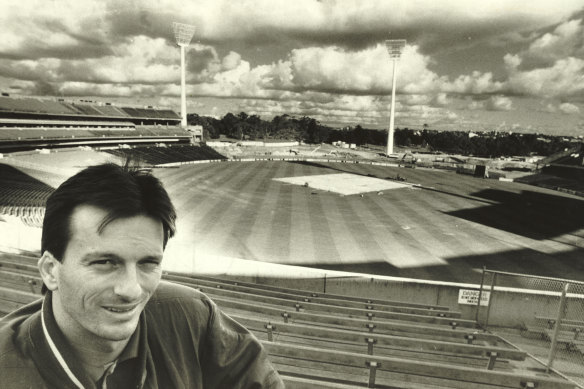
Steve Waugh at the MCG in 1990 as the Great Southern Stand was being built.Credit: The Age
There was Melbourne’s failed bid for the 1996 Olympics which, when announced in September 1990, went to the US city of Atlanta, causing disappointment among many Victorians and outrage among the state’s Greek-Australians, who believed it should have gone to Athens to mark the centenary of the modern Games.
What we know as Melbourne’s sporting precinct got special attention. Cain’s minister for environment and planning, Evan Walker, oversaw the development of both Southbank and the sporting precinct.
Cain made the National Tennis Centre at Flinders Park – now Melbourne Park – a special interest, paving the way for it to become the permanent home of the Australian Open tennis.
Cain himself would not abide old-school rules that refused entry to women at Melbourne’s major sporting institutions.
“The government passed landmark equal opportunity legislation, and Cain took on Melbourne’s stuffiest establishment sporting clubs over their maintenance of exclusively male zones,” Strangio said.
“He spurned invitations where his wife, Nancye, could not accompany him, and threatened action unless the clubs abolished these archaic practices.
“The Melbourne Cricket Club and Victorian Racing Club bowed to his pressure.”
Eventually, however, the unrealistic economic optimism of the “greed is good” 1980s and high-risk loans for property development combined with the 1987 stock market crash and complacent management at the State Bank’s Tricontinental subsidiary to bring Cain’s government undone.
By the time Kirner became premier she had no choice but to sit through that funereal press conference with Keating, announcing she had sold the bank to save the state. The years of positive reform were but a memory.
The release of documents detailing the cabinet decisions that eased Victoria out of a hidebound past into a future still recognisable today might go some way to squaring history’s ledger.