Homo erectus wasn't the first human species to leave Africa 1.8 million years ago, fossils suggest
A new analysis of enigmatic skulls from the Republic of Georgia suggest that Homo erectus wasn't the only human species to leave Africa 1.8 million years ago.
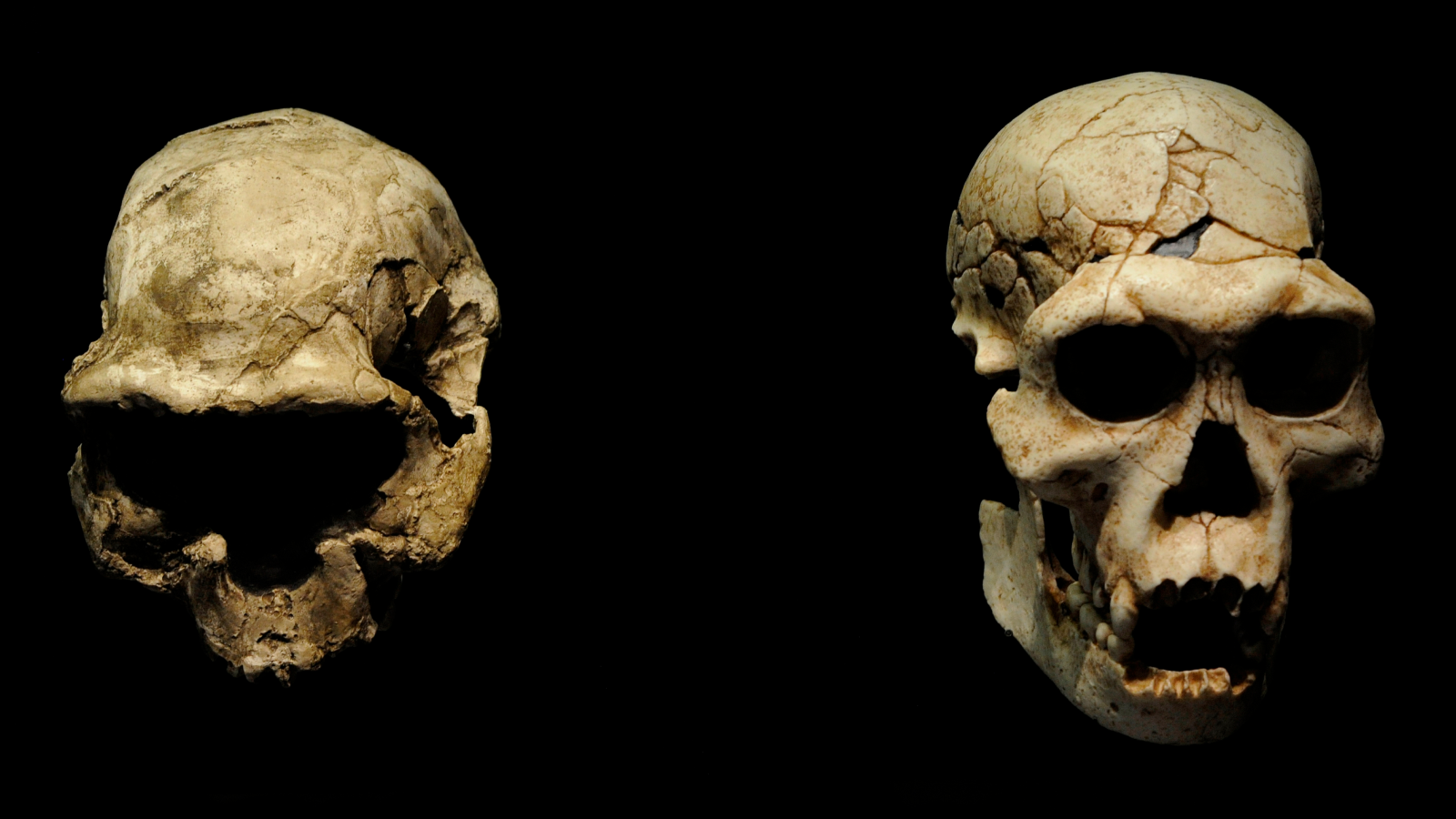
Reproductions of ancient skulls found in Dmanisi, Georgia, including a skull (left) of a young woman and the skull and jaw (right) of a male. (Image credit: Universal History Archive/Universal Images Group via Getty Images)
Early, ancestral members of the human lineage may have left Africa earlier than widely thought, a new study of fossil teeth suggests.
Modern humans, Homo sapiens, are the only living member of the human lineage, Homo, which is thought to have arisen in Africa about 2 million to 3 million years ago and first left that continent a few hundred thousand years ago. But many other extinct human species previously roamed Earth, such as Homo habilis, suspected to be among the first stone-tool makers, and Homo erectus, the first to regularly keep the tools it made.
The fossils of Dmanisi have drawn intense debate because of the unusual level of variation they display. Many researchers have suggested these specimens all belong to H. erectus, with the anatomical diversity seen between the specimens resulting from factors such as natural differences between the sexes. Other scientists have argued that the Dmanisi fossils represent two distinct human species. One, dubbed Homo georgicus, seemed more closely related to predecessors of humans known as australopiths, while the other, Homo caucasi, appeared more similar to early human species.
Resolving this controversy might reveal whether H. erectus was the first human species to leave Africa, or if others preceded it, study co-author Victor Nery, a historian and archaeologist at the University of São Paulo in Brazil, told Live Science.
Previous analyses of the Dmanisi fossils mostly focused on the skulls. In the new study, published Dec. 3 in the journal PLOS One, researchers instead concentrated on similarities and differences among the teeth.