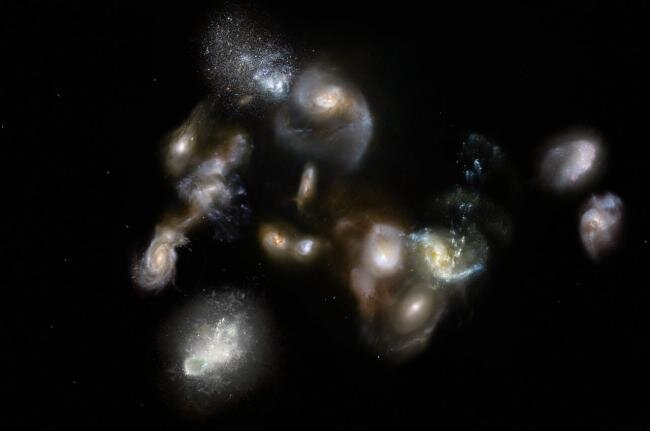
'How can all of this be happening?': Scientists spot massive group of ancient galaxies so hot they shouldn't exist
An inexplicably hot, fast-growing cluster of galaxies in the early universe has scientists questioning theories of galactic evolution.
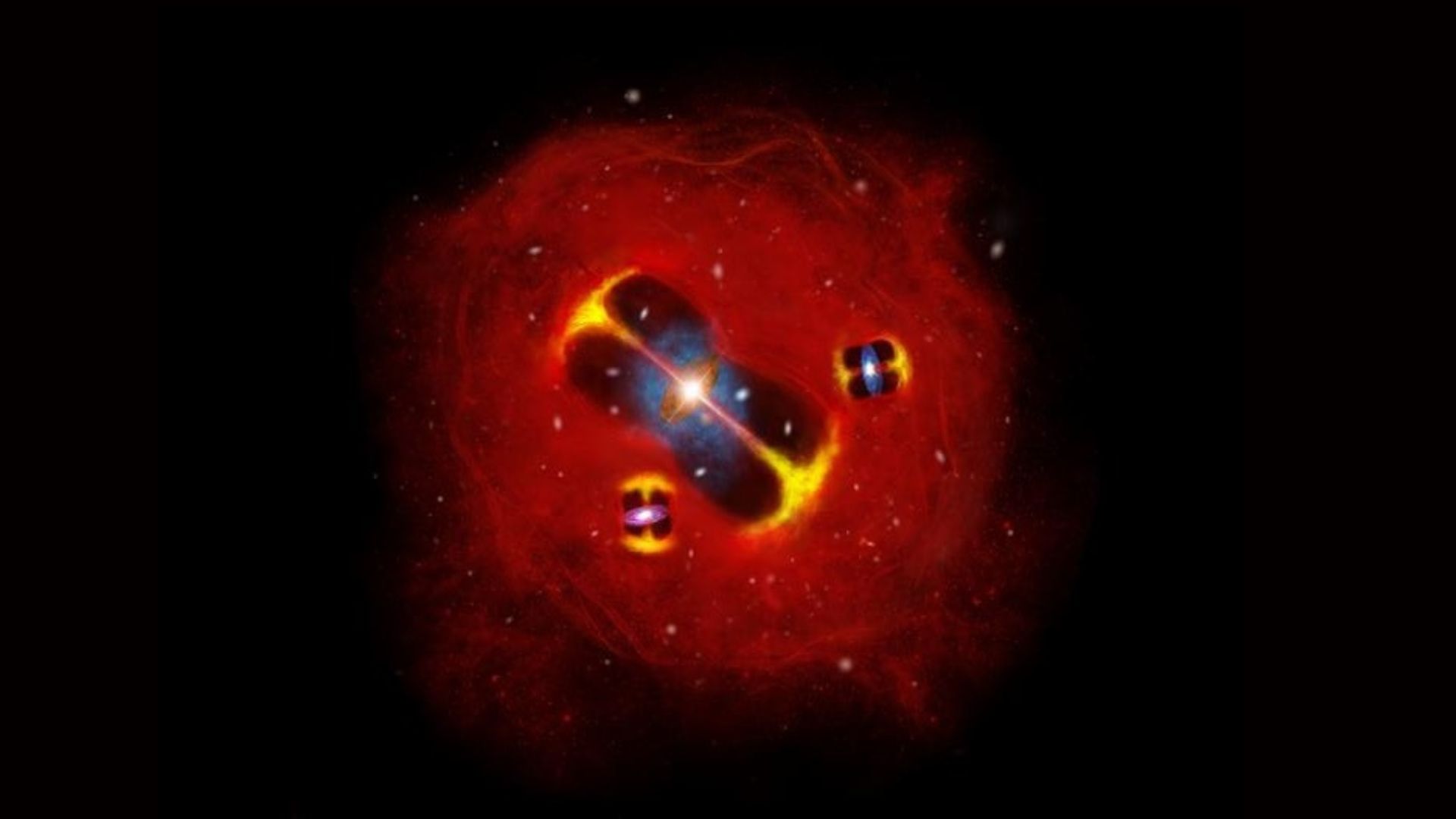
The gas streaming through an ancient galaxy cluster is five times hotter than theory predicts, yet again challenging our understanding of how objects evolved in the early universe. (Image credit: Lingxiao Yuan)
Astronomers have spotted an unexpectedly hot galaxy cluster in the early universe that's challenging theories of galactic evolution.
The scorching cluster existed just 1.4 billion years after the Big Bang, blazing far earlier and hotter than current models of galaxy cluster formation predict should be possible. The discovery suggests that the predicted patterns of cluster growth might need a rethink, researchers reported Jan. 5 in the journal Nature.
"Understanding galaxy clusters is the key to understanding the biggest galaxies in the universe," study co-author Scott Chapman, an astrophysicist at Dalhousie University who conducted the research while at the National Research Council of Canada (NRC), said in a statement. "These massive galaxies mostly reside in clusters, and their evolution is heavily shaped by the very strong environment of the clusters as they form, including the intracluster medium."
In the new study, researchers used the Atacama Large Millimeter/submillimeter Array (ALMA), a powerful radio telescope located in Chile, to observe a bright, young galaxy cluster known as SPT2349-56, whose light was emitted just 1.4 billion years after the Big Bang. This cluster is relatively small — about the size of the Milky Way's outer halo — but it contains more than 30 active galaxies and three supermassive black holes, and it forms stars more than 5,000 times as fast as the Milky Way.
Using a phenomenon called the thermal Sunyaev-Zeldovich effect, the team found that the gas in the intracluster medium is at least five times hotter than current theories of cluster formation predict it should be for its relatively young age.