How to track Santa Claus this Christmas Eve with NORAD's 2025 tracker
NORAD celebrates its 70th year of tracking Santa Claus as he flies around the world delivering joy this Christmas Eve.
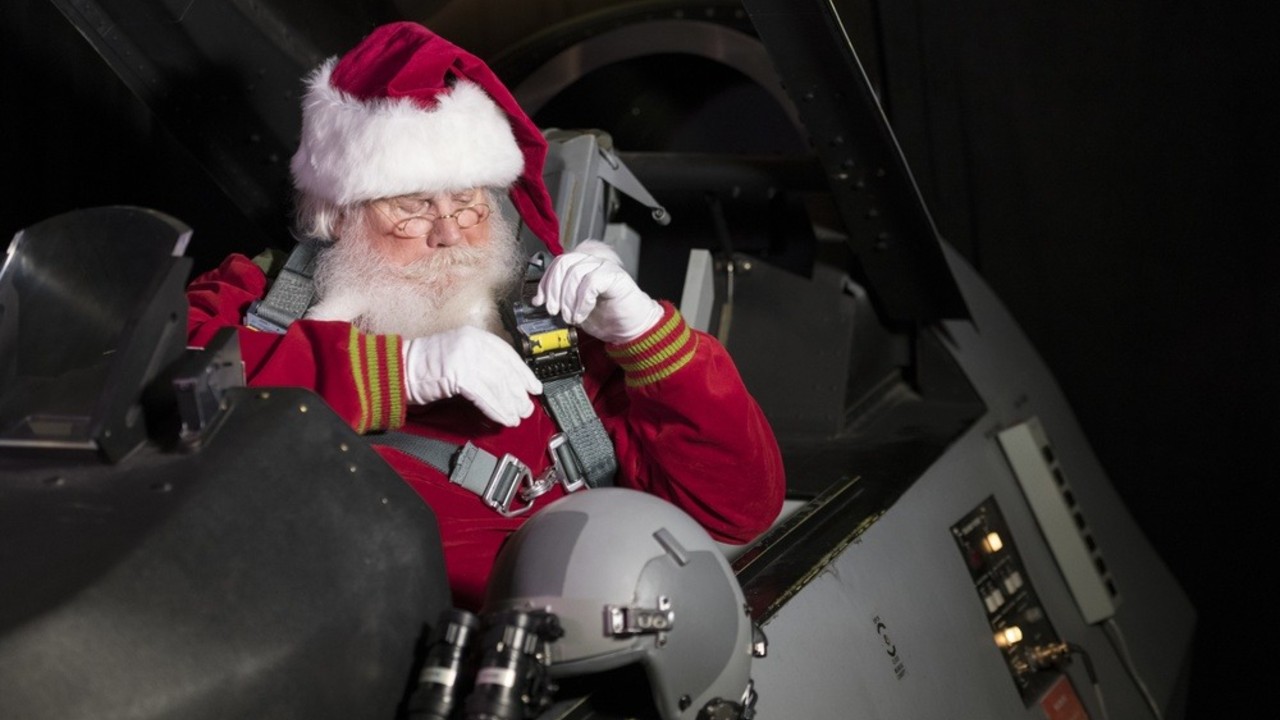
Santa Claus visits Buckley Space Force Base in Aurora, Colorado in 2018. (Image credit: NORAD)
It started on Christmas Eve in 1955, when an eager child picked up the phone to call Santa Claus and instead accidentally called a U.S. military air defense facility.
That facility is operated by Continental Air Defense Command (CONAD), the precursor to today's North American Aerospace Defense Command (NORAD), and should have only been reachable by a select few high-ranking officers and the President of the United States. But on Christmas Eve 1955, confused airmen usually tasked with tracking aircraft from foreign airspace ended up impersonating Santa Claus thanks to that child who dialed a wrong number. The accident quickly became a tradition and, like many other traditions, its origin story began to grow ever more elaborate over the years, sometimes involving a misprinted phone number in an advertisement.
But even though NORAD tracks Santa's flight around the world on Christmas Eve, that doesn't mean the air defense command knows Kris Kringle's route ahead of time.
"NORAD tracks Santa, but only Santa knows his route, which means we cannot predict where and when he will arrive at your house," a senior NORAD official said in the statement.
The U.S. military's statement notes that fighter pilots have intercepted Santa Claus' sleigh many times over the years as he enters NORAD's airspace. A previous DOD statement that is no longer available online (an archived version is available here) states NORAD is able to track Santa using infrared sensors on satellites that are designed to detect the heat from rocket or missile launches.
"As Santa flies through the skies, satellites track his position by detecting Rudolph's nose, which gives off an infrared signature similar to that of a missile," the statement reads.
Breaking space news, the latest updates on rocket launches, skywatching events and more!
Since the 1970s, NORAD has used a series of satellites known as the Defense Support Program (DSP) to detect the bright flashes of heat and light emitted by and rocket launches.