London: As far as the Russians were concerned, they had got their man.
Denis Kapustin, one of the most prominent anti-Putin Russians fighting on behalf of Ukraine, was reported dead on December 27, assassinated by a drone on the southern front.
He had long been hunted by Moscow, and the price on his head reflected this: Russian intelligence services had offered $US500,000 ($746,475) to anyone who killed him.
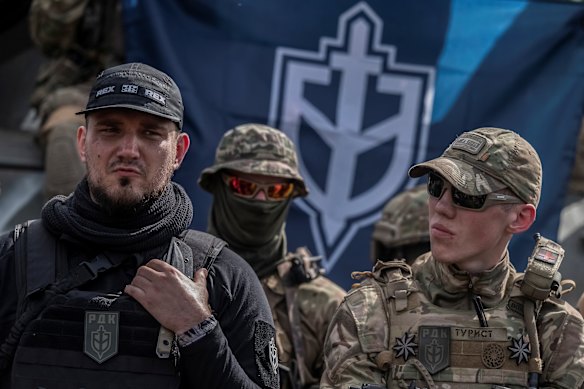
Moscow-born Denis Kapustin (left), also known by the nom de guerre White Rex.Credit: Reuters
Russia paid this out after news broke of the successful hit last week. But what Russian President Vladimir Putin’s intelligence services did not know was that they had handed the money directly to Ukraine.
‘Your legacy lives on’
Kapustin, known by his nom de guerre “White Rex”, founded the pro-Ukrainian Russian Volunteer Corps (RDK) in 2022.
Loading
The group made headlines in 2023 and 2024 when it carried out cross-border incursions into Russia’s Belgorod and Kursk regions, humiliating the Russian president and his generals.
His death was first confirmed by the RDK itself. “We will definitely take revenge, Denis,” the group said on Telegram. “Your legacy lives on.”
Yet on New Year’s Day, in a morale-raising ruse, Kapustin re-emerged – alive and unscathed – in a video posted by Ukraine’s military intelligence (HUR).
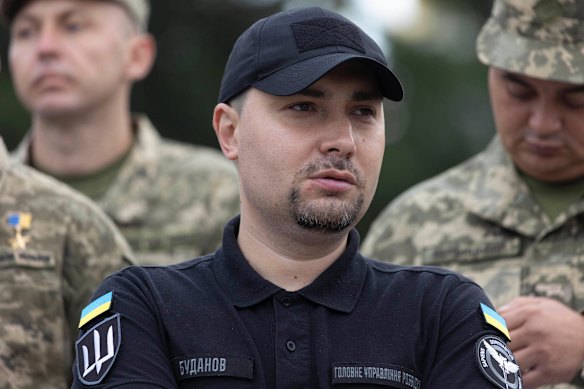
“Welcome back to life,” General Kyrylo Budanov, head of HUR, said with a wry smile. He congratulated Kapustin and his team on a successful operation to deceive their Russian adversaries.
General Kyrylo Budanov, head of HUR, congratulated Kapustin and his team on a successful operation to deceive their Russian adversaries.Credit: AP
It turns out HUR, along with the RDK, had hatched a plan to fake Kapustin’s death and claim the $US500,000 bounty from Russia for themselves, to be used in Ukraine’s war effort.
“First of all, Mr Denis, congratulations on your return to life. That is always a pleasure. I am glad that the money allocated for your assassination was used to support our struggle,” Budanov added.
Outsmarting Russians
Russia’s FSB and GRU agencies have long been feared for their ruthlessness.
Loading
But Ukrainian intelligence, throughout the nearly four-year war, has consistently proved its ability to outsmart its Russian counterparts, carrying out assassinations of generals and Kremlin officials on Russian soil, orchestrating complex sabotage operations and recruiting Russian agents.
In November, it was reported that Ukraine’s intelligence services used Russia’s own agents to accept missions offered openly by the FSB for financial reward and to sabotage its objectives.
In one case, a Ukrainian double-agent accepted a task from a Russian jobs board to build a bomb, which was then handed to a Russian saboteur. The bomb, however, was made using flour and the Russian agent was captured by Ukraine after it failed to detonate.
Ukraine has also claimed responsibility for assassinations of high-ranking Russian officials, while Kyiv is suspected of being behind many others.
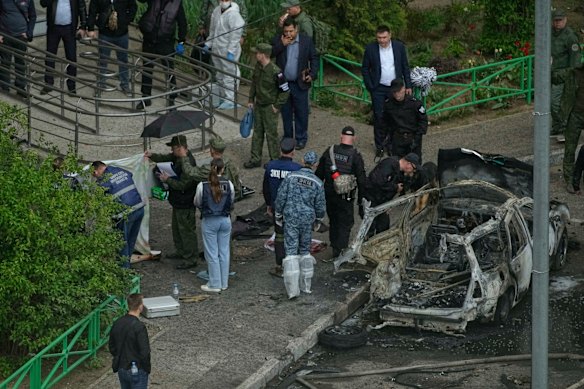
Investigators work at the scene where Yaroslav Moskalik, a deputy head of the main operational department in the General Staff of the Russian armed forces, was killed by a bomb placed in a car.Credit: AP
In April, Yaroslav Moskalik, deputy chief of the main operations directorate of Russia’s army, was killed by a car bomb on Nesterov Boulevard in the Balashikha suburb of Moscow. Baza, a Russian media outlet with sources inside law enforcement agencies, said the home-made bomb was strapped to a parked Volkswagen car and detonated remotely when Moskalik, who lived in the neighbourhood, walked past.
A month later, a former Ukrainian politician was shot dead in what appeared to be a professional hit job at the entrance of an exclusive school in Madrid. Andriy Portnov, a pro-Russian politician who worked as a close aide to the Moscow regime, was dropping off his daughters when an assassin shot him several times. The shooting took place at the American School of Madrid while other parents were also making the school run.
Most recently, Lieutenant General Fanil Sarvarov, 56, head of the Russian army’s operational training directorate, died in an explosion on December 22 in Moscow, probably planted by Ukrainian special forces. The force of the explosion was such that at least seven cars parked nearby also sustained damage. The general worked in the Russian Defence Ministry and participated in combat operations in Chechnya, Syria and Ossetia as well as Ukraine.
Loading
Among the most striking assassinations was the killing of Lieutenant General Igor Kirillov on December 17, 2024. The officer, who was in charge of Russia’s nuclear, chemical and biological weapons, was killed by a remotely detonated device hidden inside an electric scooter.
“Kirillov was a war criminal and an absolutely legitimate target, as he gave orders to use banned chemical weapons against the Ukrainian military,” a Ukrainian security source said.
In a daring mission in June 2025 – dubbed Operation Spiderweb – Ukraine-operated drones destroyed several Russian surveillance aircraft and nuclear-capable bombers, with officials in Kyiv saying this rendered a third of Russia’s strategic cruise missile carriers useless. The drones had been smuggled into Russia and assembled, and launched from trucks deep within Russian territory, in another huge victory for Ukraine’s spies.
Ukraine’s latest intelligence success meant Kapustin, a far-right extremist and former football hooligan, was inside Ukrainian territory and “preparing to continue carrying out assigned tasks”, a Ukrainian commander said.
The commander’s family moved from Moscow to Germany when Kapustin was 17 and he relocated to Ukraine in 2017. Since 2019, he has been banned from entering the Schengen Area for promoting neo-Nazi ideology.
In the early weeks of Russia’s full-scale invasion, Kapustin helped set up units that would become Ukraine’s 3rd Assault Brigade, which played a key role in defending Kyiv and later became renowned for its fierce fighting on the eastern front.
Responding to reports of his death, the 3rd Army Corps said: “We together confronted the common enemy in the battle for Kyiv.”
It added on December 27: “He perceived [Ukraine] as a place of real resistance and freedom.”
In August 2022, Kapustin set up the RDK, with the goal of overthrowing Putin to bring “peace to Russia”. Its stated aim is to end Putin’s regime of “lies, corruption, and lawlessness”.
Loading
Jailed in absentia
It is made up of former Wagner Group recruits, some former FSB agents and civilian volunteers. It is deemed a terrorist organisation by Russia.
Russian courts have twice sentenced Kapustin to life imprisonment in absentia on treason and terrorism charges.
In March 2024, the RDK stormed into Russia alongside other anti-Kremlin militias on tanks and armoured vehicles. It clashed with Russian security services and captured Russian soldiers.
Kyiv has said that while it fights as part of Ukraine’s military, under its command, the incursions into Russia were not taking place under Kyiv’s orders. Since its incursions, the group is either fighting at the front or engaged in cross-border sabotage operations in Russia.
In an interview with London’s Telegraph in September, an RDK commander known as “White”, a 26-year-old Russian volunteer, described how he joined to exact revenge on Putin for invading Ukraine.
“We fight to change something in Russia,” he said. “When the war ends, I will continue fighting until Putin falls.”