Humongous 52-inch Dell monitor will make you feel like king of the internet with four screens in one
If you like to separate your workflow onto multiple monitors but hate the gap and bezel between screens, Dell’s new display was made for you. Announced on Tuesday at CES, the Dell UltraSharp 52 (U5226KW) offers 52 inches of 6K resolution screen real estate that you can divide into up to four virtual monitors, supporting input either from up to four different devices, or one computer that creates that many desktops.
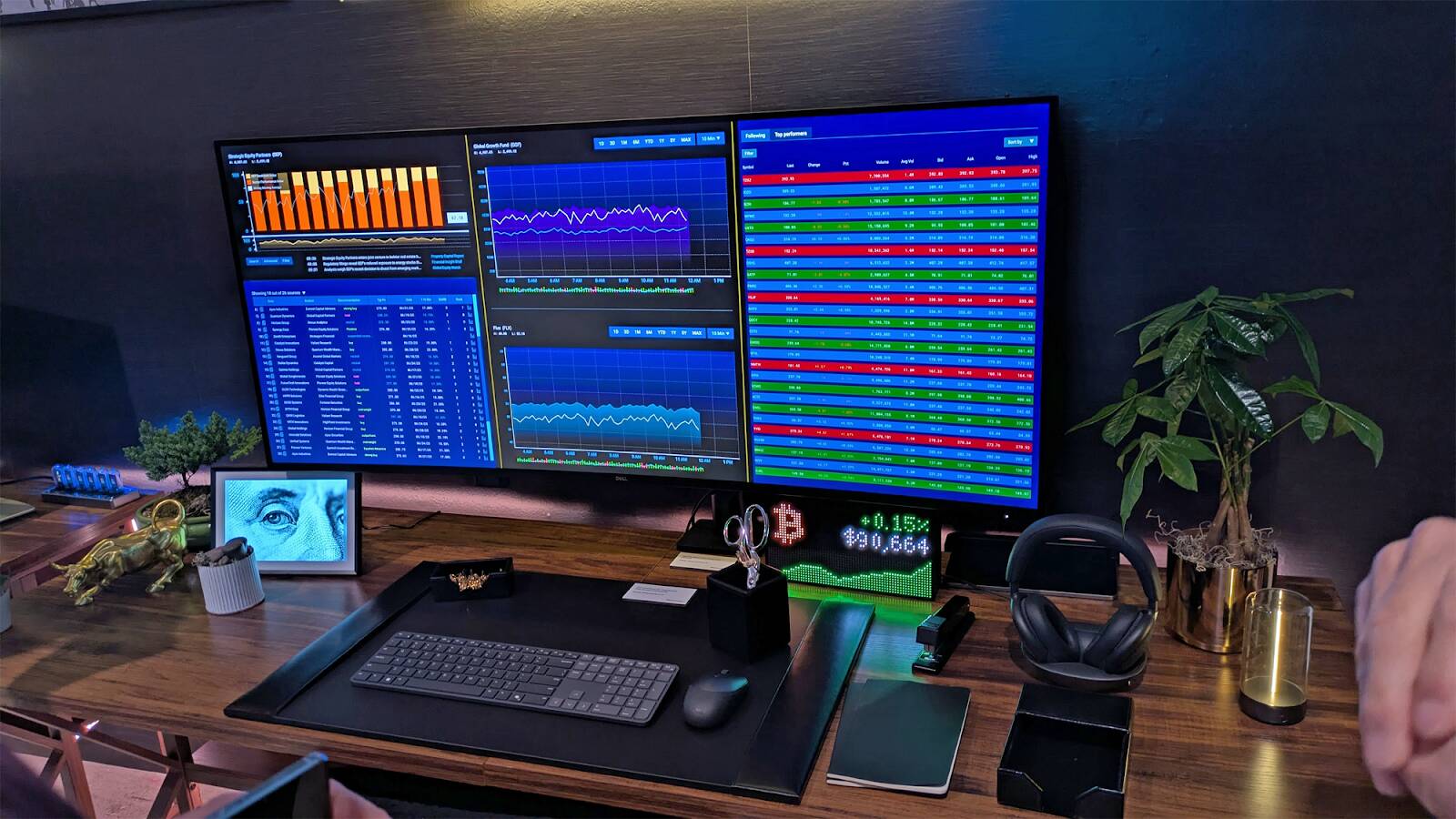
Dell UltraSharp 52 - Click to enlarge
Due out in January for $2,899, it's definitely a more elegant solution than having three or four monitors on your desk. Dell’s 27-inch, 4K Ultrasharps are about 24.1 inches wide, but this new one is just 48.16 inches wide, so it would take about the equivalent desk space of two monitors while providing the real estate of three or four.
With a 21:9 aspect ratio and 6144 x 2560 resolution, this IPS monitor has plenty of room for your work, whether it’s three or four desktops' worth of content stacked horizontally next to each other or a parade of windows on a single 6K workspace. That’s a solid 129 pixels-per-inch, which is about on-par with a 32-inch 4K monitor (138 PPI).
Four desktops, evenly divided, would yield desktops that were each 1536 x 2560. That’s probably adequate for viewing web pages, but it might not be the best for seeing stock charts or wide spreadsheets next to each other. I’d recommend going with just three desktops at 2048 x 2560 each.
The panel has strong specs, boasting a 2000:1 contrast ratio, 400 nits of brightness and the ability to reproduce 99 percent of the DCI-P3 color gamut, along with 100 percent of the sRGB gamut. It has a slew of ports to help you connect to all those devices, including two HDMI 2.1 connections, two DisplayPort 1.4 ports, one Thunderbolt 4 port, three USB-C upstream ports for connecting to computers, two USB-C downstream ports for connecting to peripherals, and four USB Type-A ports for peripherals.
The Thunderbolt 4 port can deliver up to 140 W of juice to a laptop that needs it. And some of the USB-C and USB Type-A ports can offer up to 27 W to charge a phone or tablet.
QD-OLED monitor targets creative professionals
If you need vibrant accurate color more than you need multiple desktops, Dell’s UltraSharp 32 (U3226Q) could be a solution. Due out in February for $2,599, this 32-inch screen features a vibrant QD-OLED panel that promises to reproduce 99 percent of the DCI-P3 color gamut with a Delta E accuracy score of under 1 (lower is better). It also supports DisplayHDR True Black 500 and Dolby Vision HDR, both of which offer deep blacks that make the other colors pop more.
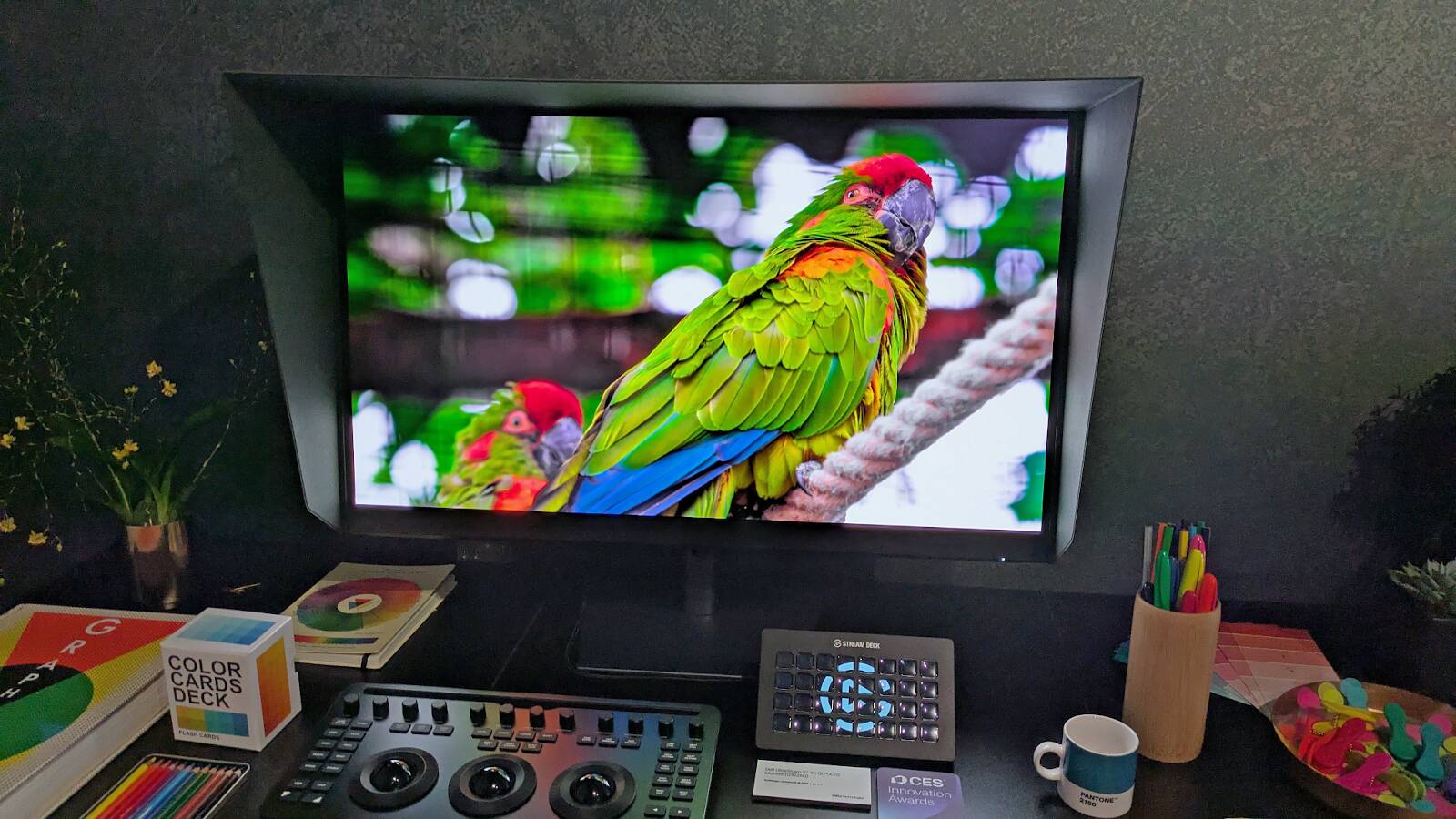
Dell UltraSharp 32 (U3226Q) - Click to enlarge
Perhaps more importantly, you can calibrate the display yourself using a built-in colorimeter. You can run the calibration on the display itself, without software, and the results are stored in the monitor’s firmware, so even if you connect it to another computer, it will stay the same. You can also use Dell’s software or a remote console to correct the color.
Like most OLED monitors, it doesn’t get super bright, at least not if you want the entire screen lit evenly. The UltraSharp 32 can reach up to 1,000 nits in a small 3 percent area of the display, about 500 nits in a 10 percent window, and roughly 300 nits across the full screen.
I got to see this monitor in person running a demo video and was impressed with the vibrant colors that seemed to jump off the screen. The green feathers of a parrot and the orange fur of a tiger really looked fantastic. Perhaps not surprisingly, the monitor also comes with a hood, something most serious photo and video editors require.
XPS is back, but did it ever really leave?
Dell stirred some controversy in 2025 when it decided it was killing off most of its laptop brands and replacing them with names like Dell Pro, Dell Plus, and Dell Premium. This year, the company acknowledged that it went too far and is going to bring back the XPS line of premium laptops that, for a moment, was known as Dell Premium.
If you were to have checked the Dell.com website before this announcement, you’d still have seen some XPS 13 laptops for sale, so it’s fair to say that the brand was never really gone. However, the 14 and 16-inch members of the family didn’t carry that tag.
Along with its brand announcement, Dell is bringing out new 14 and 16-inch systems, appropriately named the Dell XPS 14 and Dell XPS 16. To really show off the company’s commitment to the brand, the lid of the CNC aluminum laptops has the XPS logo on it, a first.
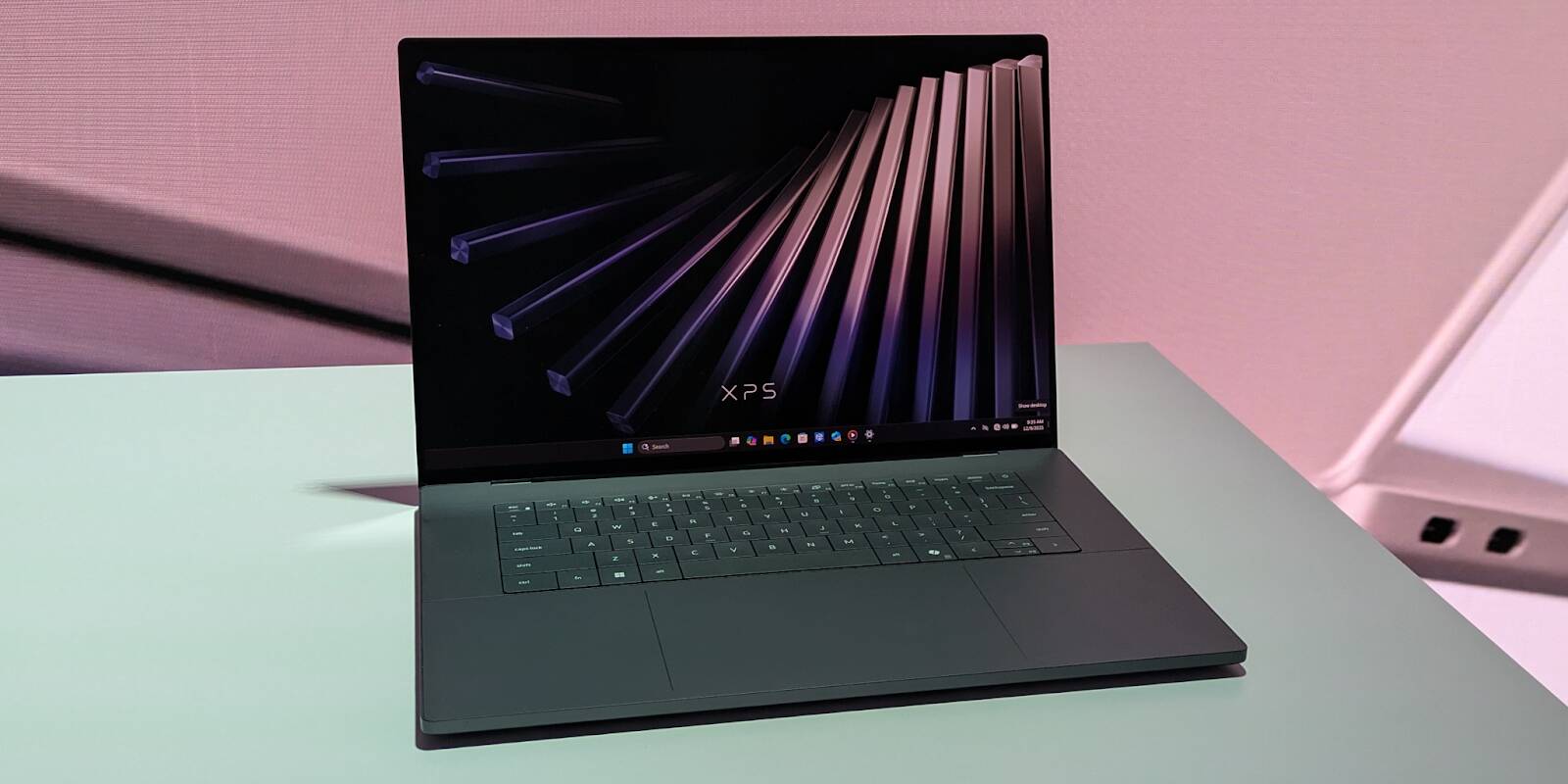
Dell XPS 14 - Click to enlarge
Available for sale right away, both laptops will be powered by Intel “Panther Lake” CPUs, ranging from the eight-core, Intel Core Ultra 5 325 on the low end to the 16-core Intel Core Ultra X9 388H on the high end (the 388H will be available at a later date). You’ll be able to configure them with up to 64GB of LPDDR5x RAM that runs at up to 9600 MT/s and up to a 4TB PCIe 5 SSD.
The Dell XPS 14 weighs just 3 pounds (1.36kg) and is a mere 0.58 to 0.6 inches (15.2 mm) thick. It’s available with either a 1920 x 1200 panel that has 500 nits of brightness and covers 100 percent of the sRGB color gamut or a 2880 x 1800 OLED touch screen panel that also hits 500 nits of brightness and offers 100 percent of the much-wider DCI-P3 color gamut, along with an impressive 1,000,000:1 contrast ratio.
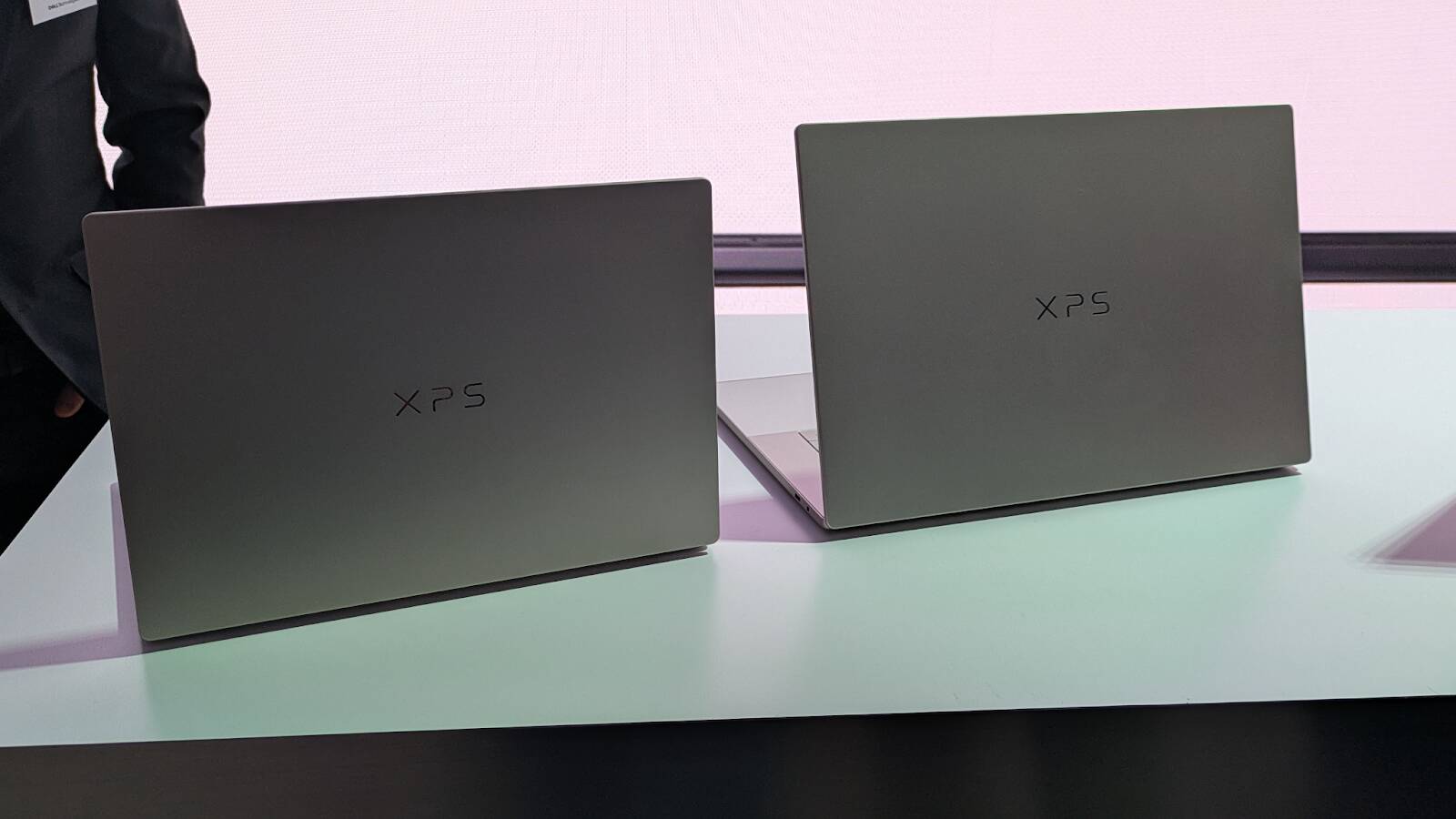
Dell XPS 14 and 16 - Click to enlarge
- Dell scoffs at breach, says miscreants only stole 'fake data'
- Dude, you got a Dell, period! RIP XPS, Inspiron, Latitude, Precision
- Patch now: Millions of Dell PCs with Broadcom chips vulnerable to attack
- Dell says Windows 11 transition is far slower than Win 10 shift as PC sales stall
The Dell XPS 16 starts at 3.65 pounds and is the same 0.58 to 0.6 inches thick. Its 16-inch display is available with either a 1920 x 1200, 500-nit panel or a 3200 x 2000 OLED touch panel. The base panel promises 500 nits of brightness and reproduces 100 percent of the basic sRGB gamut, while the OLED panel has the same peak brightness but reproduces the wider DCI-P3 gamut at 100 percent, along with a 1,000,000:1 contrast ratio.
Interestingly, the LCD display on both models has a variable refresh rate that’s controlled by the system’s “smart power management.” It automatically adjusts the refresh rate from 120 Hz down to as low as 1 Hz, depending on the type of content you’re viewing. So video and games get the highest while reading emails gets the lowest, most power-efficient mode.
According to Dell, the XPS 14 and XPS 16 lasted “up to 27” hours on a charge when streaming Netflix at 4K using a 250-nit brightness setting. The company also claims that, at 150 nits of brightness and playing FHD video, the XPS 16 lasted an impressive 43 hours and 20 minutes and the XPS 14 endured for 40 hours and 27 minutes.
The XPS 14 and 16 are available for purchase on Tuesday with starting prices of $2,049 and $2,199 respectively in the US. A 13-inch XPS 13 will come later this year. ®