'I needed them and they were there' - when young players find new homes
BBC Sport explores how young footballers build bonds with second families when they leave home to sign for a new club on their path to the top.
'I needed them and they were there' - when young players find new homes
Media caption,
'They are definitely second parents to me' - how football host families work
ByDaniel Austin
BBC Sport senior journalist
Shortly after signing for Brentford, teenage forward Michel Boni sustained an adductor injury that left him with difficulty walking and kept him out of action for three months.
He had moved away from home after his transfer, and with his development being dealt a significant blow at a crucial point, did not have the support of his family to call upon.
But what he did have was the relentless backing of Tiffany and Steve, a married couple who just weeks before were total strangers to him.
The pair are Boni's host family - people who have signed up to take in young footballers who join a new club, care for them in a safe home environment, and give them the best platform possible to pursue a professional career.
"I really needed them and they were there," the 17-year-old says. "I had never gone through that, so it was really difficult. Them reassuring me was was huge.
"Having them means I can go home to a safe place, rest, recover, and focus on what I want to focus on."
So how can total strangers build up the kind of affectionate, trustful bond that allows young players to go on and thrive at the top level?
Premier League dreams - when young footballers find new homes
Watch the full video on iPlayer
'I feel able to express myself'
When Brentford were relaunching their academy in 2022, they set about building a host family programme designed to make players signed from beyond the local area feel as settled and supported as possible, akin to initiatives run by most other Premier League clubs.
They posted adverts on social media and through letterboxes, inviting people to apply to take in young lads requiring a helping hand on their path to potential greatness.
"It's daunting leaving home at 16," says Michel. "Being with your parents is all you've known. But sometimes you have to make sacrifices.
"Tiff and Steve are lovely people to be with. When I first arrived, they told me some ground rules, how they want me to be around the house. Now they support me in everything.
"I played at the GTech Stadium recently with the under-21s and straight away they were asking if they could come and watch. It shows how committed they are.
"Whenever something is on my mind I feel like I'm able to express myself, talk to them and open up, and they listen. They are definitely second parents to me."
'It keeps you young'
Becoming a host family can be a long process, and much planning goes into pairing players with the right people.
"When families apply, we look for potential red flags as well as traits that might be beneficial," says Rachael Abebrese, Brentford's host family co-ordinator.
"I've developed a natural sense - I can go into a home and quickly know if it will feel warm for a player.
"We look at their motivations and conduct a very robust report which follows a private fostering approach. It is rigorous.
"We have a matching process - I get to know a player and get a gist of who they would get along with. Some players will identify things they do or don't want, like pets.
"Most of the time it works. The majority of the boys this season decided to stay with their host families, even though they had the opportunity to move out and rent their own apartments."
Some host family units are made up of a mix of cultures.
Boni and Nate Ogungbemi, the two academy players living with Tiffany and Steve, are British born but their heritage is Ivorian and Nigerian respectively.
The couple have made a conscious effort to understand and embrace the differences between themselves and the two boys living with them.
"It's just learning and being open to what's out there," Tiff says. "In the very beginning we would all talk about religion, politics, culture. I want them to feel happy and safe.
"They have introduced us to their cultures, and we have been trying to offer them food that their mums would do - I've tried making jollof rice.
"My own children have left home and I miss them, but now I've got people here that I can care for. Having young people around you keeps you young."
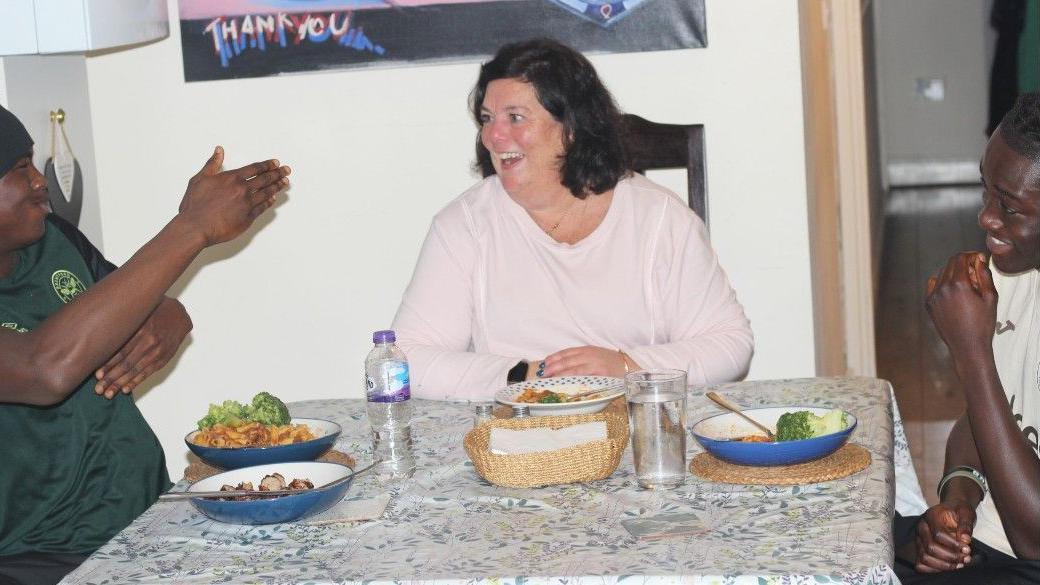 Image source, BBC Sport
Image caption,
Every evening in her kitchen in west London, Tiffany comes home from work and sets about cooking a healthy meal for two teenage athletes she has no relation to
'Funny and always full of life'
Some clubs eschew the host family approach in favour of a boarding system, in which players live together in dormitories on club property, the most famous being Barcelona's La Masia.
"There are strengths and weaknesses to both models," says Sam Bayford, Brentford's academy head of safeguarding.
"The reason we went with our model is that we want to give the players a real break, a geographical and psychological separation rather than living with and sleeping next to the lads they've been training with all day."
Adolescence is a key time for personal, physical and technical development in young footballers - done right, the management of an academy player's living situation can propel them forwards.
From age 15 Theo Walcott spent two years living at Darwin Lodge, a boarding house run by Southampton until 2010, which the former England international credits with underpinning his successful career.
Walcott lived at the Lodge alongside players like Adam Lallana, Nathan Dyer, and Leon Best, and shared a bedroom with five-time Champions League winner Gareth Bale.
"Being around the other players all the time I found really hard at the start," the former Arsenal winger tells BBC Sport. "But the environment was built to be like you were in a proper home.
"When you have a lot of good players in the same age group around each other constantly every day, you can feed off each other, always willing to do well together.
"People would act silly sometimes. You would come home and the lights would all be off and you'd know you were in trouble because Gareth and a lot of the other players would be waiting with their underpants on their head and batter you with pillows! You'd have to dart to your room but luckily I was quick.
"Put us all together in a room even now, it's like we saw each other yesterday."
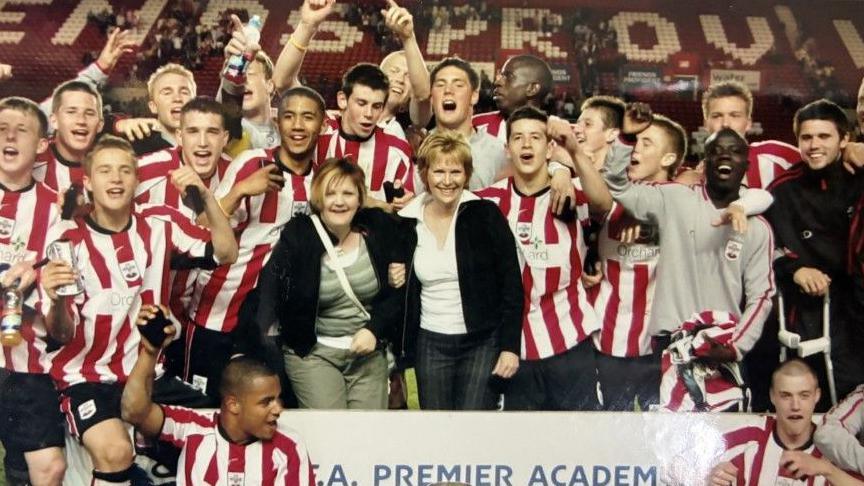 Image source, Julia Upson
Image caption,
Julia Upson (centre, wearing black and white) was a key figure in the development of Gareth Bale (above her left shoulder) and Adam Lallana (two to the right)
Darwin Lodge was run for more than a decade by Julia Upson, who took care of up to 20 young players at a time, and who Walcott and many others have maintained a close relationship with.
"99% of the time everybody got on, bearing in mind they lived with each other, trained with each other, and then had a match together," Julia says. "They were funny and always full of life.
"They all had the same level of care. I think that system is a really good idea - the camaraderie they have with each other is so good.
"I could more or less tell who would make it as a professional and who wouldn't by the way they acted at home. The percentage who made it is really small – 2-3% maybe.
“When one of the boys was released I felt extremely sad. My only wish was that they went on to be good people in all aspects of life.”
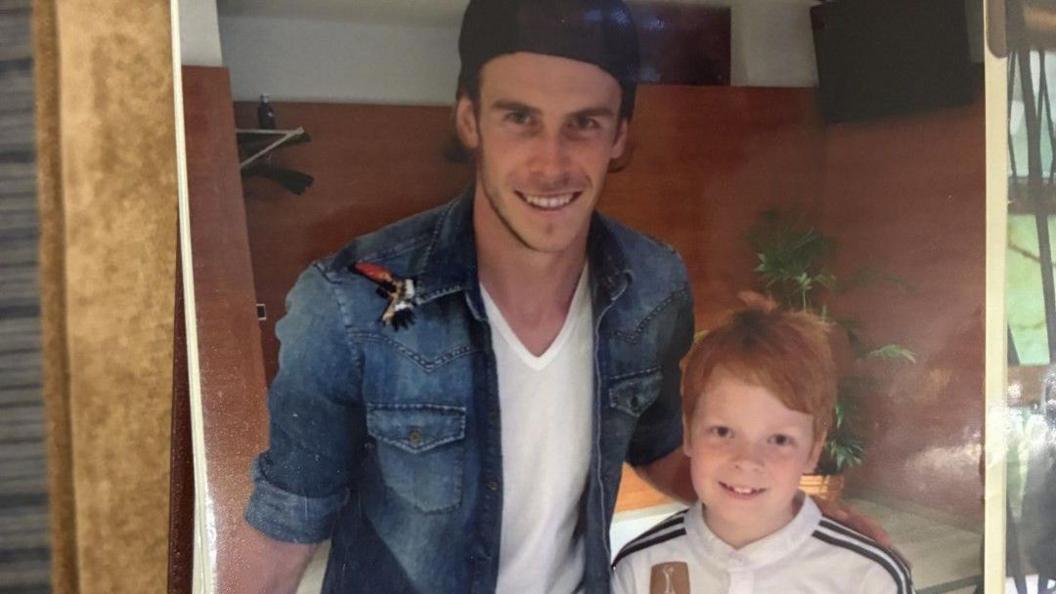 Image source, Julia Upson
Image caption,
Julia has maintained her bond with players including Gareth Bale, who provided her and her grandson with Real Madrid tickets when the family visited the city
'We'll always be in touch'
Some young players are signed from abroad, presenting even greater potential challenges regarding homesickness and difficulty settling.
"At first it felt very different, but after a while it just becomes your normal life," says 19-year-old Julian Eyestone, a goalkeeper who is part of Brentford's first-team set-up.
He lived with a married couple and their three young children in Ascot after moving to the club from Dallas, Texas in 2024.
"To them I was like their big brother - they wanted to play football in the park, or basketball in the driveway, and they started to come to me with their bickering and their fighting. One of them is even a little goalkeeper at Brentford himself now, which is really nice.
"From my first day with that family to my last, I was able to focus on my football and not sorry about anything else.
"I live in my own apartment now but we keep in touch and I bought them all presents and spent Christmas with them last year."
The depth of the bonds shared by host families and young footballers means the connection often lasts way beyond the end of their careers.
"If I get my pro contract, we'll see where's best for me to live - I do want to stay with Tiff and Steve", Michel says.
"Even if and when I do leave, 100% we'll keep in touch. They have done a lot for me and I'll always be grateful for that."