If there is an eternity, I will be looking for you throughout it
SOURCE:Sydney Morning Herald|BY:Adam Zwar
Acclaimed writer/director Amanda Brotchie, best known for The Letdown, Gentleman Jack, and Lowdown, starring her husband Adam Zwar, died of cancer last month aged 55. Here, Zwar delivers his tribute to her.
On the afternoon of June 2, 2002, I was happy. There was no reason to be, and I’m not usually an optimistic person, so it felt great, but strange. The St Kilda Film Festival Awards were that night, and I’d already been told we hadn’t won because one of the judges had very much hated our short film Wilfred. And yet there I was, bouncing around that apartment.
That night, I arrived at the Palace Theatre, took my seat, and seconds later a woman sat down eight seats away. A minute passed. For no real reason, I leaned forward and looked down the row at her at the exact moment she leaned forward and looked back at me. In her memory of the event, she felt it was a serendipitous connection between two people. Whereas all I remember was, “Oh no, I’ve been caught checking her out.”
Amanda Brotchie and Adam Zwar filming Lowdown.
At the after-party, the woman came up to me and said she was disappointed that Wilfred didn’t win best comedy. She said her name was Amanda and I asked if I could buy her a drink. I was surprised she said yes. A little later, she excused herself to talk to other people and, as she walked away, I remember thinking: “That’s her. That’s the one.”
Dad always said, “Son, when you know, you know”. But Dad also gave Christopher Skase a reference saying he was a fit and proper person to buy Channel Seven, so I took that rule with a grain of salt. But here I was. I knew. And I knew.
I tracked her down later and asked if I could buy her another drink. Again, she said yes. Again, I was surprised. There was another guy also interested in her that night. He asked for her number under the guise of organising a card game, which is Amanda’s weakness – she loves games nights. And as she gave him her number I was nearby, watching on, thinking, “There’s gonna be no card night, mate. No card night.”
Brotchie was a member of the band Not Drowning, Waving.
There was no card night.
Amanda and I went home to her place to watch the Big Brother finale, which she had taped. After that, we talked and talked. For some reason, the conversation got onto cricket and she correctly named the Australian batting order for the 1980-81 series against India, which of course meant we would have to move in together. Later, she would tell me that when I hugged her goodbye, she felt home. I felt the same.
We moved in together within six weeks, and I lived to impress her. In those early days we would lie in bed in the dark chatting until very late and I would try to make her laugh. When one of my jokes didn’t get the requisite vocal response, I would lean over and touch her cheek to see if she was at least smiling. If she wasn’t, that simple act ensured she did. It sounds creepy and manipulative now I’m saying it out loud – but it was lovingly creepy and manipulative.
When I first proposed, she said something along the lines of “wow, that’s a big step”. Now, an emotionally mature person would’ve responded by saying: “That’s completely fine. You take as much time as you want. I’ll be here when you’re ready.” But I said: “No, don’t worry about it then. I’m sorry I asked!”
I didn’t propose again until there was assurance – probably in writing and notarised – that she would say yes.
When we got back from our honeymoon, she acknowledged that an unwelcome pattern had emerged in her directing career. She would work with the writer on their scripts. (Her script editing always made scripts soar beyond their potential.) Then, just as the film was about to be financed, the producers would decide to replace her with a mediocre man – who no one would ever hear from again. And if we did hear from them again, it’s because they were selling duplexes in Parramatta. This was the playing field for Australian female directors in the late ’90s, early 2000s. Even if they’d won an AFI award as Amanda had. But she never held grudges. In our household, I ran the office in charge of grudges. It was an efficient operation. Particularly, when it came to anyone who’d wronged her. The receipts were logged and noted.
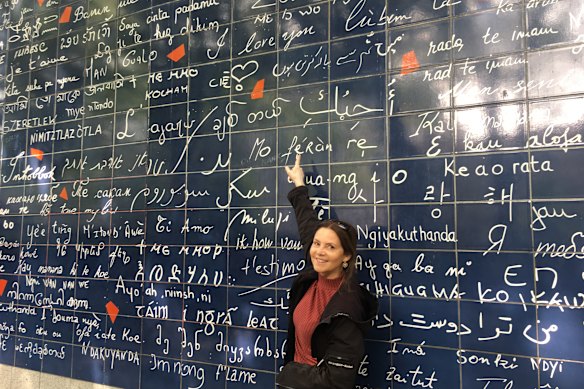
Brotchie studied a PhD in linguistics.
Sometimes, I would randomly bring up slights others had inflicted on her. And she’d say, “Oh that. I’d forgotten about that. Can’t you let it go?” And I’d say, “No. I’m German, babe. This is what my people do.”
So with her directing career going through a quiet period, Amanda decided to return to uni to do a PhD in linguistics, where she would live on a remote island in Vanuatu, creating a writing system and grammar for a language that had never been written down before, and then analysing its narrative structure.
To do this, she would need to learn Bislama – the lingua franca of Vanuatu – so she could communicate with the people about the language they were trying to preserve – and she would live in a hut in an isolated village for five months with one tap, malaria and 10,000 giant centipedes. If one of the centipedes stung you, the pain sensation was similar to a hot needle repeatedly stabbing you in the arm for three hours.
When Amanda told me of the plan, I remember being confused about why she was doing it. But I was looking at it from my point of view. What I hadn’t quite got my head around was that I’d married an adventurer. This was her métier. She loved it. She loved the challenge, the new experiences, the sleeping in the jungle. Whereas I love a concierge and a turndown service.
Before she left, I gave her a handmade book filled with blank pages for her to write a diary of her adventure. I have that diary at home. About a quarter of the way through, she writes about me visiting the island and describes me getting off the plane and looking (quote) “smaller than she remembered”. Which is not the compliment it sounds like.
When she returned home, we wrote the TV show Lowdown while she finished her PhD at the same time. I have memories of her sitting at her computer, her whole torso shaking with laughter. That generally meant she wasn’t writing the PhD. She was writing Lowdown, or more particularly, the character of Alex, which she used to exorcise everything that frustrated her about me.
Amanda loved learning. She was always curious. And honoured every challenge with a thoroughness and attention to detail. As Doctor Who showrunner Russell T. Davies said of her: “She was bright and sharp and kind and questioning and always determined to make things better, better, better. Ooh, she could be beady, peering at the script, niggling away at something … until we all realised she was right! God, we adored her.”
Her perfectionism wasn’t pervasive. It was a happy perfectionism which got the job done.
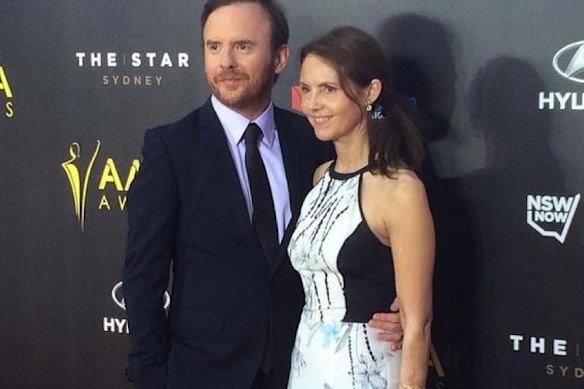
Zwar and Brotchie at the AACTA Awards in 2013, the year The Lowdown won Best Television Comedy Series.
That’s why not getting pregnant confounded her. We went on an Odyssean journey to get pregnant. Miscarriages, IVF, donor eggs. Finally, we decided to move to the US to adopt. We were matched with a birth mother through an agency. Met her in Florida. Flew her to LA. Paid for her medical expenses. Amanda took her under her wing, looked after her cat, and made her life blissful. The woman had the baby. She gave it to us. We were parents for two days and then the woman decided she wanted the baby back. We were gutted.
But after spending a week on the couch, crying, fate intervened and Amanda’s directing career took off. First, she directed Girlboss for Kay Cannon, then Picnic at Hanging Rock, A Place to Call Home, How to Stay Married, The Letdown with her friends Sarah Scheller and Alison Bell. After that, England and Sally Wainwright came calling with Gentleman Jack, Renegade Nell and Riot Women, and then Russell T. Davies tapped her for Doctor Who.
Amanda suffered from depression. She went through a lot of hardship. She pulled herself out of it with meditation, structure and Wordle. And she was so happy in the final five years of her life. She loved her job. She loved her friends and family. She was so proud of her nieces Taylor and Brit. And nephew Cody. She said they were like oxygen to her. And then there was her sister, Rebecca. Rebecca was Amanda’s rock. The Dean Martin to Amanda’s Jerry Lewis. No matter where Amanda flew in her life – physically or emotionally – Bec and her husband, Daryl, were her safety net: they were there with emotional support, a bed, excellent advice, and sometimes a truck to carry stuff.
There was her pharmacist father Norman, whose precision, sense of style and love of cricket she admired and inherited. And then there was her mother, Joy, actress and director. As a female director, she put cracks in the glass ceiling so Amanda could soar.
Some quick facts: Amanda had an other-worldly sense of smell – that she could also use to detect bullshit. She never called it out directly. Instead, she’d ask calm, reasonable questions, gently backing liars into a corner like a sweet, five-foot-three Perry Mason, until they either told the truth or burst into tears.
She never dissed anyone’s creative output, she’d just refer to things as_“not being her cup of tea”_ – which, coming from her, was devastating. She had a profound sense of justice. She liked things to be symmetrical. And she had an extraordinary ability to make people feel seen.
Amanda smiled at me whenever I walked into any room she was in. A smile that never stopped taking my breath away. Even when she was very sick, she would smile whenever I turned up. A few months ago, I thanked her for doing that and told her how much it meant to me. I’m not sure she was aware she even did it. The honour of having that in your life – the agony of it being taken away.
So here we find ourselves in an Amanda-less physical world. That smile, that laugh, that wit, and that unflappable happiness is no longer here.
And when I say unflappable. Not even dying rocked her. Five days before she took her last breath, the palliative care doctor told her, “Unfortunately, all we can do now is make you comfortable.” Amanda said, “Not unfortunately. I’ve had a great life. And now I’m getting ready for the next adventure.” The author Bradley Trevor Greive said it best when he called Amanda: “A deeply serious thinker. Slight of frame, huge of heart, she bent light with her gaze and held countless worlds inside her mind.”
On her last night of being conscious, she said she was so happy and so grateful. And here we are – so grateful and sad. Sweetheart, if there is an eternity, I will be looking for you throughout it. To find you and hold you again would mean everything to me. Goodbye, my beautiful girl.