Indian students placing their bets on destinations beyond the Big 4: Here’s why
SOURCE:Times of India|BY:SASWATI SARKAR
Indian students are still looking abroad, but they are choosing differently. The US, UK, Canada and Australia now come with higher costs, stricter visa checks and too many unknowns. So many are turning to places that feel more workable—Germany for affordability, New Zealand for stability, and the UAE for proximity and job links. It is study abroad, with fewer surprises.
Indian students are still looking abroad, but they are choosing differently.
Indian students are redrawing the study-abroad map with a calculator in hand. Fresh data tabled by the Ministry of External Affairs puts the total number of Indian students overseas at 1,882,318 (as on January 1, 2025)—a headcount spread across 153 countries and, crucially, one that now includes school-level enrolments alongside university/tertiary students. In that context, the old Big Four—the US, UK, Canada and Australia—still matters, but it no longer gets to be the default. The pitch that once worked—English-medium degrees, brand-heavy campuses, and post-study work routes that felt legible—now competes with visa friction, higher fees, and a harsher cost-of-living reality.That shift sits at the heart of Beyond Borders: A New Chapter in Global Student Movement, a report by Leap Scholar, an AI-powered study-abroad ecosystem which draws on application and survey data from over 3 million students.The report flags a clear re-ranking towards “value” destinations—Germany, the UAE and New Zealand. In these countries, the proposition is less about prestige and more about price-to-outcome: Affordable excellence, clearer pathways, and fewer unpleasant surprises mid-journey.
The Germany arithmetic
Germany is becoming popular with Indian students for the most unromantic reason possible: It adds up. In fact, it is winning Indian students with a proposition that survives a family budget meeting.
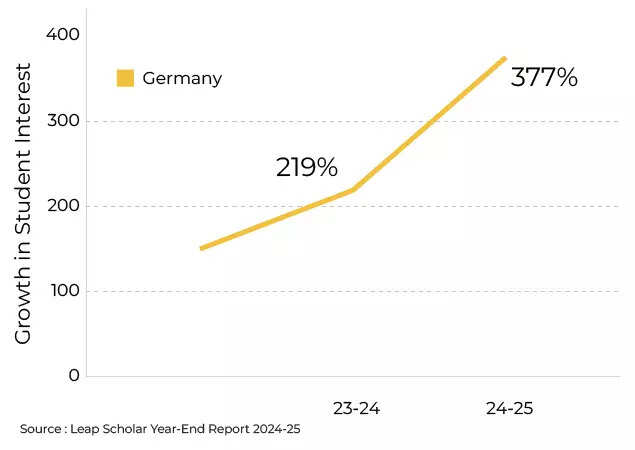
The Leap Scholar report tracks how quickly the pivot is happening: Interest in Germany rose 219% in 2023–24 and then surged 377% in 2024–25.
Student interest in Germany surged 377% in 2024–25.
The same report notes Indians are now the largest international student cohort in Germany, at nearly 59,000. It points to the core reason: Most public universities are tuition-free, with students typically paying only about USD 1,500 in administrative charges for a full two-year programme.
Cost of studying in Germany
Germany made the transition less scary by expanding English-taught courses, especially in STEM, so students don’t feel they’re signing up for a language battle on day one. Then comes the practical clincher: Graduates can get a residence permit for up to 18 months to look for qualified work—and can take up any type of job during that period. Add to this a broader policy mood that is openly about attracting skills—the government’s own explainer of the new Skilled Immigration Act.
It is framed around making it easier for skilled workers to come to Germany.
New Zealand’s appeal lies in manageability
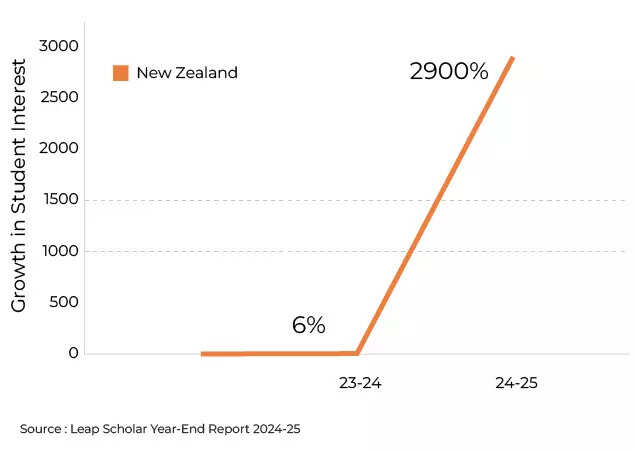
New Zealand’s spike in Indian student interest looks less like a PR victory and more like a collective pivot away from uncertainty. The Leap Scholar study captures the turn in blunt numbers: Interest in New Zealand was almost flat at 6% in 2023–24, then shot up by 2,900% in 2024–25.
Interest in New Zealand shot up by 2,900% in 2024–25.
In plain terms, this is not students browsing; this is students reordering the shortlist when the Big Four starts feeling like high cost plus high friction.
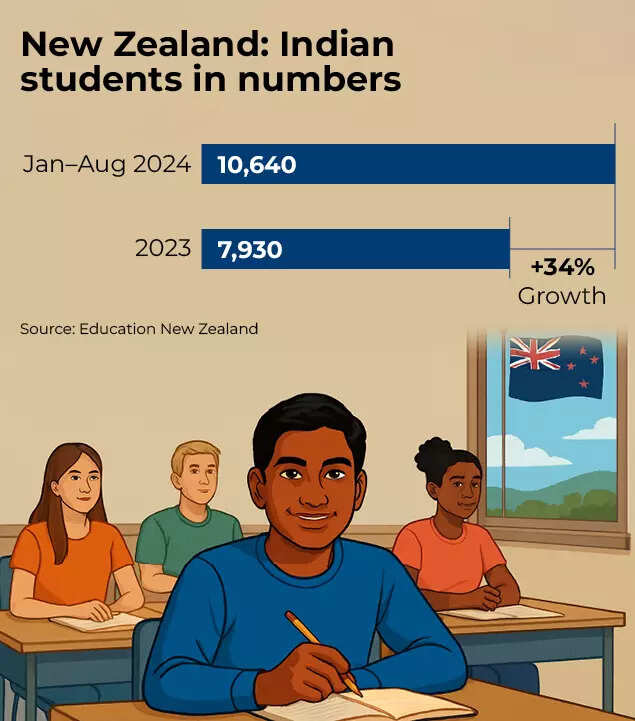
It is a pattern that suggests Indian students are actively re-ranking destinations, not merely exploring alternatives. That surge is in line with what Education New Zealand, the government education promotion agency, is reporting on the ground. According to the agency, international student enrolments from India grew 34% between January and August 2024, rising to 10,640 enrolments, compared with 7,930 across the full year of 2023.
University enrolments alone grew by around 64%, signalling that the interest is concentrated in degree-level study.
International student enrolments from India grew 34% in New Zealand between January and August 2024.
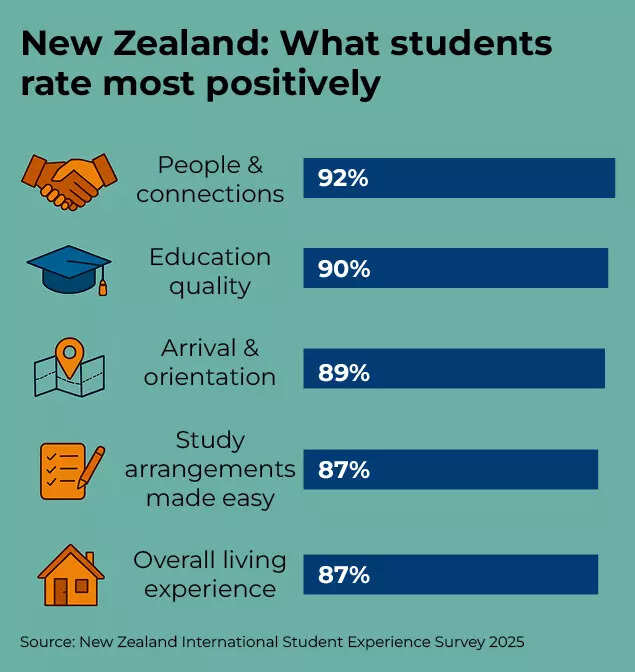
The crux of this story is that experience is matching expectations. The New Zealand International Student Experience Survey 2024 found that 86% of Indian students rated their overall experience positively. The 2025 edition of the same survey deepens that picture: globally, students singled out the quality of connections (92%), quality of education (90%), and arrival and orientation support (89%) as standout strengths of studying in New Zealand.
Visa processes, often the weakest link elsewhere, are improving here—80% of students rated their visa application experience positively, while 74% were satisfied with processing times, up from 64% the year before.
What internatoinal students like most about New Zealand.
New Zealand is being chosen not because it dazzles, but because it behaves predictably: Clear rules, improving systems, and a student experience that feels designed rather than improvised. In today’s study-abroad climate, that steadiness has become its biggest draw.
UAE’s growing pull for students: Cost, comfort and careers
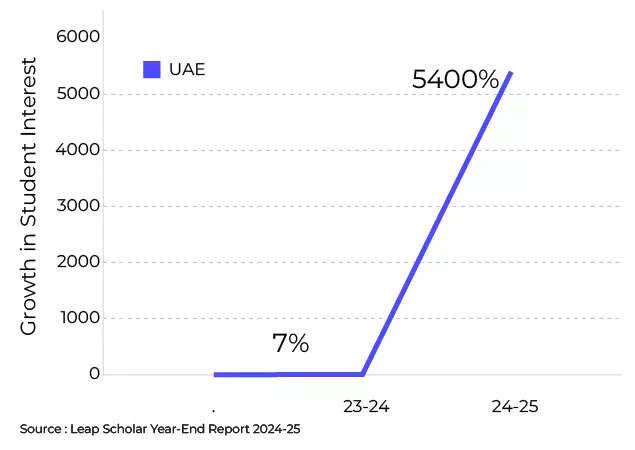
The UAE is fast emerging as an unexpected—but increasingly logical—study-abroad destination at a time when traditional choices feel costlier, slower and more uncertain. Long seen primarily as a work destination, the country is now positioning itself as a place to study with intent. For Indian families weighing education as an investment rather than an adventure, that recalibration matters. This shift shows up sharply in Indian student behaviour. The Leap Scholar survey describes the UAE’s rise as a “stunning emergence”. Interest among Indian students grew modestly by 7% in 2023–24, before exploding by 5,400% in 2024–25—a near 55-fold jump in a single cycle.
Interest among Indian students for UAE exploded by 5,400% in 2024–25.
Leap’s analysis points to a deliberate repositioning: The UAE has used education free zones to host international branch campuses at competitive price points, turning what was once a peripheral option into a front-rank consideration. For students targeting post-study employment in the Middle East, the UAE now looks less like a detour and more like a direct route.Official data from the UAE underlines how central Indian students have become to their strategy.
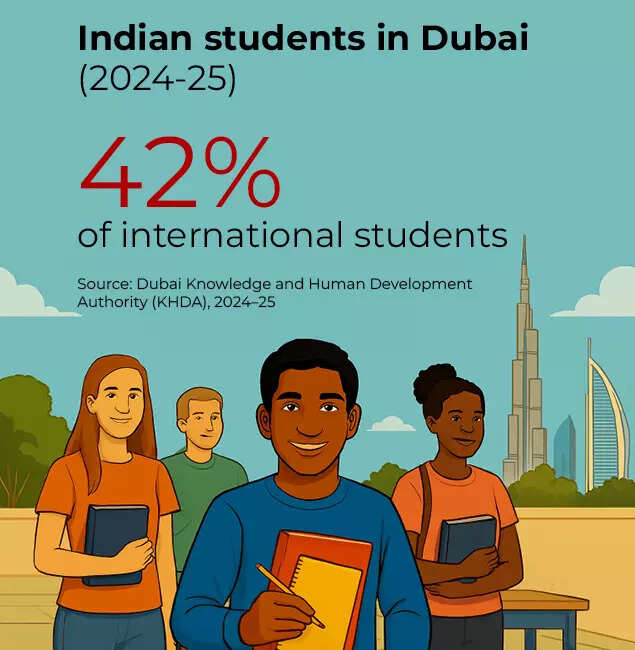
According to Dubai’s Knowledge and Human Development Authority (KHDA), Indians account for 42% of Dubai’s international higher-education intake in 2024–25.
Indians account for 42% of Dubai’s international higher-education intake in 2024–25
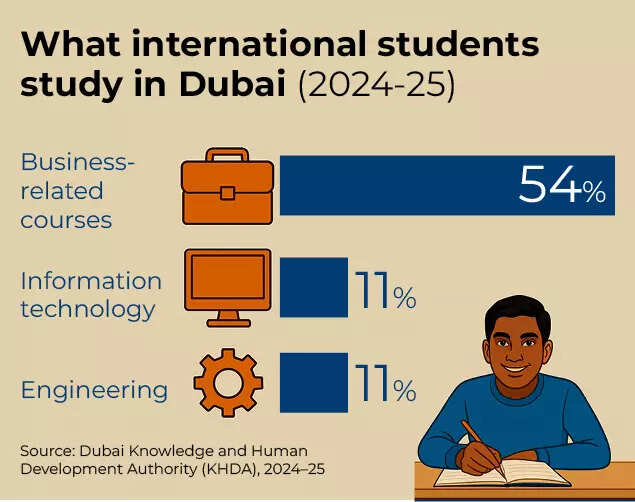
Programme choices mirror employability logic: 54% of international enrolments are in business-related courses, followed by information technology and engineering at 11% each, KHDA data shows.
Subject choices of international students in Dubai mirror employability logic.
Indian influence extends into classrooms too—29% of faculty members in Dubai’s licensed institutions are of Indian origin, the highest share of any nationality.
Why the Big 4 feels less welcoming
What has changed in the Big 4 is not ambition, but atmosphere. The formal language is bureaucratic—integrity measures, system sustainability, quality controls. The lived reality for Indian students is simpler: Studying abroad now feels less like an invitation and more like an audition with moving goalposts.Across the US, UK, Canada and Australia, visa regimes have shifted from facilitation to filtration. The intent is not hidden.
Governments are signalling that student routes are no longer backdoors to migration, and that only those who can clearly justify academic intent, financial capacity and post-study plans will pass. For many applicants, the uncertainty itself is the deterrent.In the UK, the tightening of dependant rules has altered family calculus overnight. For a generation of Indian postgraduate students—many married, many mid-career—the study decision was never individual.
Removing dependants from the equation reframes the choice as a personal sacrifice rather than a household investment. Visa rules here do not just regulate entry; they reorder life plans.In Canada, the shift has been structural. Caps, housing-linked scrutiny, and sharper institutional oversight have transformed what was once the most welcoming of destinations into the most procedural. The message is unmistakable: Volume is the problem, and control is the solution.
For students, that translates into fewer seats, higher compliance anxiety, and diminished margin for error.The US, while rhetorically open, has doubled down on intent scrutiny. Interviews probe credibility, ties, and long-term plans with renewed intensity. The visa is still possible—but it feels conditional, situational, and personality-dependent. The degree may last two years; the uncertainty begins much earlier.In Australia, rising visa fees combined with stricter “genuine student” tests have redefined access itself as a premium. The cost is no longer just tuition; it is proof—of seriousness, solvency, and suitability.Together, these shifts explain why Indian students are not abandoning the Big Four, but they are hedging against them. When rules harden, certainty becomes currency. And students, like markets, follow where risk is priced more honestly.