After 35 years of ruling Iran, Ali Khamenei is running out of options fast.
The 86-year-old supreme leader is facing his most serious challenge yet. Protesters chant “death to Khamenei” rather than the regime’s traditional “death to America”.
Protests against him have entered their second week and spread to 340 places in all 31 provinces of Iran. At least 65 people are dead because of his response to the demonstrations, with the death toll expected to climb.
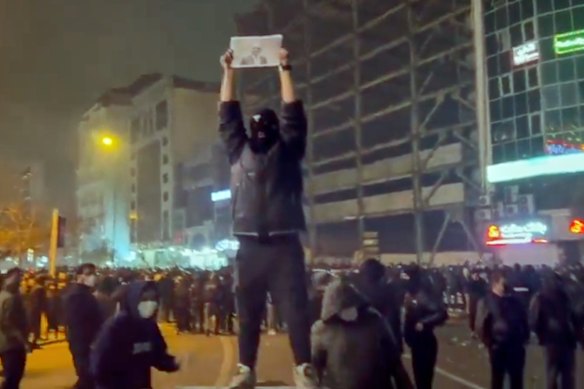
In this frame grab from video obtained by the AP outside Iran, a masked demonstrator holds a picture of Iran’s Crown Prince Reza Pahlavi during a protest in Tehran, Iran.Credit: AP
The revolt has engulfed small, economically devastated cities across Iran’s poorest provinces – places that should form the regime’s support base.
That is a key difference to the 2009 Green Movement, which was concentrated in Tehran, and the 2022 protests sparked by the death of Mahsa Amini, 22, who was beaten to death by Iran’s “morality police” for not wearing a headscarf.
Khamenei has always crushed dissent with brute force, which succeeded in 2009 and 2019, when protests were more concentrated geographically.
People in the capital and major cities are angry again in this new uprising, but the scale of demonstrations across small, impoverished cities suggests a breadth of fury that cannot be suppressed without casualties in the thousands.
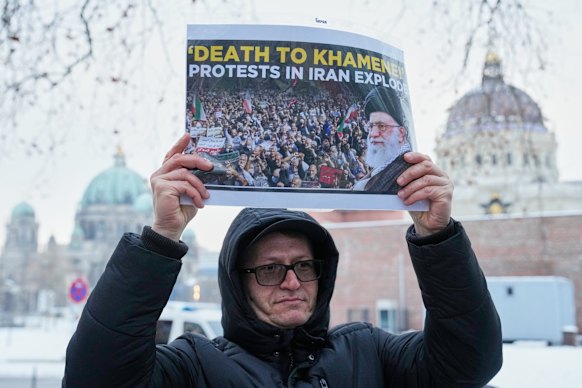
A protester in Germany supporting the Iran protests, showing a sign saying “death to Khamenei”.Credit: AP
The regime has made clear that demonstrators face execution or the threat of having military weapons turned against them.
But the ayatollah has doubts about the army and the police’s willingness to murder Iranians.
It was reported on Friday that he had transferred operational control to the fanatical Islamic Revolutionary Guard Corps (IRGC), suggesting fears that conventional security forces could fracture if forced to gun down their own people in mass killings.
This leaves him with a shrinking number of options to halt the protests, none of which guarantee the survival of the regime.
Khamenei could try to ease tensions through meaningful reforms.
He could release political prisoners, allow free assembly or even call a long-delayed referendum on the Islamic Republic’s future.
But the supreme leader is shackled by his own ideology. He has spent decades consolidating power around the principle of velayat-e faqih (guardianship of the jurist) – the notion that clerical rule is divinely mandated and non-negotiable.
To offer a referendum on the system’s legitimacy would be to admit it requires popular validation, undermining the theological foundation of his authority.
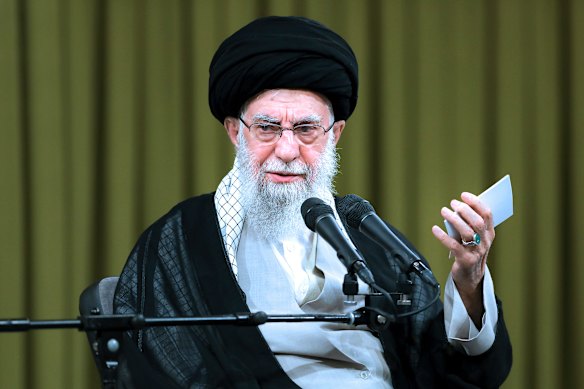
Official photo of the Iranian supreme leader, Ayatollah Ali Khamenei, who is now 86.Credit: AP
Any significant concessions could also be interpreted as weakness, potentially accelerating, rather than calming, the uprising.
A middle path involves cosmetic changes – firing Masoud Pezeshkian, the president, or other officials, announcing economic reforms, promising investigations into killings – while keeping the power structure intact.
This has worked before by buying time and dividing the opposition by appearing responsive to the protesters’ grievances. But this time, the supreme leader himself is the focal point of anger, which makes scapegoating subordinates ineffective.
The protests originated with merchants striking over the currency collapse caused by regime policies and corruption, rather than individual politicians who can be thrown under the bus.
Besides, ministerial reshuffles are unlikely to satisfy the rage driving people into the streets to risk death at the hands of the IRGC.
Rather than smoothing out domestic tensions, Khamenei could launch an attack abroad to rally nationalist sentiment.
He could justify his repression as a wartime security measure, as he did during June’s 12-day war between Israel and Iran that left Iran’s military infrastructure severely damaged.
Iran’s participation in naval drills with Russia and China could signal that an attack on US assets or Israel is on the cards.
But Iran’s military infrastructure was severely damaged in the 12-day war. Donald Trump has also made clear US retaliation against Iran would be devastating.
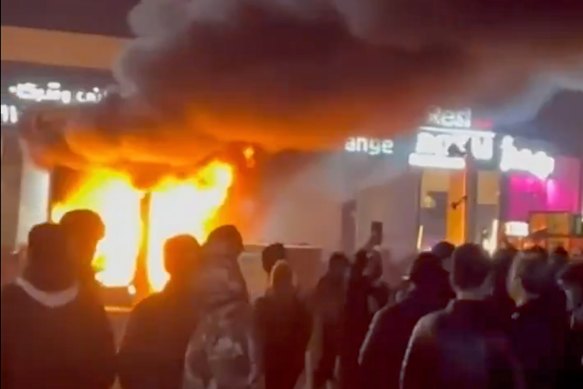
A frame grab from a video shows a fire as people protest in Tehran, Iran, on Saturday AEDT.Credit: AP
When people are protesting about the affordability of bread, it seems unlikely that wartime patriotism will be enough to end the demonstrations.
The protesters’ chants focus on domestic failures – “Poverty, corruption, inflation. We go until overthrow” – not hatred of America or Israel.
The prospect of Khamenei fleeing to Russia, as some ousted leaders such as Syria’s Bashar al-Assad have done, is highly unlikely.
At 86 and ailing, he is ideologically committed to defending the Islamic Republic. His entire adult life – from imprisonment under the Shah to supreme leadership – has been defined by revolutionary commitment.
He conceives of himself as God’s representative on Earth, making exile unthinkable.
Moreover, Russia – mired in its war in Ukraine and economically strained – may calculate that supporting a collapsing regime is not worth it. A deposed Khamenei in Moscow is a liability, not an asset.
The most dangerous path available to Khamenei is one he has reportedly considered before: racing to develop a nuclear weapon.
Loading
Iran has maintained that its nuclear program is purely civilian, but it has the technical capability to enrich uranium to weapons-grade levels within weeks if Khamenei issues the order.
This option carries catastrophic risks. Israel has made clear it would launch military strikes to prevent Iran from obtaining nuclear weapons, potentially with American support.
After years of economic mismanagement, tyranny and fanaticism, Khamenei has no good options left.
The supreme leader’s most likely path remains escalated violence – mass arrests, show trials, executions and overwhelming force deployed by the IRGC.
But whatever he does next risks collapsing his regime or an escalation of violence so severe it could turn his security forces against each other.