Is dark matter made of mysterious 'ghost particles?' Galaxy clusters could hold the answer
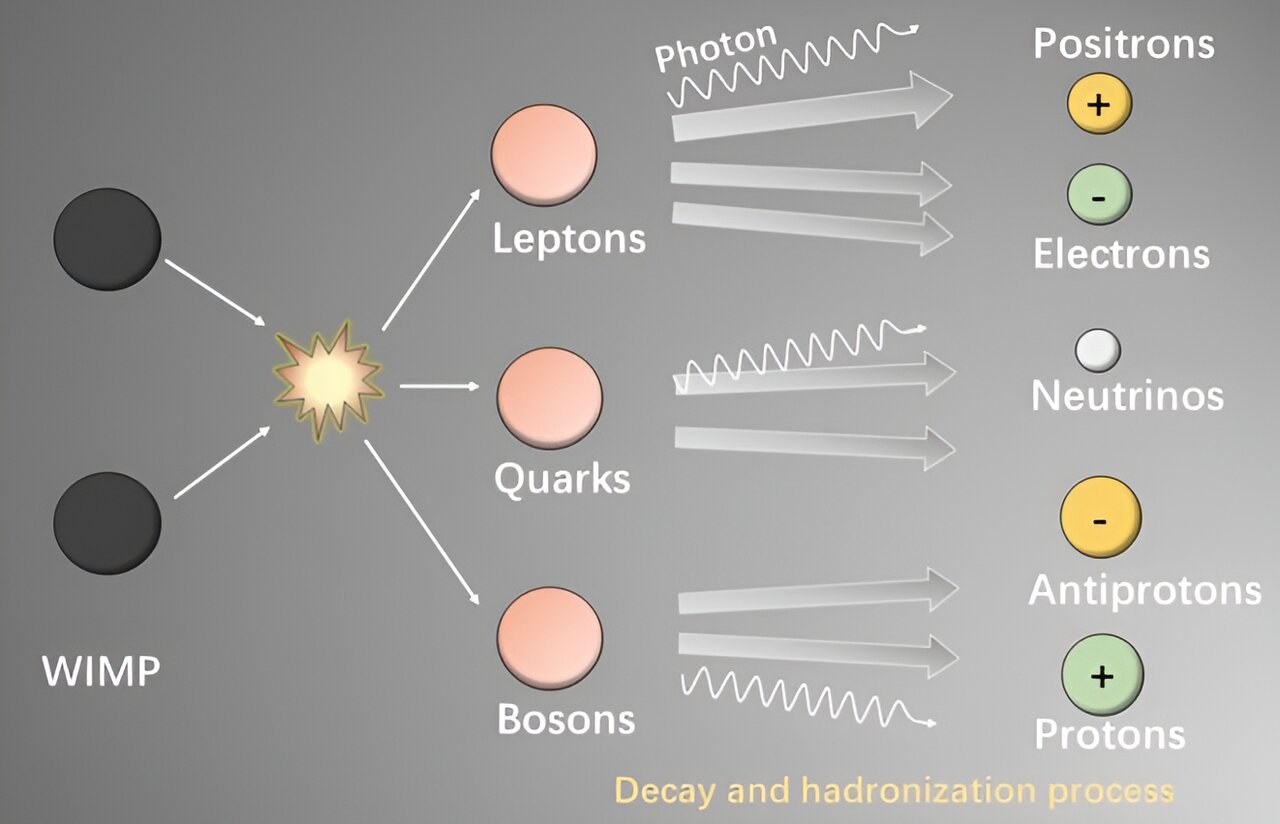
"WIMPs are still the leading candidate for dark matter, but billions of dollars of experiments have been done, only getting stronger and stronger upper limits, so alternative scenarios have to be considered."
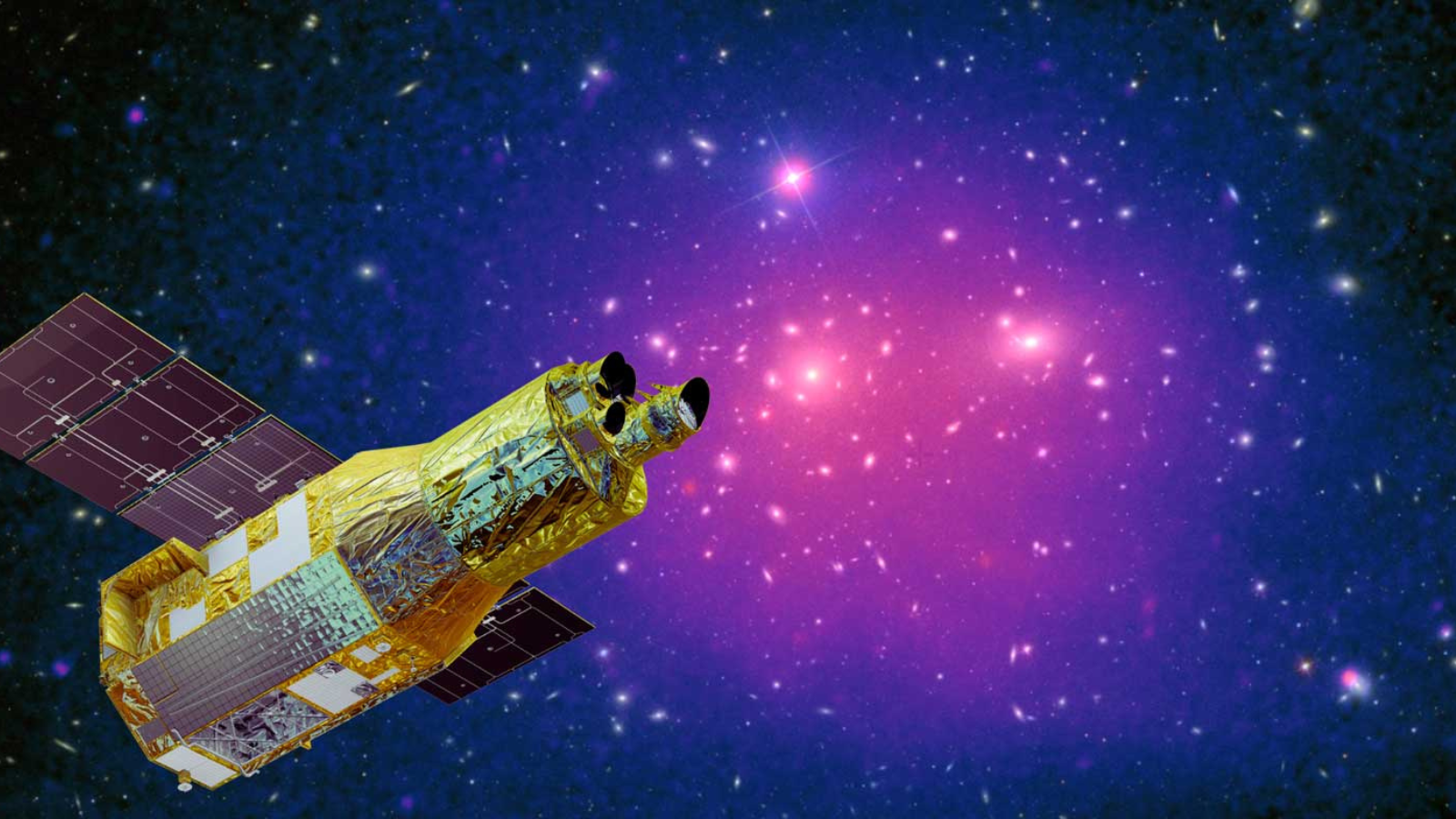
An illustration of XRISM studying dark matter around a galaxy cluster (Image credit: NASA)
If dark matter particles decay, then scientists could hunt for signs of this process, including X-ray or gamma-ray radiation or even emitted "ghost particle" neutrinos, in vast clusters of galaxies.
Not only could this finally reveal what particles comprise mysterious dark matter, but it could also help astronomers understand the universe's structure like never before. And new research suggests that NASA's X-ray Imaging and Spectroscopy Mission (XRISM) could play an important role in this hunt.
Dark matter poses a significant challenge for scientists because, despite comprising around 85% of the matter in the cosmos, it remains effectively invisible. This is because it doesn't interact with electromagnetic radiation, or light — or, if it does, the interaction is too weak to be detected. This has led scientists to suggest a whole host of hypothetical particles to account for dark matter, which go beyond the standard model of particle physics and the electrons, protons and neutrons that make up the atoms that compose all everyday matter, like stars, planets, moons and our bodies.
One particular dark matter model suggests that whatever particles make up this mysterious stuff, they undergo a process called decay. This involves large particles breaking down over vast timescales to lighter particles, releasing energy in the form of photons, the particles of light. One possible signature of this process that astronomers could hunt for are X-ray photons released when decay occurs. In fact, scientists may have already spotted this cosmic fingerprint in the form of an unidentified X-ray emission in the light spectra from galaxy clusters.
"Eighty-five percent of mass in galaxy clusters comes from dark matter, and we can model the dark matter radial distribution well," study team member Ming Sun, of the University of Alabama in Huntsville (UAH), said in a statement. "Thus, galaxy clusters are great targets for such a search as they are dark matter-rich and we know the dark matter mass in clusters well."