James Webb telescope spies a monstrous molecular cloud shrouded in mystery — Space photo of the week
In this James Webb telescope image, the gigantic molecular cloud near our galaxy's center appears as a canvas of pink and purple clouds set against a shadowy backdrop.
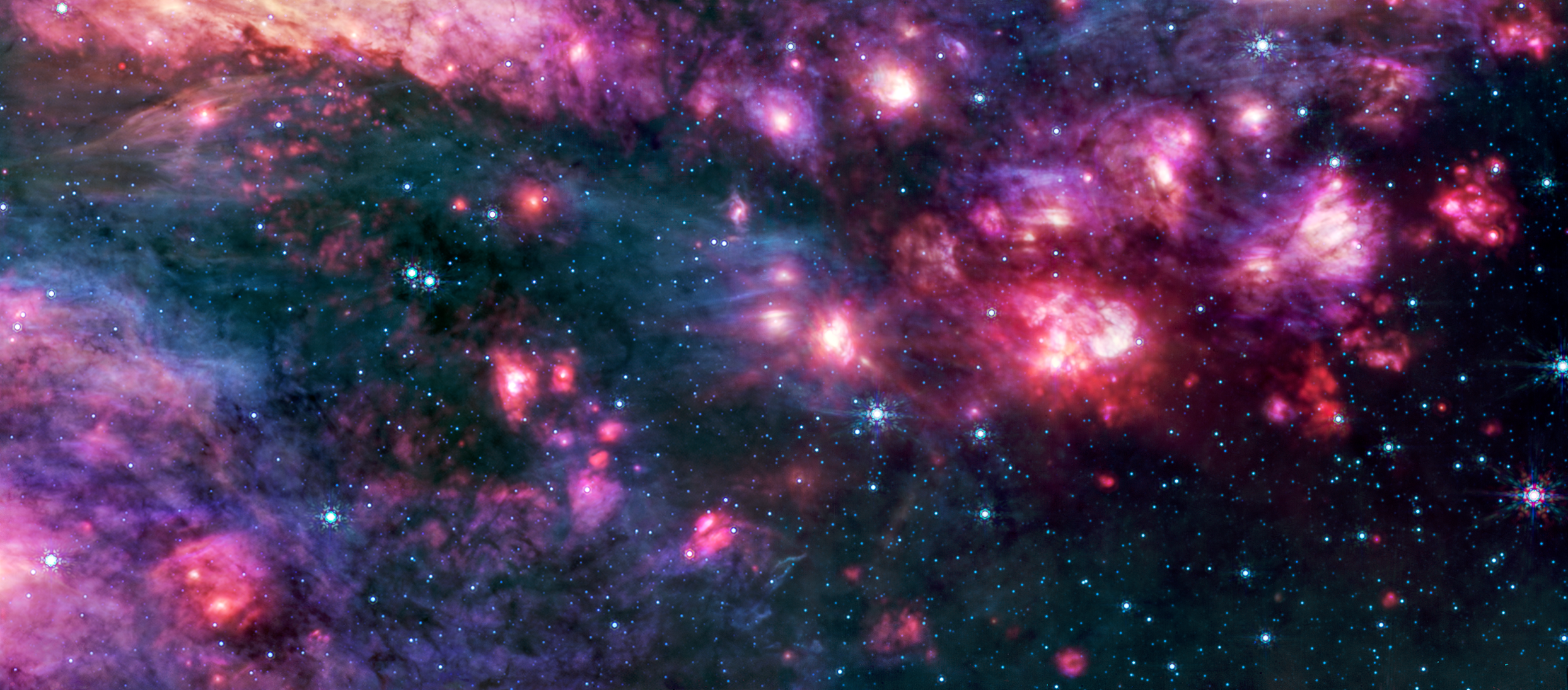
JWST's view of the Sagittarius B2 region in near-infrared light. (Image credit: NASA, ESA, CSA, STScI, Adam Ginsburg (University of Florida), Nazar Budaiev (University of Florida), Taehwa Yoo (University of Florida); Image Processing: Alyssa Pagan (STScI))
QUICK FACTS
What it is: Sagittarius B2 molecular cloud
Where it is: Roughly 26,000 light-years from Earth,, in the constellation Sagittarius
When it was shared: Sept. 24, 2025
But this giant star-forming region is shrouded in a mystery: how it has managed to produce 50% of the stars in the region, despite containing just 10% of the galactic center's gas.
Astronomers observed this super-efficient stellar factory using the James Webb Space Telescope (JWST), in the hope of finding some clues about its unusual productivity. This spectacular image is the telescope's mid-infrared view, captured by JWST's Mid-Infrared Instrument (MIRI).
In the image, the clumps of dust and gas in the molecular complex glow in shades of pink, purple and red. These clumps are seen surrounded by dark areas. Dark does not mean that these regions are empty or emit nothing; instead, light in these areas is blocked by dense dust that the instrument cannot detect.
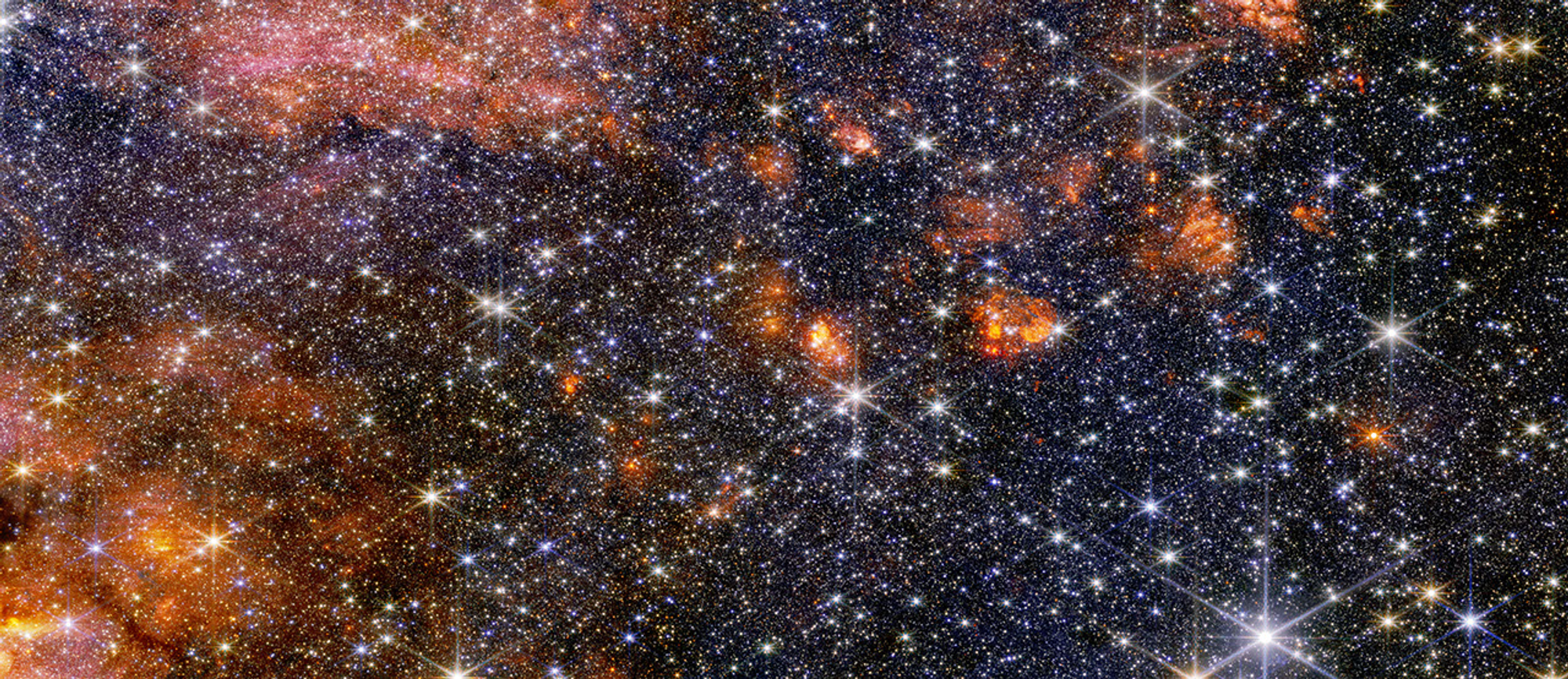
JWST's view of the Sagittarius B2 region in near-infrared light (Image credit: NASA, ESA, CSA, STScI, Adam Ginsburg (University of Florida), Nazar Budaiev (University of Florida), Taehwa Yoo (University of Florida); Image Processing: Alyssa Pagan (STScI))
RELATED STORIES
In star-forming regions like this one, warm dust and gas and only the brightest stars emit in the mid-infrared. This contrasts with the near-infrared image captured simultaneously by JWST's Near-Infrared Camera (NIRCam), which reveals an abundance of stars because stars emit more strongly in the near-infrared light.
In this MIRI image, the clumps on the right that appear redder than the rest of the cloud complex correspond to one of the most chemically complex areas known, as revealed by previous observations using other telescopes. Astronomers think this unique region may hold clues to why Sgr B2 is more efficient at star formation than the rest of the galactic center.