January belongs to Jupiter: See the king of planets in the night sky this month
SOURCE:Space.com|BY: Joe Rao
Jupiter currently shines as a brilliant silvery "star" in the constellation Gemini the Twins, low in the east-northeast sky as dusk slowly fades. You really should catch the show.
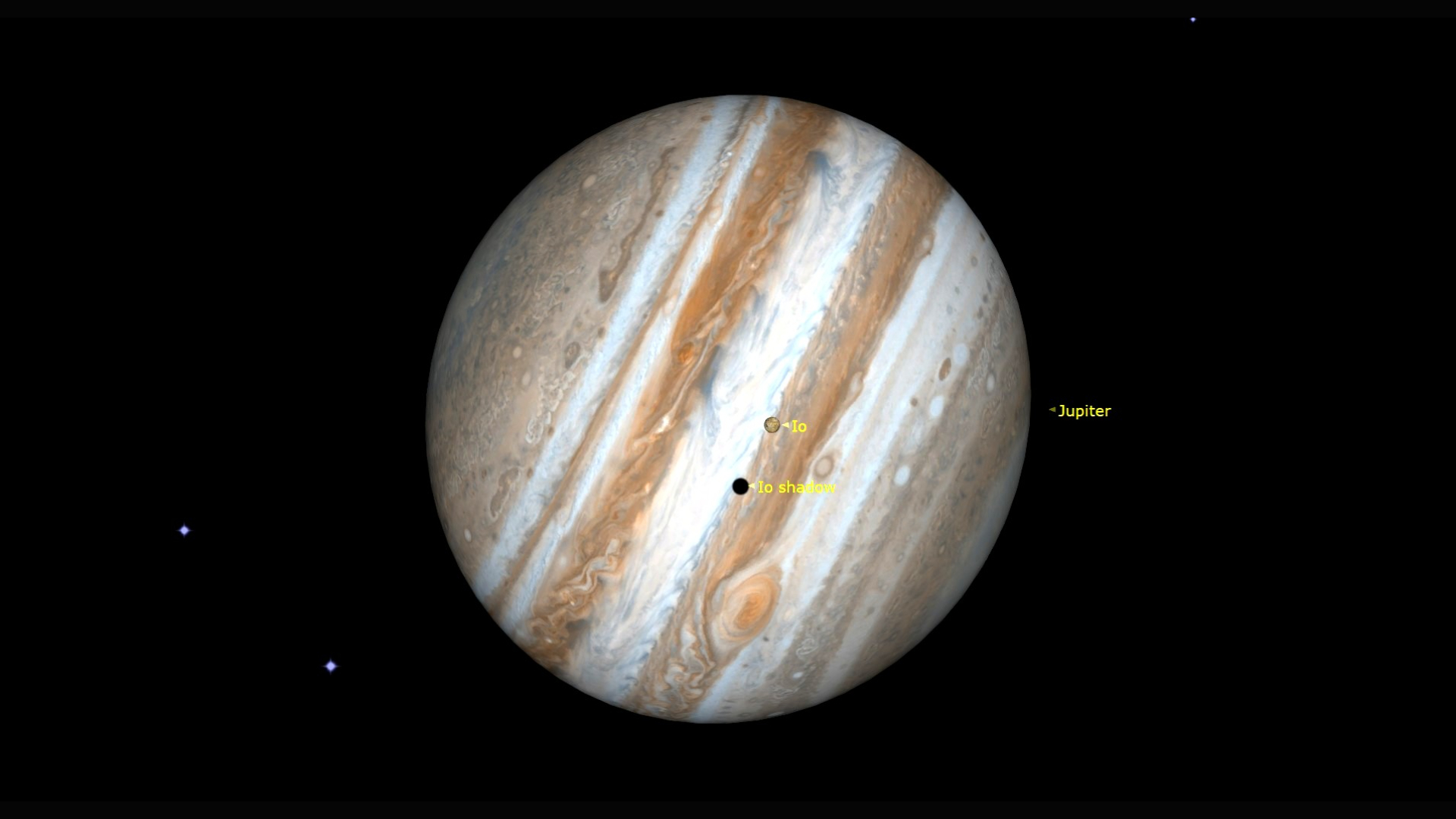
Jupiter puts on a show in January. (Image credit: Starry Night/Chris Vaughan)
Jupiter, the largest planet in the solar system, currently shines as a brilliant silvery "star" in Gemini the Twins, low in the east-northeast sky as dusk slowly fades. It forms an eye-catching scalene triangle configuration with the "Twin Stars" Pollux and Castor; you really can't miss it.
And at 4 a.m. EST (0900 GMT) on Saturday (Jan. 10), Jupiter will arrive at that point in the sky directly opposite to the sun, called "opposition." If all the planets' paths around the sun were true circles, this would also coincide with Earth's closest approach to Jupiter, 393.3 million miles (632.9 million kilometer). That, however, occurs 25 hours earlier, at 3 a.m. EST (0800 GMT) on Friday (Jan. 9).
Jupiter will reach its farthest point from the sun — its aphelion point, which takes it 507 million miles (815.7 million km) from our star — on Dec. 28, 2028.
'Big Jupe' almost became a star
Jupiter constantly is the most interesting object in the solar system after the moon and the sun and has always held a special place in the hearts of telescope viewers. Jupiter provides telescope users with a feast of features: a restless atmosphere and a retinue of bright satellites.
This giant planet — which has nearly 2.5 times more mass than all of the other planets put together — takes nearly 12 Earth years to go once around the sun. Thus, it spends roughly a year within each of the 12 zodiacal constellations, since the constellations are of unequal width.
With an equatorial diameter of 88,846 miles (142,984 km), Jupiter is the largest planet: a colossal ball of hydrogen and helium without a solid surface. Scientists are currently uncertain about the exact nature of Jupiter's core, but modern data suggests it is not the solid, compact rocky ball once imagined. Recent findings from NASA's Juno mission and updated scientific models suggest that, instead of a sharp boundary between a solid core and the rest of the planet, Jupiter likely has a "dilute" core. This means that heavy elements like rock and metal are dissolved and encased in a thick mantle of metallic hydrogen enveloped in a massive atmospheric cloak of multi-colored clouds of
Breaking space news, the latest updates on rocket launches, skywatching events and more!
And, in a strange sense, Jupiter might even be referred to as a stillborn star, for it has the makings (mostly hydrogen) if not the mass of a stellar body. Its relative smallness, however, prevents the initiation of the nuclear processes that could have turned it into a full-fledged star. Had Jupiter been born a bit bigger, we would have the distinction of living within a binary star system.
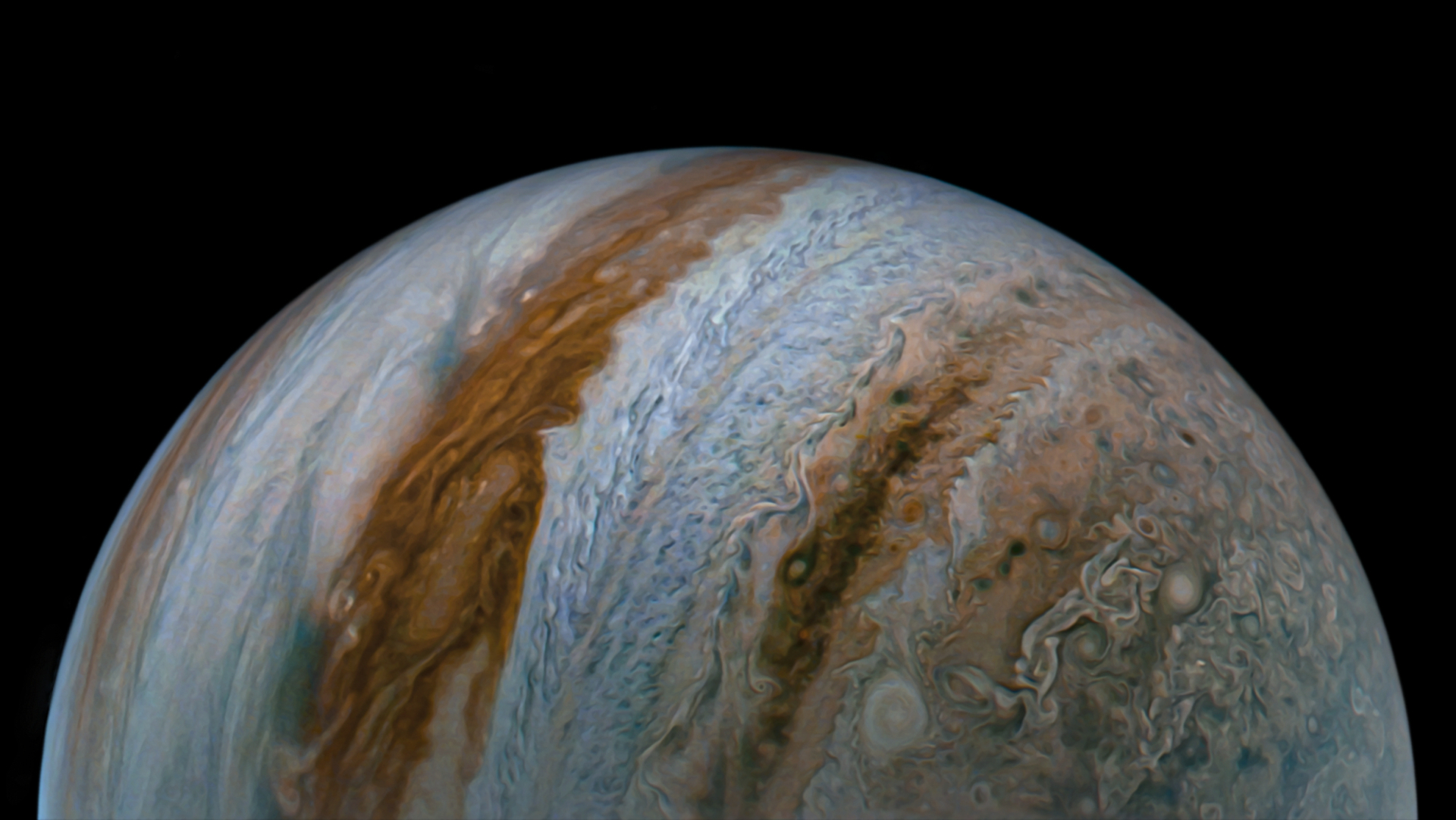
NASA’s Juno spacecraft captured this view of Jupiter during the mission’s 54th close flyby of the giant planet on Sept. 7, 2023. (Image credit: NASA/JPL-Caltech/SwRI/MSSS. Image processing by Tanya Oleksuik CC BY NC SA 3.0)
Cloud bands and satellites
Binoculars show Jupiter as a tiny disk, while a medium-size telescope reveals numerous dark belts, light zones and a wealth of festoons, garlands, ovals and other features extending here and there. Jupiter's rotation is the fastest of all the solar system's planets. It completes a rotation on its axis in slightly less than 10 hours, which creates an equatorial bulge easily perceived through most telescopes. And January offers nearly optimum views of its intricate cloud features; it's even possible at mid-northern latitudes to observe every longitude of the planet during the long night.
Besides its prominent cloud belts, Jupiter's greatest telescopic treasure are its four Galilean moons that run a merry race with each other around the planet, changing their respective positions from hour to hour and night to night. The smallest of telescopes – even steadily held 7-power binoculars – will reveal these four bright satellites of Jupiter as tiny stars nearly in line and changing their places in the line as they revolve around the planet in orbits nearly edgewise to us. Typically, at least two or three are visible at any given moment.
On Saturday (Jan. 10), for example, we will see three satellites on one side of Jupiter (going outward from the planet: Ganymede, Io and Europa), while the fourth (Callisto) remains all by itself on Jupiter's opposite side.
Coming attractions
Jupiter will appear to climb higher in the evening sky in the weeks to come. Currently, the giant planet is ready for telescopic observation by 7 p.m., when it will stand one-third of the way up from the eastern horizon to that point directly overhead (called the zenith). It reaches its highest position in the south around midnight and is heading toward its setting in the west during dawn. After the glory of its opposition on the midnight meridian, Jupiter will appear a bit higher in the east each evening and will engage its stellar neighbors, Pollux and Castor in a sort of celestial pas de trois in the coming weeks.
On the evening of Feb. 27, the scalene triangle will have changed into a narrow isosceles, and nearly aligned with Pollux and Castor will be a waxing gibbous moon. But the real show occurs in late May and early June, when a fascinating dance of three planets and the moon will provide evening enchantment. On the evening of May 20, a crescent moon will be positioned well to the upper left of Jupiter. During the final week of May, one hour after sunset, you can watch how Venus climbs to meet Jupiter. On June 9, they'll call attention to themselves low in the west-northwest sky. Finally, on June 16, a slender crescent moon will appear to the right of Jupiter, and below the moon will sit yet another planet, Mercury.
The heavenly ballet continuously being performed by these "wandering stars" has played a crucial role in the celestial lore of all people. It is not surprising that they were regarded as deities. The five naked-eye planets (Mercury, Venus, Mars, Jupiter and Saturn) have been known since antiquity, and it is also interesting that the members of this quintet have all been examined closely by space probes. Of course, before the advent of the telescope, virtually all peoples regarded planets as a special category of star.
Over the following month, Jupiter sinks into the sun's glare. Emerging into the morning sky of August, he will progress into the constellation of Cancer the Crab, and on Sept. 24 he will cross over into the western boundary of Leo the Lion, where he will remain for the balance of the year. A spectacular eclipse (occultation) of Jupiter will await early risers across much of North America on Oct. 6, and a brightening Mars will closely pass north of Jupiter on Nov. 16. On Dec. 13, Jupiter will begin to swirl backward into the next loop that will climax in the opposition of Feb. 10, 2027.
Joe Rao is Space.com's skywatching columnist, as well as a veteran meteorologist and eclipse chaser who also serves as an instructor and guest lecturer at New York's Hayden Planetarium. He writes about astronomy for Natural History magazine, Sky & Telescope and other publications. Joe is an 8-time Emmy-nominated meteorologist who served the Putnam Valley region of New York for over 21 years. You can find him on Twitter and YouTube tracking lunar and solar eclipses, meteor showers and more. To find out Joe's latest project, visit him on Twitter.
You must confirm your public display name before commenting
Please logout and then login again, you will then be prompted to enter your display name.