Jessie Buckley wept and raged in Hamnet. She says it ‘woke me up’
SOURCE:Sydney Morning Herald|BY:Stephanie Bunbury
Playing William Shakespeare’s untamed wife in a role that took out this week’s Critics Choice award left the Irish actress hungry for more.
You feel something wild in Jessie Buckley as soon as you meet her, a mix of freshness and intensity and an eagerness to go straight to the heart of things. For director Chloé Zhao, it made her the ideal choice to play Shakespeare’s untamed wife in Hamnet, based on Maggie O’Farrell’s acclaimed fictional account of the death of Shakespeare and Anne Hathaway’s son.
“I had a feeling she wouldn’t be afraid,” says Zhao. “There was no vanity in her. I’m neurodivergent, and when there’s dissonance, I can’t function. I can’t look at the person. I need that authenticity.”
Buckley plays Agnes, the name O’Farrell gave to Hathaway, who describes herself to her younger brothers’ Latin tutor – the young William Shakespeare – as the daughter of a forest witch. The supposed witch died in childbirth and her father, a well-to-do farmer, remarried; Agnes has been left to raise herself.
Wild at heart, she is all spirit, fire and secret knowledge: like her mother, she keeps bees and collects herbs. There was no question in Zhao’s mind about who should play her. “I mean, there she is,” she says, nodding towards Buckley.
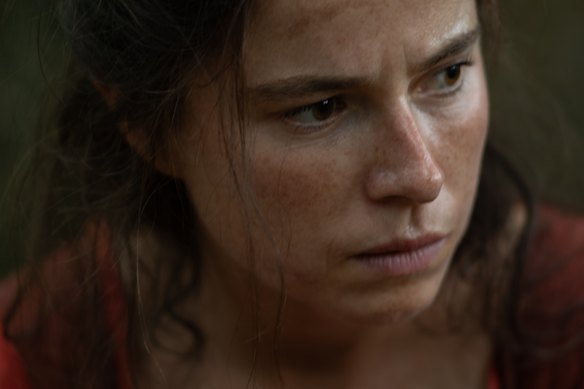
Buckley’s emotionally charged performance, for which she was named best actress at this week’s Critics Choice awards, is so intense that she was frequently asked how she coped.
“I only want to live like that,” says Jessie Buckley of her intense performance in Hamnet.Credit: Focus Features
“People have asked me: ‘Are you OK? Was it hard? How did you recover?’,” she says. “In all honesty, it was one of the most awakening, life-affirming, deep and human experiences I’ve ever had on a film. It woke me up; it made me realise what it was to love somebody, what it was to lose somebody, what it was to imagine. I needed this like food. I needed to know these feelings. The fact that this woman could hold such ferocious life-full tenderness in herself and live on a precipice of life and loss and love – I mean, I only want to live like that.”
When the wild Agnes meets Shakespeare (Paul Mescal), a reader, dreamer and secret writer whose drunken, crooked father can’t stand the sight of him, each recognises a kindred spirit. They marry and have a daughter, then twins called Hamnet and Judith. When the twins are 11, Judith catches the plague. As she lies gravely ill, Will is away in London, putting on one of his new plays. When Hamnet catches the disease, willingly taking the place of his sister in death, Agnes is inconsolable. Her loss is a king tide that never ebbs but if her husband is grieving, he doesn’t share it. Anger, longing and grief course through her, something Buckley conveys even in silence.
Zhao, whose film Nomadland won best picture and best director at the 2021 Oscars, had already refused an offer to direct Hamnet when she met Buckley and Mescal at the Telluride Film Festival. She hadn’t read or even heard of the book. “I wasn’t going to do this,” she says. “It just happened.” She didn’t know who Mescal was, either, but he walked with her through the woods around Telluride and urged her to read Hamnet. “I liked his vibe,” she says. So she did as he said. “And I do believe what my art teacher said to me: that when the container is in the right form, the material comes through. And that material is not something you choose. It chooses you.”
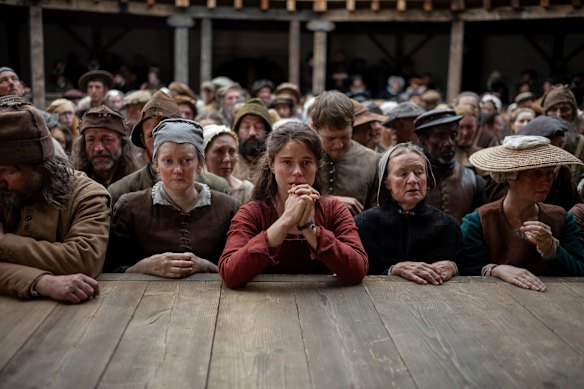
The film, which Zhao co-wrote with O’Farrell, is paradoxically uplifting, an affirmation of humanity that reaches a crescendo in the wake of Hamnet’s death, when Will puts on the play he has been writing. Hamlet, an alternative form of his son’s given name, unleashes his private pain. We watch Agnes watch the play, weeping with the rest of the audience at one of the greatest pieces of theatre ever written. Along with sadness, there is a sense of delirious joy.
Director and actor clearly felt that revelation, too. For Zhao, the material she was initially reluctant to embrace turned out to be what she needed. “I like that my work helps me to deal with my own shit,” she says softly. Like what? “Where do you start? Fear of death? Fear of love? Fear of so many things. But also the purpose of being a storyteller.” After directing the Marvel film Eternals (2021), Zhao questioned whether there was a purpose for her. “But this gives a glimpse into the chemical power of storytelling. How important it is to the human experience. It made me feel that ‘no, I won’t stop. I want to keep getting better at this’.”
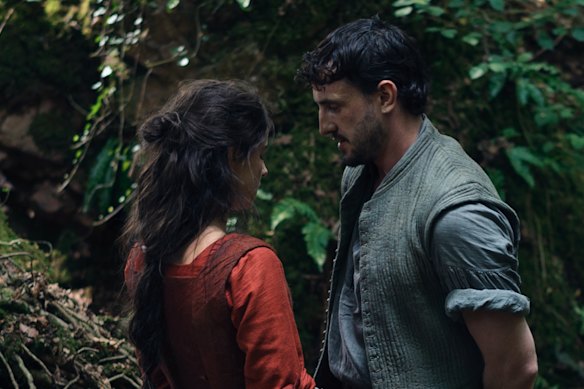
Jessie Buckley and Paul Mescal in Hamnet.
Zhao says she has tried in all her films to tell stories built around humans’ relationship with nature, “where nature will not necessarily heal, but remind the characters of who they truly are”.
In Hamnet, Agnes spends much of her time in the woods in eccentric solitude, collecting plants and communing with nature; in the evenings, the sick and emotionally afflicted sidle up to her window, hoping her suspect potions will help. Zhao estimates that a third of the film takes place in the forest, where Buckley often improvised Agnes’ grief. She found a favourite spot, for example, in the recesses of a tree root.
Loading
“They wouldn’t let me go down there first of all; it was a hole and dangerous,” Buckley says. “And I was like ’no, I have to – oh, ‘bye! Oh look, it’s too late!’. This hole in a tree is very much how she’s navigated loss and death.” You never know what you will find on location, she says, or how you will respond to it. “And we just turned up and there happened to be this little shell for her, like a red egg, as if she was about to be born into the life she was going to start living. I found it very moving, being in there.”
She also insisted on ditching her hotel room for a shepherd’s hut at the edge of the wood where they were working. “As the driver was driving me there, he said, ‘Are you going to be OK here?’. I was like: ‘yes, I’m going to be so fine’.”
Buckley is now 36. When she was 17, she left Killarney in Ireland for London, hoping to get into the Guildhall School of Music and Drama. When she didn’t make the cut, she threw herself into Andrew Lloyd Webber’s I’d Do Anything, a television talent quest to find a young unknown to play Nancy in a West End revival of Oliver!. She missed out by a few votes, went on to sell cereal in a street market, then got into the Royal Academy of Dramatic Art. Her first job when she left was playing Miranda in The Tempest at the Globe Theatre, which is also the setting for Hamnet’s long final scene. When Buckley speaks of Shakespeare, it is with a kind of rapture. “We need big language for right now,” she says.
Jessie Buckley in Hamnet’s closing scene, as Agnes watches her husband’s new play. Credit: AP
On stage, she swept London’s theatre awards with her performance as Sally Bowles in Cabaret. Her film choices have been infallibly interesting, playing an aspiring country singer in Wild Rose, a scandalous single mother in Wicked Little Letters, a rebel Mennonite in Women Talking and a harried, unloving young mother in Maggie Gyllenhaal’s The Lost Daughter, which she described as “life-changing”. She has just made another film with Gyllenhaal: The Bride is an adaptation of Bride of Frankenstein set in 1930s Chicago, where the female monster gets to do the talking.
Working with female directors, she says, has opened up her experience as an actor. “It’s so thrilling to be with female directors, especially because that is still new,” she told me after she made Women Talking (2022) with Sarah Polley. It wasn’t a priority in itself, simply that these were the most interesting scripts that came her way. “You feel like a really hungry force-field coming from these women who really want to challenge something, asking really provocative questions and asking you as a woman to step forward and be part of that, not just for yourself but culturally as well.”
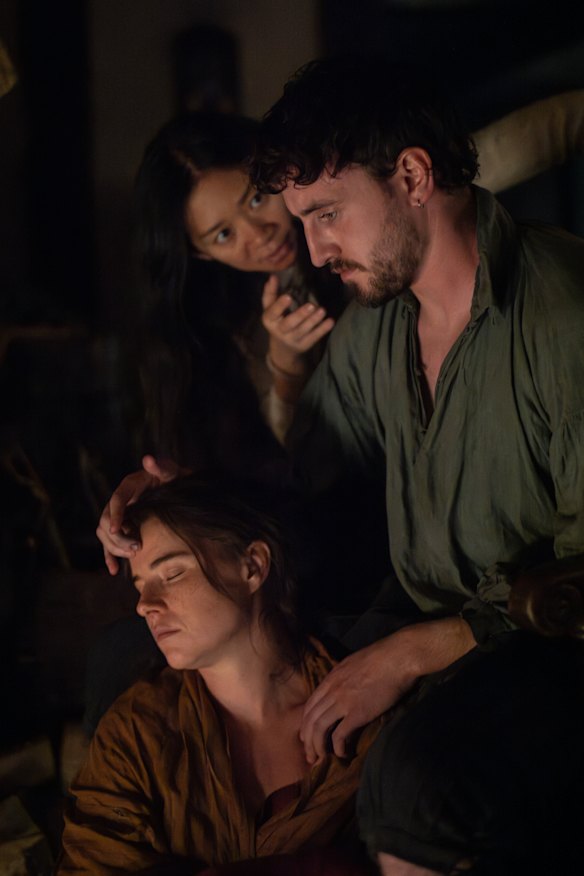
Jessie Buckley and Paul Mescal with director Chloé Zhao on the set of Hamnet.Credit: Focus Features
Zhao, who was born in Beijing, was sent to school in England when she was 15 and subsequently took herself to the United States, where she studied filmmaking under Spike Lee. Some instinct drew her to the impoverished communities on Native American reservations: the ostensibly shabby remains of the American West. Songs My Brothers Taught Me (2015) and The Rider (2017), a truly marvellous portrait of a Sioux rodeo rider, were the result. Then came Nomadland, about shifting communities of homeless people living in vans and working casual jobs, with Frances McDormand playing opposite real people they met on the road. It was a hard life, of course, but they were surrounded by beauty.
“We talk about nature as if we’re not part of it any more but, fundamentally, we’re no different from a leaf,” she says. “We’re made from the same particles from the Big Bang. Our greatest prophets went into the wilderness and sat under trees to harmonise their own vibrations with nature. That’s when they would get the message from the divine and bring it back into a civilisation that has inevitably lost that connection. That’s where God is.” She quotes from somewhere a favourite adage, that says you will find the Holy Grail only when you become the grail yourself. “Like in Eastern religion. Everyone is the Buddha.”
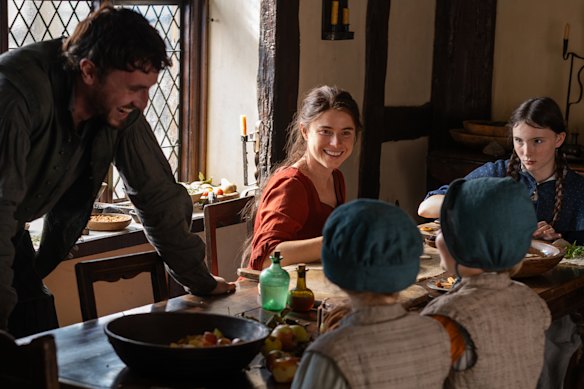
Paul Mescal as William Shakespeare, Jessie Buckley as Agnes and Bodhi Rae Breathnach as Susanna before tragedy strikes in Hamnet.Credit: Focus Features
That sense of universal unity permeates O’Farrell’s novel; Zhao’s challenge was to manifest that in images. Adapting books is inherently difficult, she says. “Because they’re so ancient. Cinema is a very young language. Books are so old that our association with the word on the page triggers something very old and ancestral.” She told O’Farrell she would direct the film only if she had written the script, partly because the story would need changes and additions and only the author knew what she had discarded, a storehouse of detail she could excavate when they needed it.
O’Farrell straightened out the book’s flashback structure and wrote a scene between Shakespeare and his son – played by an irresistible Jacobi Jupe – after Steven Spielberg gave them notes on an earlier draft. The play’s performance was added to conjure the body blow of the book’s last sentence: 20 minutes for two words and the reader’s act of imagination.
“You use your body as a measurement,” says Zhao. “If you’re feeling that emotion in your body, the same feeling from watching five minutes as reading one line, then you’ve got it.”
We shy away from feeling in our everyday, says Buckley, and are the poorer for it. “I think we’ve become so detached and removed, trying at all costs to not look and not feel, that when you do meet a feeling in a story, it feels like a shock,” she says. “But in the context of our world right now, maybe this is exactly what we need: these containers and vessels and stories to open our hearts again.”
For Zhao, this goes to the heart of what she does. “We have been using art and storytelling and a collective communal experience, to grieve, to feel, to deal with that since way before any of these things that are telling us we should be separated even existed. We’re remembering, ready to survive.”
Loading
Hamnet opens on January 15.
Must-see movies, interviews and all the latest from the world of film delivered to your inbox. Sign up for our Screening Room newsletter.