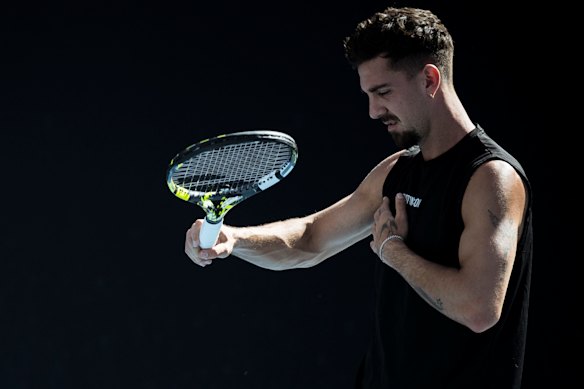
Kokkinakis was losing hope, but a tendon from a dead person might have saved his career
Seven years on from receiving “bad doctor’s advice”, and many setbacks later, Thanasi Kokkinakis is on the comeback trail again – after revolutionary surgery he hopes saves his career.
Thanasi Kokkinakis had to earn his Australian Open spot the hard way in qualifying on the backblocks of Melbourne Park seven years ago.
He proceeded to breeze through three matches without dropping a set – defeating Mohamed Safwat, Sebastian Ofner, then Peter Polansky – to qualify for a grand slam for the first time. However, the now-29-year-old remembers that Open for a different, yet familiar, reason.
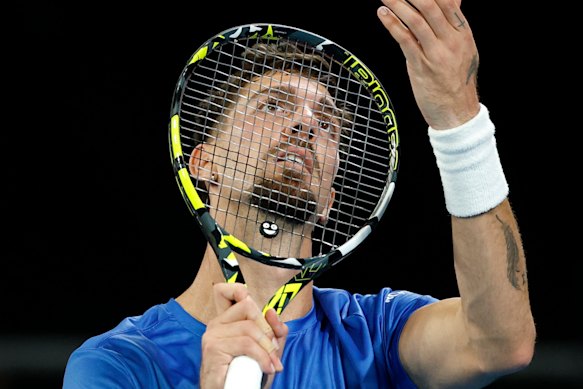
Thanasi Kokkinakis just needs some luck to go his way on the injury front.Credit: Getty Images
“I hit a forehand against Polansky, and something didn’t feel right,” Kokkinakis told this masthead.
“I went and got a scan. They said it was maybe a grade one [strain in my pectoral muscle]. I was like, ‘It feels a lot worse than a grade-one strain’, but they said that’s all you can see on the scan, and you’ll be right to play.”
So, Kokkinakis played his first-round match against Japan’s Taro Daniel – but it did not go well.
The injury-cursed baseliner began suffering nerve pain and his serving arm went numb, eventually resulting in him retiring from the match while leading Daniel 7-5, 2-4.
Kokkinakis said afterwards that he would not require surgery, which he explained this week was based on “bad doctor’s advice”. Seven years and many setbacks later, he is on the comeback trail again – but this time after insisting on revolutionary surgery he hopes saves his career.
Kokkinakis knew entering last year’s Australian Open that he was headed for another extended stint out, owing to the right pectoral issue that has plagued him, off and on, since that clash with Polansky.
Weeks later, after Kokkinakis conducted extensive research himself and surveyed experts at home and abroad, world-renowned Melbourne surgeon Greg Hoy reattached the pectoral muscle to the right shoulder with the help of an Achilles tendon graft from a dead person.
Hoy was one of the few willing to perform what is believed to be a tennis-first operation that is more common in weightlifters.
“If someone recommended me not to do it, I just blacklisted them,” Kokkinakis said.
“I was fine with retiring rather than keeping on doing what I was doing. I couldn’t back up matches, and was losing hope. I want to lose because people beat me at tennis. If that happens, fine. But if I lose because I can’t serve, which is my strength, then I’m cooked.”