Last common ancestor of modern humans and Neanderthals possibly found in Casablanca, Morocco
A collection of bones from Casablanca holds important new clues to the origins of modern humans and Neanderthals.
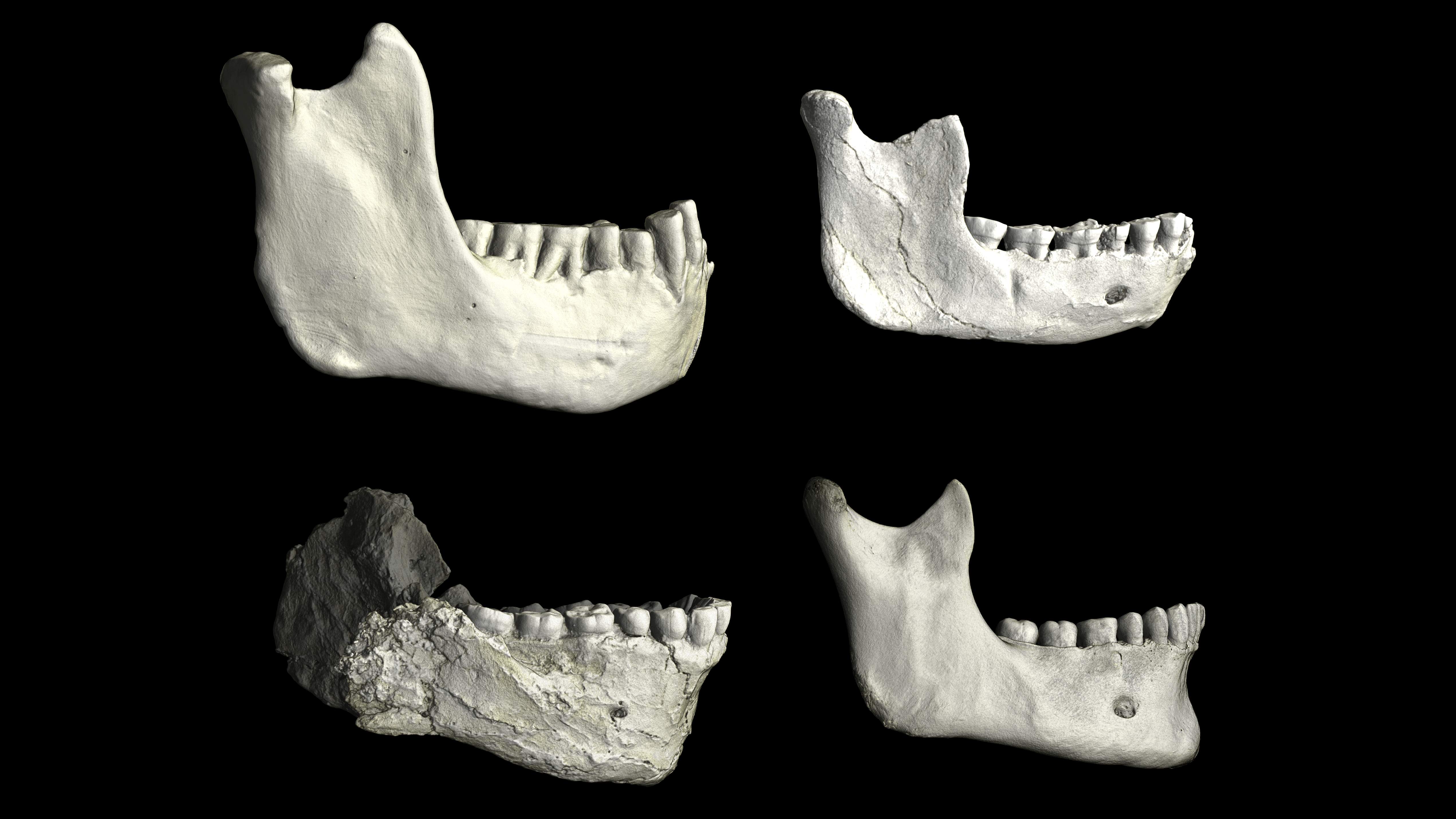
A series of lower jaws from North Africa demonstrates variation among hominin fossils. The jaw on the upper right is from the Thomas Quarry I site in Morocco, newly dated to 773,000 years ago. The one on the upper left is Tighennif 3 from Algeria, from around 700,000 years ago, the lower-left jaw is Jebel Irhoud Homo sapiens from Morocco, dated to 300,000 years ago; and the lower-right jaw is from a recent modern human. (Image credit: Philipp Gunz/Max Planck Institute for Evolutionary Anthropology)
The discovery of 773,000-year-old fossils in a cave in Morocco is transforming the geography of human origins by placing the start of the modern-human lineage squarely in northwestern Africa, according to a new study.
In the research, published Wednesday (Jan. 7) in the journal Nature, a team of Moroccan and French researchers detailed their analysis of a handful of bones they think represent the last common ancestor of modern humans (Homo sapiens), Neanderthals and Denisovans.
The researchers discovered the fossils in a cave called Grotte à Hominidés (Cave of Hominids) at the site of Thomas Quarry I in Casablanca, Morocco. The bones consist of three partial lower jaws, several vertebrae and numerous individual teeth, all of which share some characteristics of Homo erectus but also have traits distinct from this human ancestor.
Additionally, there were numerous stone tools at the site, and one leg bone suggests that hyenas might have dined on the hominins. By testing the magnetic properties of 180 samples of sediment from around the fossils, the researchers found that the sequence spanned the Matuyama-Brunhes magnetic-field reversal, a geological event that occurred 773,000 years ago.
The new discovery fills a major gap in the African hominin fossil record between 1 million and 600,000 years ago, study co-author Jean-Jacques Hublin, a paleoanthropologist at the Max Planck Institute for Evolutionary Anthropology in Leipzig, Germany, told Live Science in an email. Genetic evidence has suggested that, during this time span, the last common ancestor of modern humans, Neanderthals and was living in Africa.