Millions are being 'slowly poisoned' - and pleas for change are being ignored
"The air is absolutely poison, in the last two years we've not had even one single good a day in spite of the monsoon rain," says Bhavreen Kandhari, an activist spearheading a public movement on clean air.
"The air is absolutely poison, in the last two years we've not had even one single good a day in spite of the monsoon rain," says Bhavreen Kandhari, an activist spearheading a public movement on clean air.
Hundreds have converged to raise their voice against air pollution at Jantar Matar, a stone's throw away from the Indian parliament where the winter session is taking place.
"As a citizen and a mother we've done every possible thing to highlight our concerns," says Ms Kandhari.
"We really believed that this time the parliament session will begin with something on air pollution, but unfortunately that didn't happen."
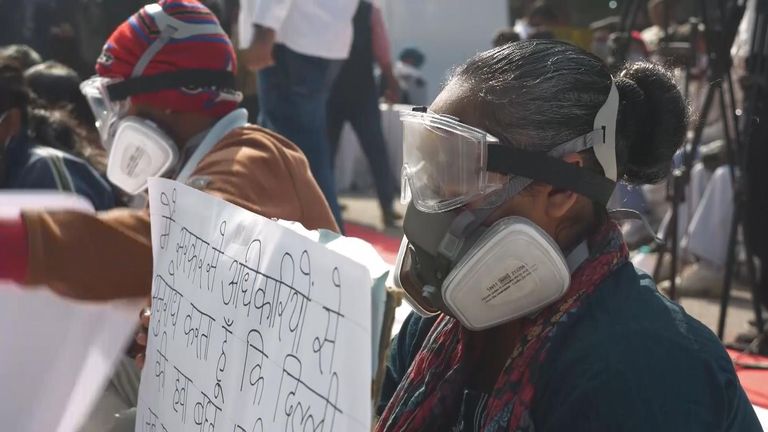
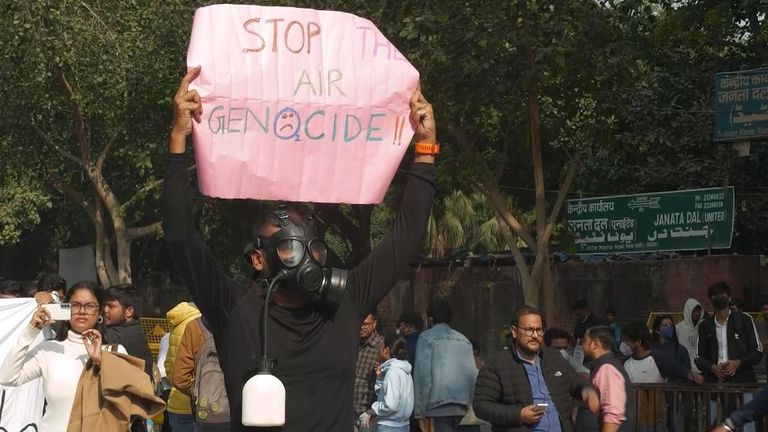
Image: People protest against air pollution in Delhi
A silent killer
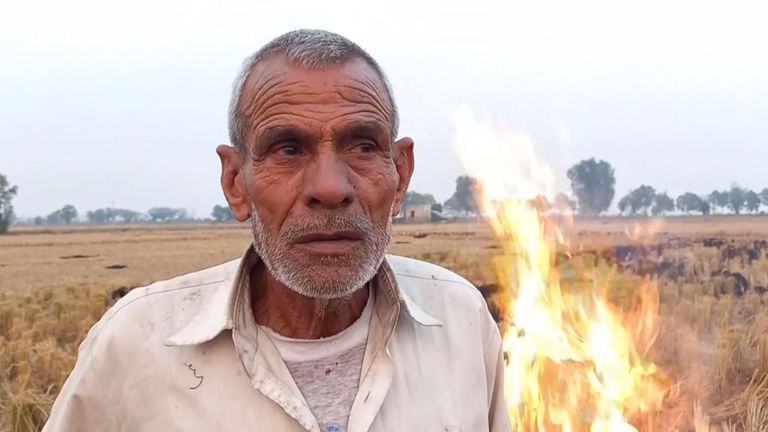
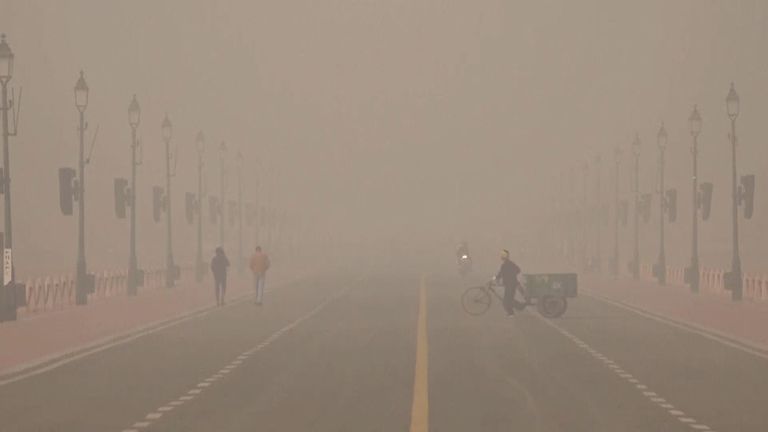
Delhi is the world's most polluted capital, with vehicle emissions, farm fires, pollution from industry, power plants, waste, construction and household energy the main causes for this poisonous air.
A lethal cocktail of carbon monoxide, nitrogen dioxide and other harmful gases - combined with tiny inhalable particles known as particulate matter - blankets the capital and its surroundings.
PM2.5 refers to particles less than 2.5 micrometers in diameter - 30 times smaller than human hair, meaning they can penetrate deep into the lungs and enter the blood stream.
Doctors warn of severe respiratory, heart and reproductive problems, cognitive decline and a reduction in life expectancy.
Since the cold set in here in India's capital, almost every day the air quality index has been rated very poor, severe, or hazardous, which is many times over the World Health Organization recommended safe levels.
The Global Environment Outlook-7 report released by the UN Environment Programme (UNEP) this month warned that 99% of the world's population is exposed to some form of air pollution - and more than 90% of pollution-related deaths occur in low and middle-income countries.
According to a 2022 report by medical journal The Lancet, air pollution caused by fossil fuels has claimed 1.72 million lives in India. That's more than the combined deaths of terror attacks, riots, epidemics and natural disasters.
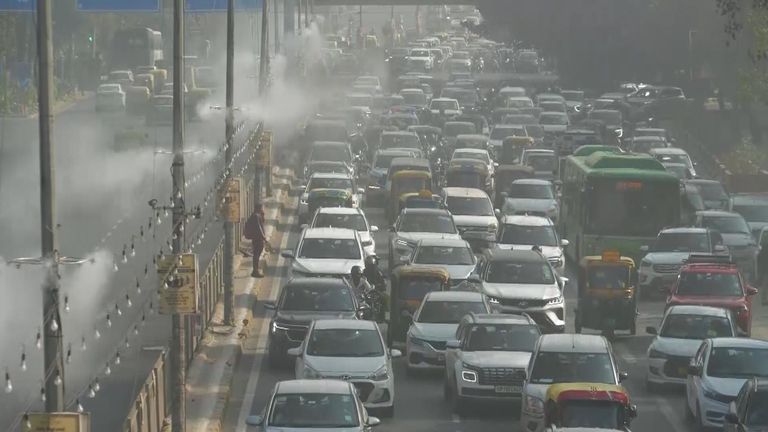
Air pollution is no longer just Delhi's problem as it is affecting the whole of the Indo-Gangetic plain, with hundreds of millions of people breathing toxic air.
According to the Centre for Research on Energy and Clean Air, 150 cities of the 256 cities monitored in 2025 exceeded nationally recommended PM2.5 levels.