MTG might go even further than Universes Beyond in 2026
Magic: The Gathering is primed to shake up the lore of its multiverse in the year ahead
Last year, crossover sets like Avatar: The Last Airbender, Spider-Man, and especially Final Fantasy proved that crossovers could bring in new players, drive record-setting revenue, and meaningfully shape competitive formats without slowing the game’s momentum. In October 2025, Hasbro CEO Chris Cocks said, “I think we're still in the early innings of what Universes Beyond can do.” Around the same time, the game’s head designer Mark Rosewater confirmed that the team has Universes Beyond crossovers planned out through the early 2030s. The initiative has come a long way in a few short years, evolving from an experiment into a lucrative focal point for the game’s future.
But what does Magic look like as that happens? Could that shift force the game to bend, fracture, or reinvent the very idea of its multiverse in order to survive its own success? It’s fitting that the culminating in-universe set scheduled for late in the year literally focuses on fracturing reality itself. That just might give the crossover-heavy slate of releases more cohesion as a result.
Magic: The Gathering’s 2026 schedule
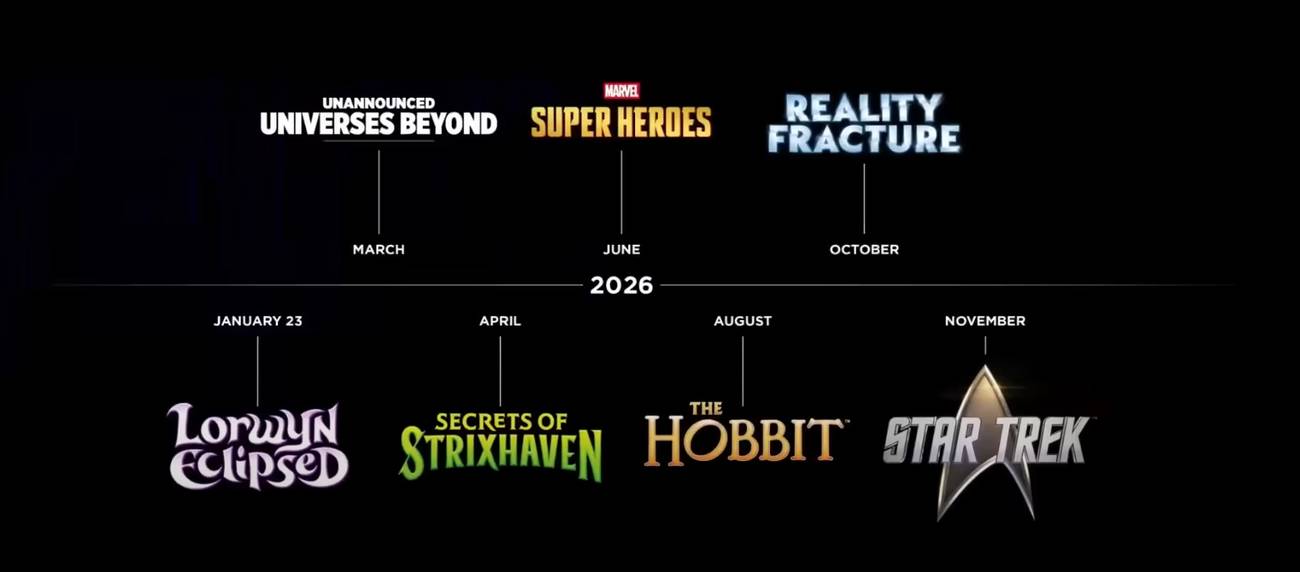
Wizards of the Coast published the schedule even before announcing the Teenage Mutant Ninja Turtles set.
Image: Wizards of the Coast
Here’s what we know is coming from Wizards of the Coast in 2026, based almost entirely on what was revealed in September 2025 at MagicCon in Atlanta:
- Lorwyn Eclipsed (Jan. 23)
- Teenage Mutant Ninja Turtles (March 6)
- Secrets of Strixhaven (April 2026)
- Marvel Super Heroes (June 2026)
- The Hobbit (August 2026)
- Reality Fracture (October 2026)
- Star Trek (November 2026)
That’s four Universes Beyond sets and three in-universe Magic sets, an inversion of 2025’s ratio. The four crossovers also span wildly different tones, audiences, and genres. You’ve got some kowabunga Saturday-morning cartoon energy with TMNT, prestige superhero storytelling in Marvel Super Heroes, The Hobbit’s classic high fantasy, and science-fiction adventures with Star Trek.
TMNT further widens the definition of what might “fit” in Magic. As a goofy, pop-forward franchise, it feels more suited to a Secret Lair Superdrop at most. But based on the products that’ll be available, it’s a legitimate full set, albeit one on the smaller side somewhere between Avatar and Spider-Man. It’ll have the typical play and collector boosters, a single Commander deck, two different kinds of bundles, and a “Turtle Team-Up” co-op box with a themed deck for each turtle.
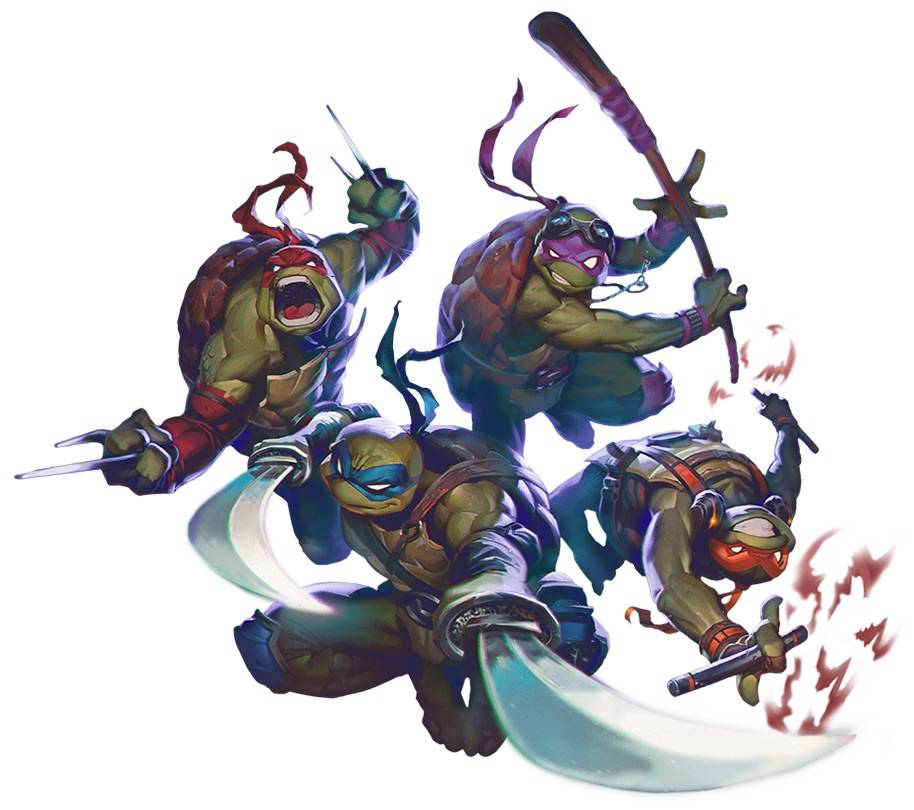
"Kowabunga!"
Image: Wizards of the Coast
If TMNT can be a Magic set treated with the same care and marketing weight as any other release, then Universes Beyond has truly evolved into part of the game’s foundation. Rather than ponder whether a crossover feels like Magic, Wizards is instead figuring out how the game can accommodate it.
Like Final Fantasy last year, Marvel Super Heroes gets top billing in the same release window in the middle of the year. While only a select number of cards have been revealed thus far, it feels safe to expect that it’ll be similar in size and influence as Final Fantasy. We already know about dozens of cards, at least two new mechanics, and a Fantastic Four Commander deck. As a full standard set, it’s bound to have a total of four Commander decks (Avengers? X-Men? What else?) and have a massive impact on competitive play and the overall state of the game.
An early criticism of Universes Beyond was that it would feel gimmicky and isolated from the rest of the game. Back in October 2024, however, Wizards made all sets legal in Standard play, essentially positioning Universes Beyond products as a core part of the game. In 2025, sets like Final Fantasy and Avatar reshaped the game’s competitive scene in major ways. Even after Vivi Ornitier was banned in late 2025, blue-red decks remained some of the best thanks to Avatar’s focus on lesson spells and other cards that support them. Design-wise, sets continue to introduce new mechanics that interact with the foundations of the game as it builds momentum toward something new.
Spider-Man focused on mechanics with heroic and villainous flavors that are bound to return in Marvel Super Heroes, suddenly making cards that interact with hero and villain creature types much more valuable. (Looking at you, Doctor Octopus!) The set also already introduced the Soul Stone as a major chase card, teasing that the rest of the Infinity Stones and the Infinity Gauntlet would arrive as part of the tentpole Marvel set. Spider-Man also quietly rewrote the rules for transforming double-faced cards as a way to showcase heroes and their alter-egos.
Marvel Super Heroes will also introduce flavorful mechanics like Power-Up, which allows a creature to permanently enhance itself through a single activation, and Plans that function as long-term enchantments that might accumulate counters over time before unleashing big effects if left unchecked. Crossover mechanics used to feel like odd novelties. Rad Counters in the Fallout crossover decks functioned as strong flavor in a vacuum, so we’ll probably never see it return as a mechanic. But Power-Up and Plans? They’re flavorful but also generic enough that they expand Magic’s rules and can be reused in future sets. And Magic already started thinking about Universes Beyond sets in this way.
Star Trek was announced less than two months after Edge of Eternities launched in early August 2025. The knee-jerk reaction for Universes Beyond’s critics was to assume Eternities was a test case to see if sci-fi could work within Magic. And it did, quietly laying the groundwork by introducing Planets, Stations, Spacecraft, and Warp. These mechanics abstract space travel into clean, scalable game mechanics that aren’t explicitly tied to a single IP. They’re flexible by design. Whether it was Wizards’ intention or not, Edge of Eternities served as a proof of concept that Star Trek and every future sci-fi crossover can build upon.
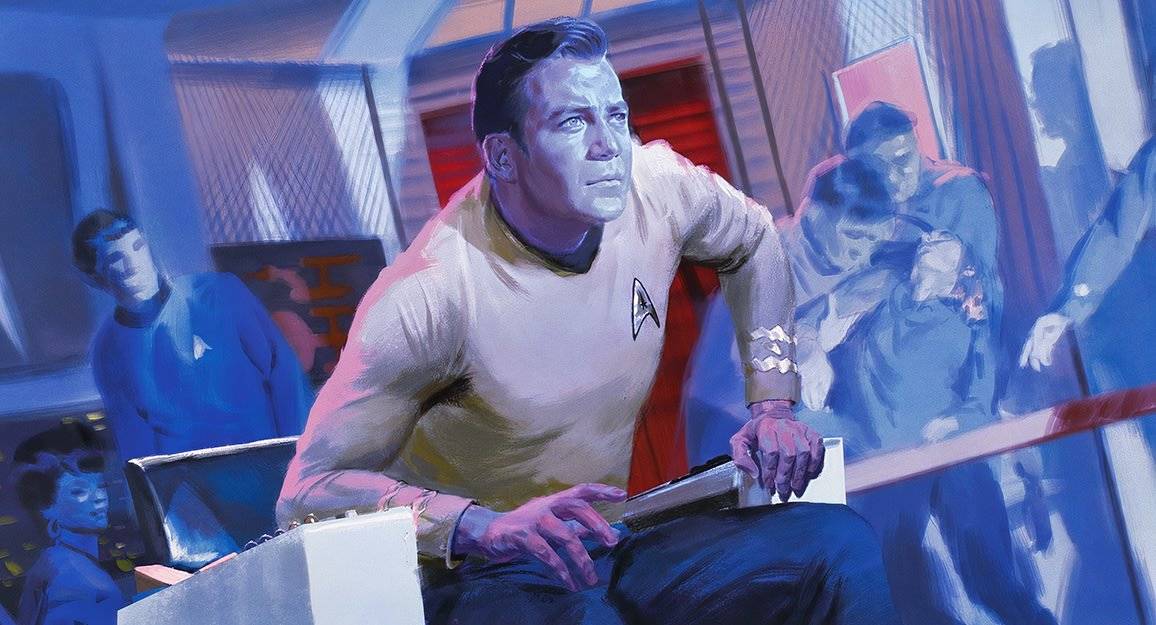
Official art from Josh Newton already revealed as part of the Star Trek set.
Image: Wizards of the Coast
This new approach to mechanics means that crossovers no longer need bespoke systems to feel authentic. They can share a mechanical backbone, reinforcing the idea that crossover Magic isn’t branching outward so much as it is building inward.
Why the in-universe sets feel different in 2026
The three non-crossover sets scheduled for 2026 leverage nostalgia for Lorwyn and Strixhaven while also delivering a major ongoing narrative that reshapes the state of Magic as we know it.
Lorwyn Eclipsed isn’t just a return to one of Magic’s strangest planes full of whimsy and decay. There are plenty of mechanical callbacks to the original Lorwyn-Shadowmoor block, thanks to a focus on tribal themes, hybrid mana costs, and -1/-1 Blight counters. The set emphasizes hand-drawn art for the setting’s folkloric vibe, making it a refreshing way to start a crossover-heavy year. But Lorwyn Eclipsed is also doing something subtler: It positions four Strixhaven students as central characters in the short stories accompanying the set.
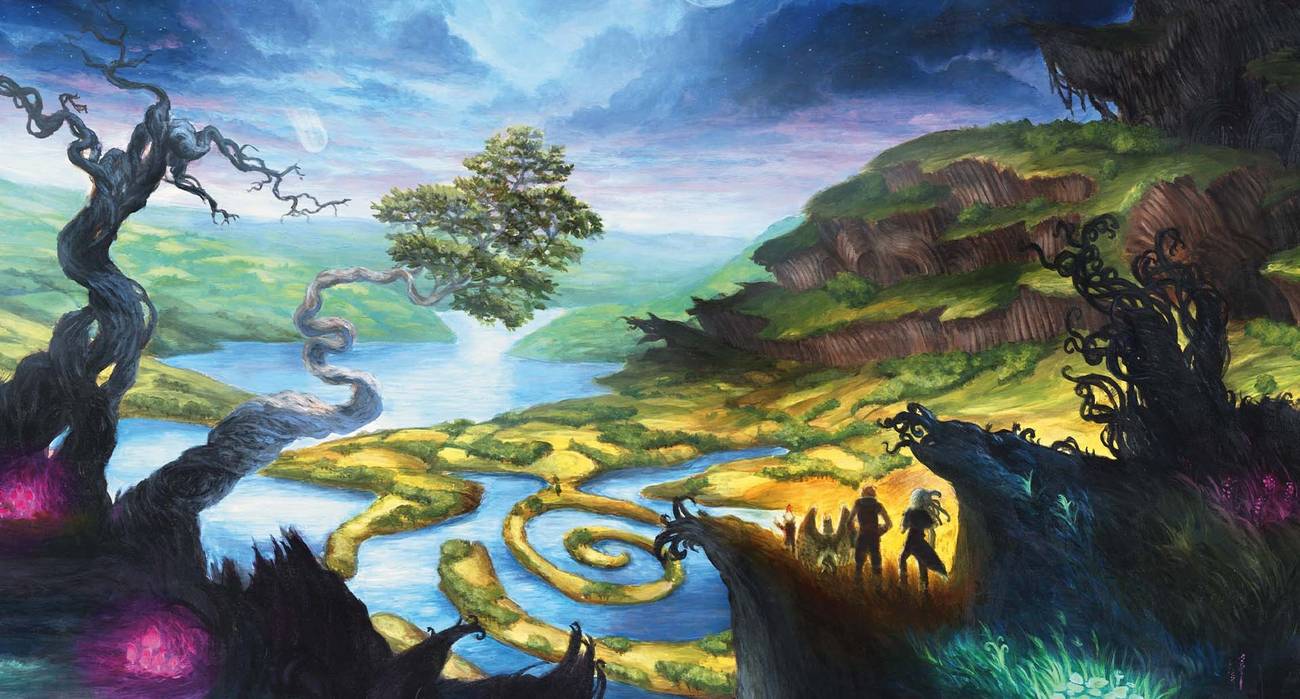
In the series of seven short stories tied to Lorwyn Eclipsed, four Strixhaven students get lost in Lorwyn-Shadowmoor.
Image: Wizards of the Coast
Normally, that might not be super noteworthy, but the next in-universe set after that is Secrets of Strixhaven. “Our adventure-hungry cohort from Lorwyn Eclipsed is hitting the books for a new academic adventure,” official materials tease. “This time, we'll be taking a closer look at off-campus life as these brave students explore what lies beyond the walls of their colleges.” So it’s worth paying attention to what’s going on with Kirol, Abigale, Sanar, and Tamira (“Tam”). There’s also a tie-in novel written by Seanan McGuire called Strixhaven: Omens of Chaos that follows a different group of students. Taken together, these narratives position Strixhaven as a major focus of the overall Magic story in 2026.
All of that culminates in October’s Reality Fracture, which is one of the most ominous titles that Wizards has used in years — and the one that could make everything else snap into focus.
The second Lorwyn Eclipsed short story introduces a compelling bit of foreshadowing: At Strixhaven, Ajani catches Liliana up to speed with the events that transpired during Tarkir: Dragonstorm. He explains how, alongside Elspeth and Narset, he found Jace Beleren in the Meditation Realm casting a spell nobody could identify. “He lost control of the spell, and it came apart in his hands, and then he came apart with it,” Ajani said. “The spell took him, and he was gone. Just light and energy on the wind."
Ajani assumes that means Jace is dead, but Liliana refuses to believe it. We’re led to believe here that Jace tried to channel the power of the Meditation Realm to rewrite the multiverse in some way, but got sucked into the spell in the process. After Ajani rescues the missing students in Lorwyn and brings them back to Strixhaven, the seventh short story ends with a wild revelation: a “white-clad version” of Liliana — who is always depicted as a necromancer in black — shows up at her office for a “conversation.”
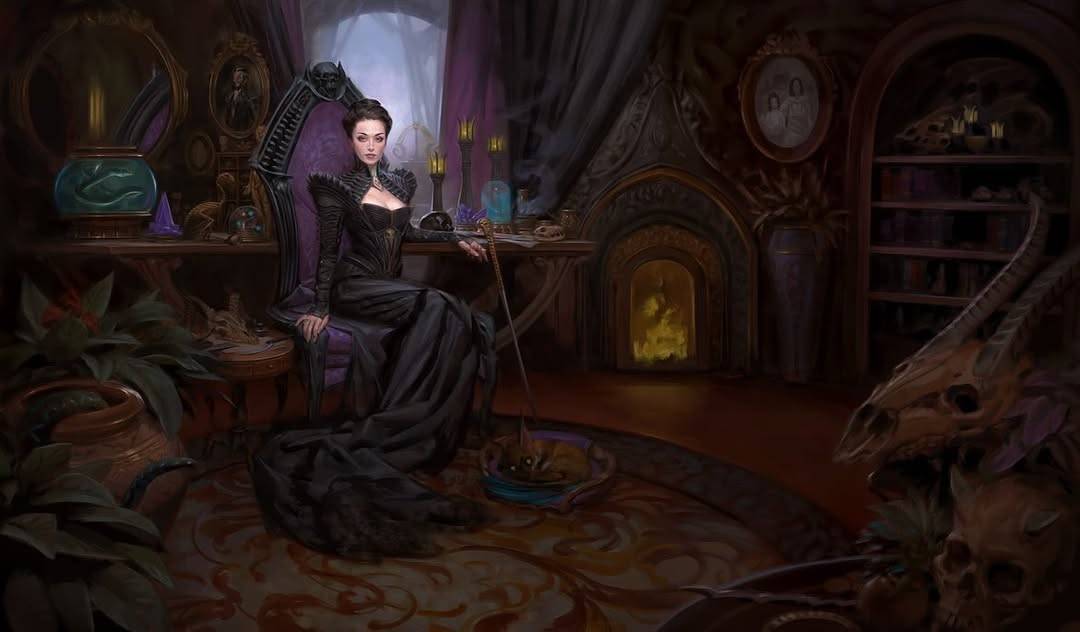
After the War of the Spark, Liliana Vess disguises herself as Professor Onyx to hide at Strixhaven University.
Image: Wizards of the Coast
This confirms a major narrative twist: an entire separate multiverse exists parallel to Magic’s existing multiverse. Long before all of these recent lore developments, a November 2024 player survey included details about how Jace “created an entire Multiverse shaped in his misguided image” where familiar characters appeared as inverted, “color-shifted” versions of themselves. The survey and concept art details a Garruk with arcane purple tattoos, a cold and calculating Chandra who wields ice magic instead of fire, and a Liliana who “dedicated herself to the healing arts rather than her signature necromancy.”
Magic has always treated planes as separate universes, but Reality Fracture adds another mind-boggling layer into the mix. The dangerous and elegant idea behind it all is that Reality Fracture is poised to destabilize the entire Magic multiverse. That framework allows for alternate versions of characters that break color identities and further stretches the narrative possibilities. On his blog, head designer Mark Rosewater confirmed that Reality Feature will not “officially merge other IPs with in-universe lore.” But unofficially? That sure feels like what’s happening here. And tonally, a story like this still expands what’s possible.
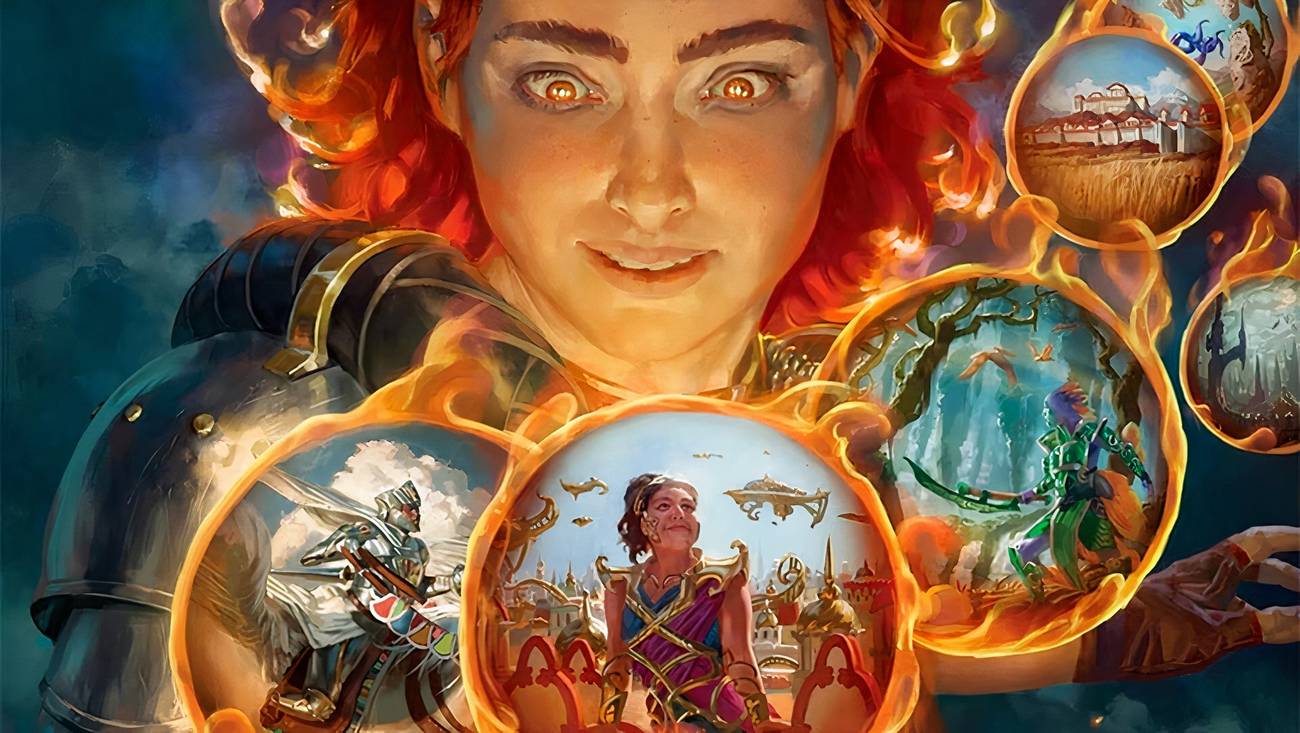
Cover art for Magic: The Gathering: Planes of the Multiverse: A Visual History by Jay Annelli depicts the Planeswalker Chandra gazing at various planes of existence.
Image: Wizards of the Coast
In a sense, Universes Beyond doesn’t need to be canon to coexist. It just needs to be possible within the scheme of this infinite megaverse. That’s the radical idea lurking beneath 2026’s release slate. Crossover worlds don’t have to replace Magic’s story or sit outside it. They can exist as alternate realities.
Not unlike DC’s Crisis on Infinite Earths, which collapsed a sprawling multiverse into a single continuity as a way to wipe the slate clean and rebuild, Magic may be engineering its own metaphysical crisis. If that’s the case, it’s not about Universes Beyond compromising what defines Magic, but a way to further stretch imaginations in a way that makes the game’s future sustainable.
If Reality Fracture really is about embracing contradiction rather than resolving it, then that meta-narrative serves as a strong justification for Universes Beyond’s prevalence. In 2026, Magic may feel stranger, broader, and more fragmented than ever before. And once reality is fractured and the crisis passes, Magic itself will only continue to grow and branch into more genres as it evolves into something new.