NASA satellite gazes into Medusa Pool | Space photo of the day for Dec. 24, 2025
The South Sandwich Islands were born from a tectonic collision, forged by volcanism and relentlessly reshaped by ice, wind and waves.
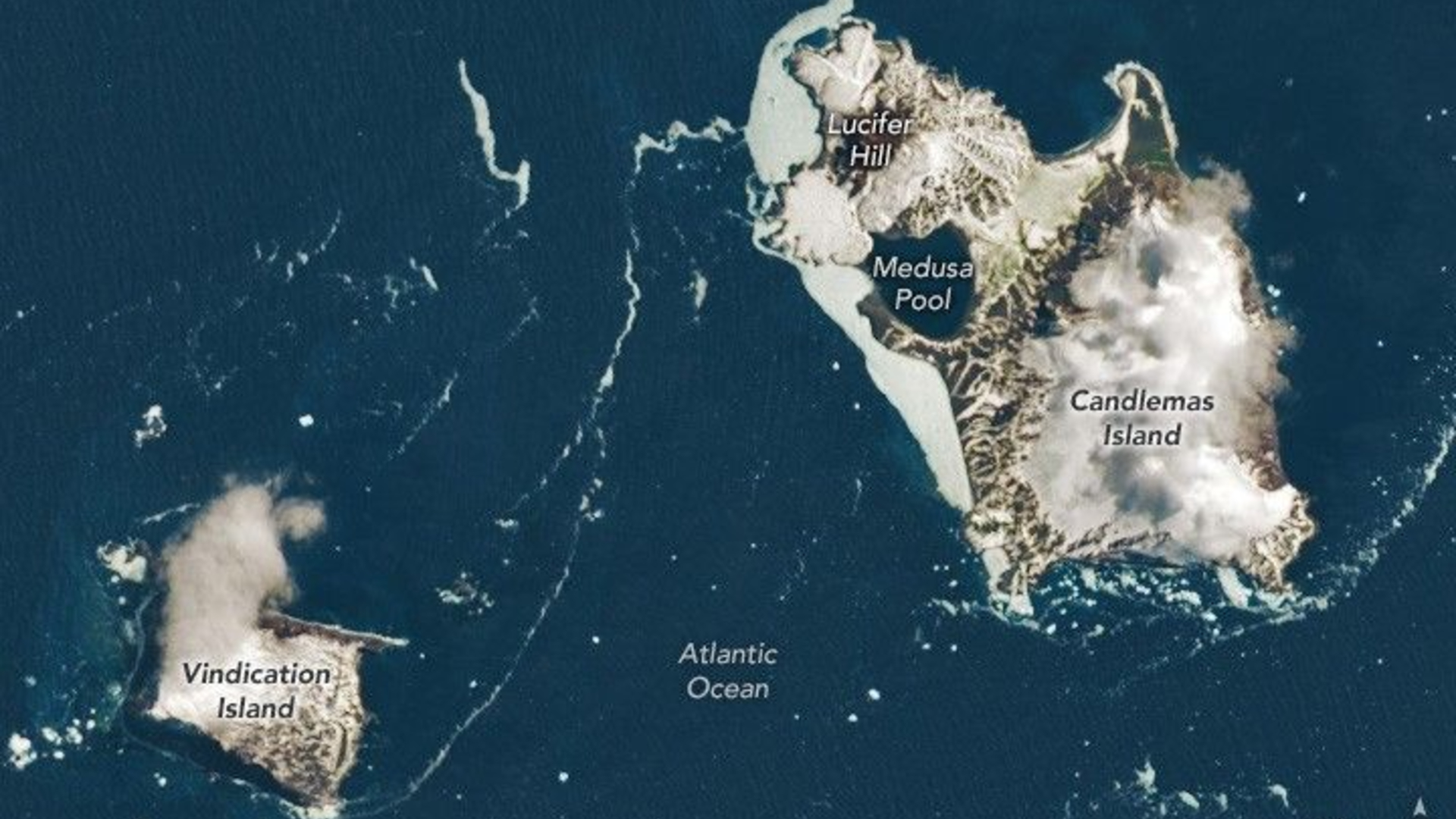
Vindication and Candlemas Island are seen from space. (Image credit: NASA Earth Observatory image by Wanmei Liang, using Landsat data from the U.S. Geological Survey.)
Far from shipping lanes, cities, and even most scientific outposts lie the South Sandwich Islands, one of the most remote island chains on Earth. Stretching in a slender arc through the stormy South Atlantic Ocean, these islands sit more than 994 miles (1,600 kilometers) from both South America and Antarctica. In this satellite image, puffs of low-level cloud drift across Vindication and Candlemas Islands, two of the South Sandwich Islands, mingling with rugged volcanic terrain and icy shorelines. The image was captured by the Operational Land Imager-2 (OLI-2) instrument aboard the Earth-observing satellite Landsat 9, a collaboration between NASA and the U.S. Geological Survey.
Such scenes are uncommon in satellite records from this region, where clouds often obscure the surface.
What is it?
Since Captain James Cook first reported two closely spaced islands in 1775 — later named Candlemas and Vindication — the region has remained largely inaccessible. Persistent cloud cover, harsh seas, and extreme weather make direct observation rare. As a result, satellites have become the primary way scientists study these islands, monitoring volcanic activity, glaciation, erosion, and atmospheric behavior in one of Earth’s least disturbed environments.
Thanks to fewer clouds, the satellite was able to observe some of Candlemas Island's features, including Lucifer Hill and Medusa Pool.
Where is it?
The image was taken above Candlemas and Vindication Islands in the South Atlantic Ocean.
These two islands are hard to access, and experts rely on satellite technology to study them. (Image credit: NASA Earth Observatory image by Wanmei Liang, using Landsat data from the U.S. Geological Survey.)