Hello and welcome to this week’s film review wrap – the big movies landing in cinemas this week.
If you want to stay in touch with all the latest movie news from across the globe, as well as reviews, please sure to sign up to our newsletter.
Must-see movies, interviews and all the latest from the world of film delivered to your inbox. Sign up for our Screening Room newsletter.
3.27pm
Hugh Jackman channels Neil Diamond in homage to real-life tribute act
By Sandra Hall
**Song Sung Blue
**★★★★ (M) 131 minutes
It took me a long time to set aside my preoccupation with Hugh Jackman’s series of bad wigs in Song Sung Blue.
I never quite managed it but after a while, the wigs ceased to matter, upstaged by the mixture of self-deprecation and chutzpah that goes into Jackman’s performance as Mike Sardina, star of a Neil Diamond tribute act he created with his wife and close collaborator in Milwaukee in the 1990s.
Sardina and Claire Stengl came out of the network of small-time gigs that keep live music going in American towns and suburbs, managing to transcend these modest beginnings to fill increasingly larger venues. Their big moment came when Pearl Jam’s Eddie Vedder became a fan and appeared onstage with them in 1995.
The film’s director, Craig Brewer, calls them “bar-room heroes”, a description which strikes the right chord. When we first meet them, they’re part of the army of part-time performers getting by with their impersonations of rock stars past and present. Claire (Kate Hudson) is doing a Patsy Cline set when Mike introduces himself. He, however, has just decided that he’s done with impersonations. Instead, he’s about to take a great leap into the unknown by trying to be himself.
Claire greets this news with a less radical suggestion. Why doesn’t he leap in a different direction and become a “Neil Diamond interpreter”?
At first, he’s overwhelmed by the idea. He wouldn’t dare. Diamond is one of his idols. She perseveres and after a succession of rehearsals in his garage with Claire playing keyboard and doing the background vocals, they find a rhythm.
From left, Hugh Jackman, Fisher Stevens, Michael Imperioli and Jim Belushi.Credit: AP
Based on a 2008 documentary about the Sardinas and endorsed by Diamond himself, the film rapidly turns into a Neil Diamond fiesta with his biggest hits punctuating the narrative, colouring its emotional tone and marking the milestones in the couple’s turbulent career. At one point, a freak accident puts Claire out of action for months and Mike, a recovering alcoholic traumatised by his wartime experiences in Vietnam, comes close to going under.
But Brewer has no interest in making a weepie. These two are working-class stoics, accustomed to bouncing back from the hard knocks they’ve endured over the years. The only glitz they’ve ever known is the kind sewn into their costumes, yet they possess a shared a sense of optimism. It may be cock-eyed at times, but it also makes them irrepressible.
The film is very much a Hollywood product. The action has been shaped and condensed to pump up the drama, Jackman and Hudson are glamourised versions of the Sardinas, a kind of gilding that is only to be expected. And Brewer and his production team have put a lot of art and effort into keeping the settings grounded in reality.
Mike’s cottage, home to the couple and children from their earlier marriages, is the type to be found in suburbs everywhere with cluttered rooms and a scraggly lawn accommodating a single flower bed. Mike has a propensity for wandering around the house in his underpants while strumming his guitar. The garage features prominently as the couple’s rehearsal studio – once they acquire a backing band, the neighbours are treated to impromptu concerts because it’s too hot to keep the roller door closed.
Rather than being sentimental, it’s a fundamentally good-natured film, paying homage, as Brewer says, to those who find their niche as entertainers beloved by those audiences who get the chance to find them and see what they can do. In the end, those bad wigs could almost be viewed as endearing.
3.27pm
Ensemble cast on song in story of a World War I choir
By Jake Wilson
FILM
The Choral ★★★★ (M) 113 minutes
In just about any backstage musical, there are a few things you can count on. There will be a sharp-tongued, tough-minded director, bent on excellence at any price. At least one newcomer will be promoted to a lead role, prompting suspense about whether they’ll rise to the occasion. Most vitally of all, whatever obstacles crop up at the last minute, the show must go on.
The Choral, directed by Nicholas Hytner, ticks all the boxes, though we’re a long way from showbiz in the usual sense. The title refers to a highly respectable choral group in the imaginary Yorkshire village of Ramsden, more or less home turf for the 91-year-old screenwriter Alan Bennett (this is the fourth movie he and Hytner have made together, though the first to be written directly for the screen rather than based on one of Bennett’s plays).
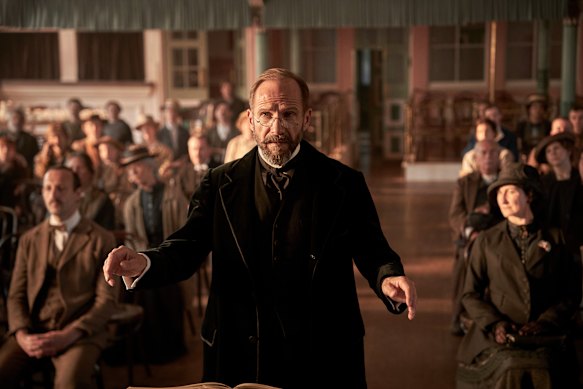
Ralph Fiennes as Dr Guthrie, recruited to direct a Yorkshire mill town’s annual music society production during World War I.Credit: AP
The year is 1916, and the show in rehearsal is a scaled-down version of Edward Elgar’s oratorio The Dream of Gerontius. In the eyes of the local bigwigs in the group, this is a daringly modern choice – but with Britain at war with Germany, it’s preferable to Bach or any other composer who might be associated with the foe.
The new choirmaster, Dr Guthrie (Ralph Fiennes), has spent a suspicious amount of time in Germany himself, nor is this the only reason his moral character might be called into question. But beggars can’t be choosers, now that Guthrie’s predecessor has headed off to fight for king and country.
In the same way, the choir is getting a little short on male voices, meaning that fresh blood has to be recruited, even if some of the lads who show up to the auditions aren’t ideal candidates in the eyes of the stuffier members of the group.
Hytner and Bennett are careful to keep the focus on the ensemble rather than any one character: Fiennes is the nominal star, but the film belongs at least equally to Roger Allam, best known as the pompous villains of V For Vendetta and Speed Racer.
He’s pompous here too as Bernard Duxbury, a leading figure in the town council not shy about throwing his weight around. But Duxbury is a more complex figure than he first appears – and he really does like singing, even if he can’t resist using it as an opportunity to show off.
In its gentle way it’s an allegory for democracy, everyone ultimately pulling together for a common purpose. But Bennett has his own kind of toughness, British national treasure though he is (“I don’t mind Jesus, but not while we’re having our tea,” one character says, perhaps the most Alan Bennett line even Bennett has ever written).
Whatever level of agreement is arrived at is fragile and fleeting at best. The most moving moments in this moving film occur when characters refuse to compromise their principles to smooth the path to a happy ending – indicating that Bennett, who knows the rules of entertainment like the back of his hand, has his own clear sense of where to draw the line.
3.27pm
Allegory lost in dazzling sequences in anthology film from star Chinese director
By Jake Wilson
Resurrection
★★★ (MA), 160 minutes
Opera, according to an old definition, is where a guy gets stabbed in the back and instead of bleeding he sings.
Bi Gan’s Resurrection isn’t literally an opera or a musical. But it has musical sequences – one involving a theremin, another set at a karaoke bar – and a bigger-than-life quality that could be called operatic. When a guy gets stabbed in the back here, instead of bleeding his wound emits blue ethereal light, while his attacker inexplicably bursts into flame.
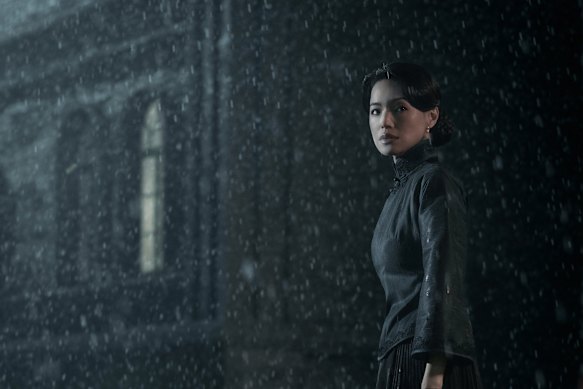
Shu Qi in Resurrection.Credit: Rialto
This is the first feature in seven years from Bi, widely viewed internationally as one of the top younger directors in China. Essentially, it’s an anthology film, with four main segments that span the second half of the 20th century.
Across these segments, the young star Jackson Yee appears in a range of guises, dying repeatedly then being restored to life. In each case, he’s a dubious character who pays a price for his misdeeds: a murder suspect on the run during wartime, a thief who stumbles into a Buddhist temple, a conman who recruits an orphan girl (Guo Mucheng) as his accomplice, and finally a gang member who falls in love on the eve of the new millennium.
This latter segment, lasting more than half an hour, plays out in a single unbroken take that follows Yee through the alleys of a port district bathed in lurid red light, the kind of stylistic stunt that has become Bi’s signature (in his 2018 Long Day’s Journey Into Night – no relation to the Eugene O’Neill play – a similar long take occupies the film’s entire second half).
Mark Chao in Resurrection.Credit: Rialto
The segments feel like dreams rather than fully coherent stories, and are set within a still more dreamlike framework, drawing on silent cinema but set in a future where dreaming itself is outlawed. Here Yee appears under heavy, pale makeup as a Deliriant, a pathetic yet monstrous figure hunted down by an enforcer ominously identified in the credits as the Big Other (Hong Kong-Taiwanese star Shu Qi).
What’s it all about, in the end? Some kind of political allegory is surely present, but is kept strategically equivocal and vague. More explicitly, the film deals with the art of cinema itself, understood as an ambiguous means of escape: the successive stories are presented as visions experienced by the Deliriant in his dying moments, with the Big Other’s blessing.
While Bi borrows from any number of cinematic sources, one precursor comes to mind above all: Leos Carax’s delirious yet melancholic 2012 Holy Motors, with the extraordinary Denis Lavant as a Parisian trickster who leaps from one identity to another throughout his working day.
But Resurrection has little of Holy Motors′ warmth and humour, and Yee, a huge star in China, doesn’t command the screen physically the way Lavant does (nor, in fairness, is he encouraged to do so).
The emotion that comes through most strongly is Bi’s determination to dazzle us any way he can, as if fearful his own time in the spotlight might soon run out.