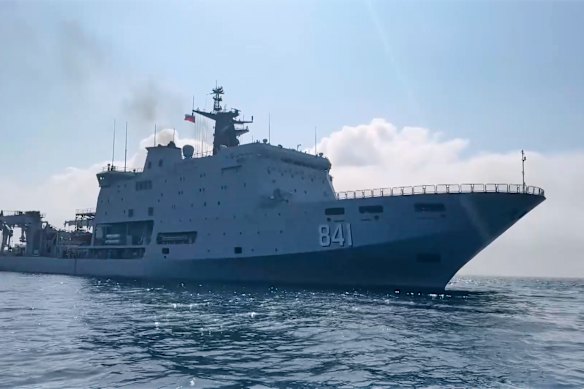
China fired rockets toward Taiwan on Tuesday and deployed new amphibious assault ships alongside bomber aircraft and warships to encircle the island on the second day of its most extensive war games aimed at rehearsing a blockade.
But US President Donald Trump, who is preparing to visit Beijing in April after reaching a truce earlier this year in his trade war with China, said he was not concerned by the exercises, launched just 11 days after the United States approved its biggest arms deal with Taiwan on record.
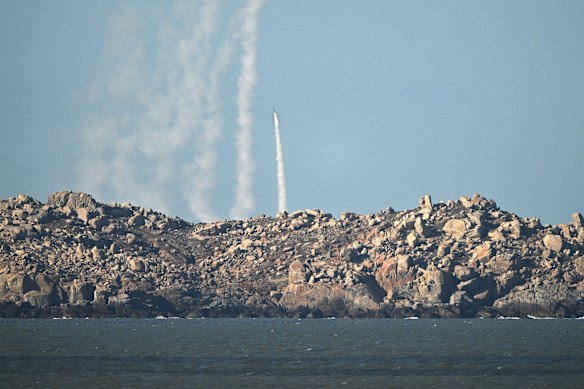
Chinese soldiers fire rockets as part of military drills on Pingtan island, the closest point to Taiwan.Credit: AFP
“I have a great relationship with [Chinese] President Xi [Jinping] and he hasn’t told me anything about it,” Trump said. “I certainly have seen it, but he hasn’t told me anything about it.
“Nothing worries me. They’ve been doing naval exercises for 20 years in that area.”
China’s defence ministry said 130 Chinese military aircraft and 22 navy and coastguard vessels had been operating around the island in the 24 hours up to 6am on Tuesday, numbers which aligned with those Taiwan said it had detected.
China’s Eastern Theatre Command said live firing would take place until 6pm on Tuesday in the sea and airspace of five locations surrounding Taiwan and off the Chinese coast, prompting warnings for commercial shipping and flights.
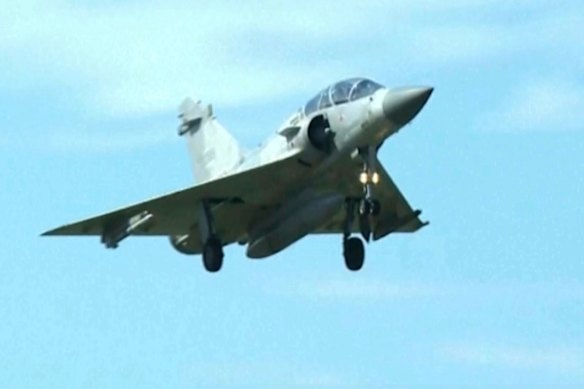
A Taiwan fighter jet prepares to land at the Hsinchu Airbase on Monday.Credit: AP
Naval and air force units also drilled strikes on maritime and aerial targets as well as anti-submarine operations to the democratically governed island’s north and south.
Named “Justice Mission 2025”, the drills began after the US announced a record $US11.1 billion ($16 billion) arms package to Taiwan and are Beijing’s largest exercises to date by total coverage and proximity to the island, following China’s Maritime Safety Administration on Monday adding two additional live-fire zones.
The first major drills off Taiwan since April served as a “stern warning against ‘Taiwan Independence’ separatist forces and external interference”, China’s Senior Colonel Shi Yi said in a statement before the operation began.
Taiwan sits alongside key commercial shipping and aviation routes, with some $US2.45 trillion in trade moving through the Taiwan Strait each year. Eleven of Taipei’s 14 flight routes were affected by the drills, according to Taiwan’s Civil Aviation Authority, although disruption to international flights appears to be minimal.
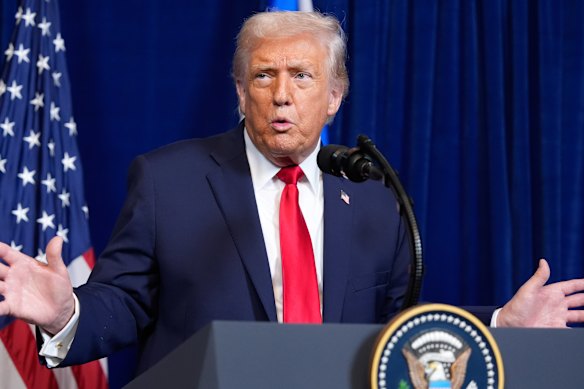
US President Donald Trump addresses the media at Mar-a-Lago on Monday.Credit: AP
The authority said 76 domestic flights to Taiwan’s offshore islands had been cancelled, affecting about 6,000 passengers.
Li Hanming, a US-based aviation analyst, said commercial carriers were making heavy use of two air corridors heading out to the island’s north-east in the direction of Japan.
The drills underscore how sensitive the Taiwan question is to Beijing, even as it seeks to stabilise relations with Washington, Taipei’s biggest backer.
It reacted angrily to the US arms sales to Taiwan, saying they raised the chances of a clash between the superpowers, and on Friday, China unveiled largely symbolic sanctions against 20 US defence companies and 10 executives.
But Chinese Foreign Minister Wang Yi said on Tuesday China wanted a healthy and stable relationship with the US, even as he reiterated Beijing’s opposition to the recent US arms sales to Taiwan.
He said China would remain engaged with the US on the basis of mutual respect but would not “yield an inch” on core interests, and repeated the ruling Communist Party’s decades-long position that the “reunification of Taiwan” is a mission that must be achieved.
The exercises are unlikely to disrupt China’s trade agreement with the US, according to Dylan Loh, associate professor of Nanyang Technological University, who said a more provocative action from Beijing was unlikely. In 2022, China sent missiles directly over the main island of Taiwan in response to then House speaker Nancy Pelosi visiting Taipei.
“They will want to hit the Goldilocks zone of inflicting pain and demonstrating resolve but not being seen as disproportionate,” Loh said. “A missile flying over the island would certainly fall under the [definition of] escalation that could invite tit-for-tat.”
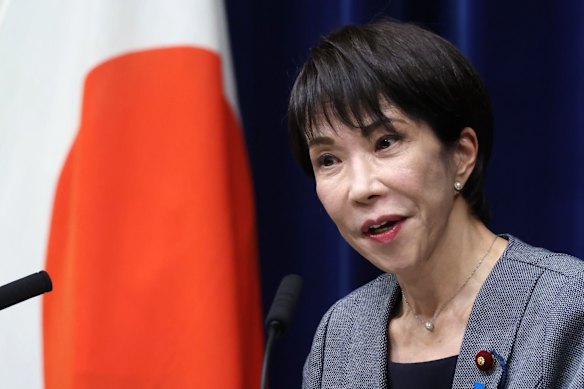
Japanese Prime Minister Sanae Takaichi addresses the media in Tokyo on December 17.Credit: Bloomberg
Footage issued by China showed machine guns on the deck of warships firing into the sea, military aircraft taking off and missiles getting into launch position for what a narrator described as “simulated strikes”.
The areas the Chinese military marked for the exercises were bigger than in the past, according to William Yang, senior analyst for north-east Asia at the International Crisis Group.
The PLA is signalling its “intent to enhance its troops’ anti-access and area-denial capabilities, which sends a direct signal to the US and its allies – especially Japan – about Beijing’s determination to block external interference in future contingency over Taiwan”.
Beijing and Tokyo have been at odds since early November, when Japanese Prime Minister Sanae Takaichi said her nation’s military could theoretically be deployed if China were to attack Taiwan. Beijing reacted fiercely to those remarks, including by placing limits on Chinese tourists travelling to Japan.
China is holding live-fire exercises near Taiwan.Credit: AP
The latest drills also come as Xi’s widening purge of the military has raised questions about its combat readiness.
“China is getting very, very good at conducting snap exercises to the point where one could happen very quickly,” said Jaime Ocon, a research fellow at Taiwan Security Monitor. “I think that’s very dangerous for Taiwan.”
‘Egregious in nature’
China’s military is holding drills because “collusion between the US and Taiwan has become frequent and egregious in nature”, an expert told Yuyuan Tantian, a social media account linked to China’s state media.
Loading
In a video posted by the account, Fu Zhengnan – an expert with China’s Academy of Military Sciences – pointed to the size of the US arms package and what he called a shift from defensive to offensive weaponry.
Fu was likely referring to the High Mobility Artillery Rocket System, or HIMARS. Those weapons, which Ukraine has used effectively in its fight against Russia, can strike well beyond China’s south-eastern coast. Taiwan first got them last year and started testing them in May 2025.
A spokesperson for Beijing’s Taiwan Affairs Office said the latest drills are “intended to curb the collusion between ‘Taiwan independence’ forces and external powers to stir up trouble in the Taiwan Strait”.
Loading
Beijing has stepped up military intimidation of the democracy of 23 million people since Taiwan President Lai Ching-te took office in May 2024. China views Taiwan as a breakaway province that must be brought under its control, by force if necessary – a stance Taipei steadfastly rejects.
In an interview, Lai told a television station that Taiwan must “keep raising the difficulty” for any attack by China.
“When we ask our service members to stand on the front lines to defend the country, we must ensure they are provided with weapons in sufficient quantity and of high quality,” he vowed.