Nvidia’s new G-Sync Pulsar monitors target motion blur at the human retina level
Four new monitors promise "effective motion clarity of a theoretical 1,000 Hz monitor."
That gives those individual pixels time to fully transition from one color to the next before they’re illuminated, meaning viewers don’t perceive those pixels fading from one color as they do on a traditional G-Sync monitor. It also means those old pixels don’t persist as long on the viewer’s retina, increasing the “apparent refresh rate” above the monitor’s actual refresh rate, according to Nvidia.
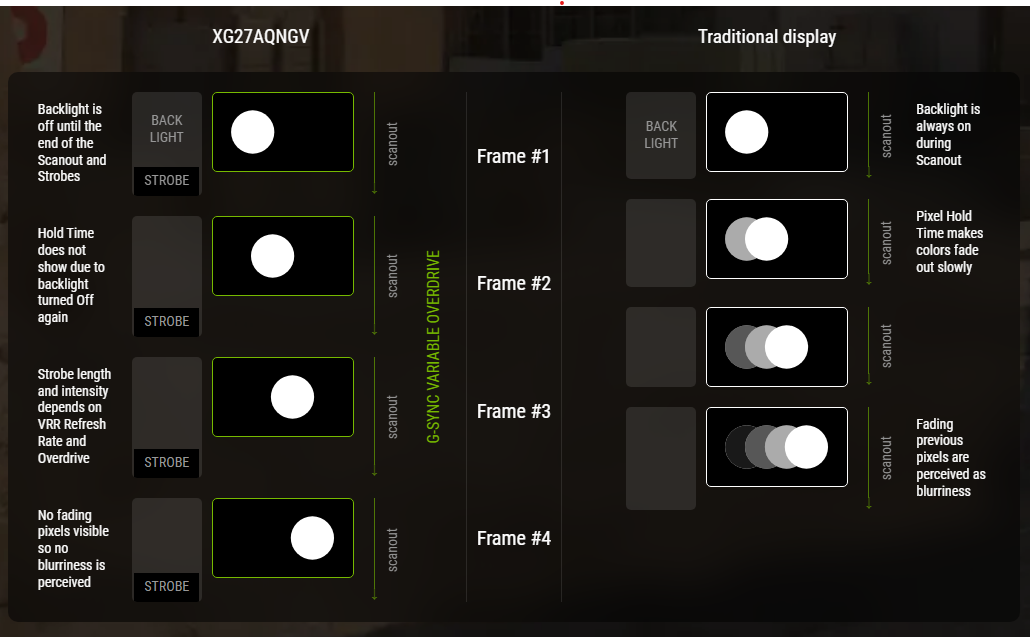
An Asus illustration highlights how G-Sync Pulsar uses strobing to limit the persistence of old frames on your retina.
An Asus illustration highlights how G-Sync Pulsar uses strobing to limit the persistence of old frames on your retina. Credit: Asus/ Nvidia
Similar “Ultra Low Motion Blur” features on other pulsing backlight monitors have existed for a while, but they only worked at fixed refresh rates. Pulsar monitors differentiate themselves by syncing the pulses with the variable refresh rate of a G-Sync monitor, offering what Nvidia calls a combination of “tear free frames and incredible motion clarity.”
Independent testers have had more varied impressions of the visual impact of the Pulsar. The Monitors Unboxed YouTube channel called it “clearly the best solution currently available” for limiting motion blur and “the first version of this technology that I would genuinely consider using on a regular basis.” PC Magazine, on the other hand, said the Pulsar improvements are “minor in the grand scheme of things” and would be hard to notice for a casual viewer.
Nvidia explains how its Pulsar monitors work.
In any case, G-Sync Pulsar should be a welcome upgrade for high-end gamers as we wait for 1,000 Hz monitors to become a market force.