NYC Schools Are Losing Students and Burning Cash. Mamdani Could Make the Situation Worse.
New York schools need more choice and better curricula, but the city's new mayor wants to take choices away.
In the February/March 2026 issue of Reason_, we explore Mayor-elect Zohran Mamdani's policy goals and what they mean for New York City. Click here to read the other entries._
New York Mayor-elect Zohran Mamdani is inheriting a public school system that has made some progress in student learning but is completely dysfunctional in terms of financial stability and operations. And his campaign promises are likely to worsen the system's flaws.
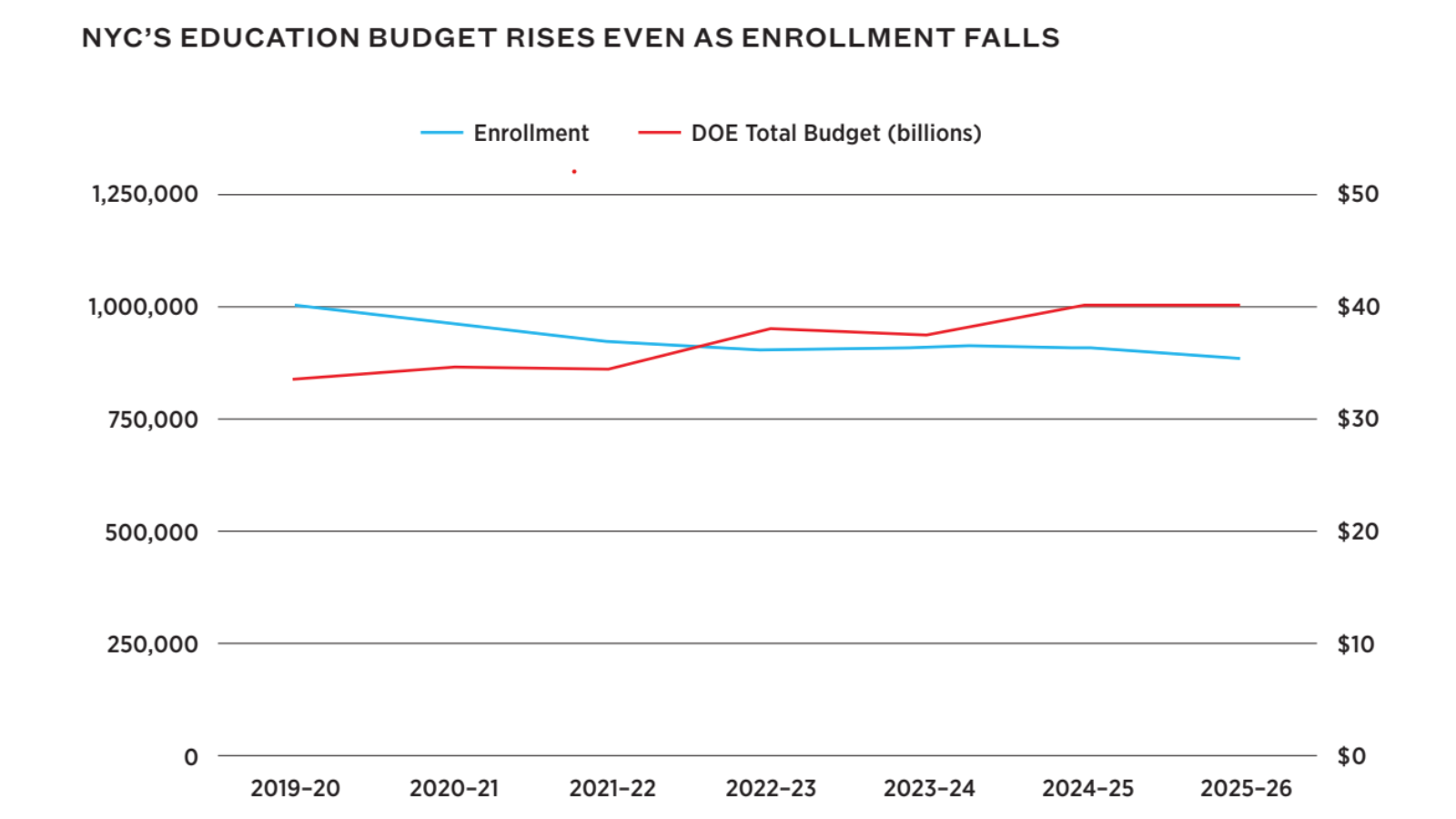
New York City's public schools once educated more than a million students, but the system's enrollment has been steadily declining. Since 2020, it has lost 10 percent of its K-12 students. Even with the expansion of pre-K and 3-K programs for young children, the schools are serving 115,000 fewer students than they did seven years ago.
Yet the budget for the city Department of Education (NYC DOE) has greatly increased, rising from $33 billion in 2019 to over $40 billion this year. This disconnect between enrollment and budget has led to the highest per-pupil spending in the nation, which the Citizens Budget Commission estimates will reach $42,000 this year.
New York City Department of Education
The shrinking number of students seems set to continue. Pre-kindergarten applications decreased by 8 percent this school year. In 2020, the New York school system had 59,143 kindergarteners; last year, that number was 55,461.
Because of this loss of students, the number of schools that are too small to remain financially viable has increased. In the 2023–24 school year, there were 80 schools with fewer than 150 students; that number has risen to 112 this year. Mayor Eric Adams closed or merged 16 schools, but he also opened or planned to open 28 new ones. Closing schools is unpopular and requires political will, and Adams showed no appetite for that.
Unfortunately for Mamdani, the schools' fiscal situation is about to worsen. The class size law passed in Albany in 2022, which Mamdani voted for as a State Assembly member, mandates that New York City schools limit classes to no more than 20 students in kindergarten through third grade, 23 students for grades four through eight, and 25 students for high school classes. To comply with this law, the city will likely need an additional 7,000 to 9,000 teachers. The Independent Budget Office estimates that will cost an additional $1.6 billion to $1.9 billion annually. Mamdani, who was endorsed by the teachers union, has pledged to comply with this mandate regardless of cost.
NYC Reads—But Not As Well as It Should
Adams' administration did get some good results revamping the city's early literacy program. In 2023, David Banks, then chancellor of the NYC DOE, launched NYC Reads, a program to ensure that all schools adopt curricula and practices that follow the science of reading. It includes phonics instruction and content-rich lessons to build vocabulary and background knowledge.
Across the nation, states and districts have been rapidly changing how they teach students to read, and some (mostly in the South) are achieving significant success in improving literacy rates. This movement is focused on moving away from curricula that taught children to merely "guess" words based on pictures and other cues. The NYC DOE had been the largest client for Heinemann Publishing, spending over $20 million in the past decade purchasing faulty curricula authored by Lucy Calkins, Irene Fountas, and Gay Su Pinnell; these authors all encouraged such guesswork, without any phonics instruction to teach kids to decode. But since NYC Reads began, the city's public schools can select one of three curricula that include both phonics instruction and content-rich lessons.
The city has seen gains in English language arts test scores in the past year, increasing the proficiency level on all grade levels by 7.2 percent. Still, more than 40 percent of students in grades three through eight cannot read at grade level. It will take years of concerted effort to change these numbers. And the NYC Reads program is hardly perfect. Twenty-two out of the 32 school districts chose "Into Reading," a curriculum the education writer Natalie Wexler has faulted for low-quality reading selections and for curricula that are too "scripted." The Reading League is a respected national organization that reviews curriculum and provides advice and professional training to school districts on reading. Their review of "Into Reading" includes a number of red flags in areas such as practice for spelling, writing assignments, word recognition, and handwriting instruction.
Even the best curriculum won't work if students don't take the lessons. Currently, 34.8 percent of New York City students are missing more than 10 percent of school days, including more than 40 percent of kindergartners.
A rational mayor would conclude the system needs to reduce expenses, keep implementing NYC Reads, and tackle chronic absenteeism. Unfortunately, Mamdani's proposals are likely to have the opposite effect.
Mamdani's War on Mayoral Control and Gifted and Talented Programs
During the campaign Mamdani spoke little about his plans for the NYC DOE, even though it comprises 40 percent of the city's budget. His campaign website had only 168 words on education. His main education focus has been on eliminating mayoral control, ending gifted and talented programs, supporting the smaller class size law, and criticizing charter schools.
In 2002, Mayor Michael Bloomberg was granted control of NYC public schools, which previously had been managed via 32 different elected school boards and the NYC DOE. Bloomberg described the previous system as "a rinky-dink candy store" and battled with corruption and patronage. The local boards were so corrupt that the state government passed legislation in 1996 to transfer their power to the schools chancellor. Moreover, it was impossible with the old system to implement any citywide initiative such as NYC Reads since it would require persuading and coordinating 32 different local school boards.
Mayoral control seemed to be doing more than fine. NYC was awarded the Broad Prize for Urban Education for raising education outcomes, especially for minority students, five years after it was implemented. Mayoral control allowed Bloomberg to introduce a number of systemwide initiatives which led to rising graduation rates and student scores across the board. For example, his administration closed a number of low-performing high schools and created new schools—graduation rates increased from 54 percent in 2004 to 80 percent in 2018. But in 2024, the New York State Board of Regents described its results as "mixed," citing equity concerns and pointing out that parents and community leaders have limited opportunities for input into major education decisions.
Mamdani is actively against mayoral control. His main criticism is that the current system does not allow parents and local communities to have input in school decisions and encourages "a culture of secrecy and patronage at the top." But the old system had no clear entity or person accountable for academic outcomes, chronic absenteeism, or citywide initiatives such as class size implementation.
The problems with New York schools are serious and demand a serious mayoral response. An NYC DOE survey of families who left public schools shows that the primary reason for their departure is a desire for "more rigorous education than what is possible at NYC public schools." The most rigorous schools in NYC are the Gifted & Talented (G&T) and Specialized High Schools Admissions Test (SHSAT) schools, yet Mamdani is proposing to eliminate these programs at the kindergarten level.
The city has 86 schools classified as G&T, offering kindergarten seats. Every year 10,000 families apply to these programs, but only 2,500 kindergarteners seats are available at a G&T school or in a different class for gifted students within a school that has a general education program. There is a wide variety in the quality and number of applications to these programs: Some G&T programs are in low-performing schools and are unable to fill all their seats.
Of the 86 schools that house a G&T program, six only offer G&T classes; they are considered the most prestigious. These six schools have only 375 kindergarten seats available, yet receive an average of almost 10 applications per seat. Over 28 percent of the students at these six schools are classified as economically disadvantaged.
While the average school in the system has $22,857 allocated per student (in addition to $12,877 in average central services spending per pupil), these G&T schools receive a far lower $13,444 to $16,808 per student. Thus, they cost on average significantly less than other schools, are highly sought after, and deliver an excellent education to a student body that is almost one-third low-income students.
School
# of kindergarten seats SY 25–26
# of applications for kindergarten SY 25–26
Funds allocated per student SY 24–25 (citywide average is $22,857)
NEST+m
100
942
$14,141
The Anderson School
50
1001
$13,705
TAG (Talented and Gifted School for Young Scholars)
50
370
$14,223
Brooklyn School of Inquiry
50
468
$14,071
PS/IS 300
50
424
$13,444
PS77 Lower Lab
75
534
$16,808
Source: "School Budget At a Glance," New York City Department of Education
At the high school level, eight schools admit students solely based on their scores from the SHSAT, and 55 percent of their student bodies are low-income. Like the G&T schools, these schools are very efficient: Most SHSAT schools receive approximately 40 percent less than the citywide average per student. These schools consistently rank among the best public high schools in the state.
In October, a Mamdani campaign spokesperson said he plans to eliminate G&T programs in kindergarten, arguing that "identifying academic giftedness at age 4 is difficult to do objectively through any assessment, whether it be tests or teacher nominations."
Mamdani is hostile to any program that seems to offend his sense of total equality in educational access, no matter how much it improves outcomes for the students in them; in May, Mamdani described SHSAT schools as "one example of systemic issues across our school system—the most segregated in the nation" and expressed support for the 2019 School Diversity Advisory Group report which recommended phasing out all G&T programs and eliminating all objective admission criteria for middle schools and high schools in favor of efforts to make schools more integrated by race and income.
There is some hope that Mamdani's animus against anything he sees as inequality in education won't hobble the SHSAT program. In October, his spokesperson said that "Zohran has said on multiple occasions he will keep the SHSAT." But if Mamdani forces the SHSAT schools to comply with the class size law, these schools would lose effectiveness, because they would have to reduce the number of seats and fewer students would be accepted every year. (A proposed law in the state Senate would create exemptions for G&T and SHSAT from the class size laws.)
In his obsession with educational equality of access, Mamdani has also criticized charter schools. He is opposed to charter schools sharing buildings with regular public schools, and he intends to audit charter school finances. The colocation of charters has created tensions between schools with very different cultures; at the same time, the city's charter school expansion would not have been possible without this practice, due to the high price of real estate.
Charter schools currently educate more than 150,000 students in New York City; 82.9 percent of them are low-income, and 19.3 have special needs. A 2023 Stanford University Center for Research on Education Outcomes study found that the city's charter schools are performing well compared both to other cities and to the city's public district schools. According to that study, students in the city's charter schools learn the equivalent of an extra 80 days of math instruction compared to those in district schools.
Mamdani's Anti-Choice Education Agenda
Mamdani's education plans are contrary to what NYC families want: more school options and more rigorous education. The 10 best elementary public schools in New York, as ranked by U.S. News & World Report, are either G&T or charter schools, which Mamdani is hostile to. He wants to eliminate or stifle the very schools that NYC families actively wish to enroll their children in. While half of the country is moving toward empowering families to choose the best education for their children, allowing public funding to follow those choices, Mamdani wants New York City to move in the opposite direction. His proposals could reduce or eliminate the only public schools that are popular with New York parents and that consistently achieve excellent academic results.
If the city wants to retain students and stabilize enrollment numbers, losing the most desired programs is a terrible choice. Parents have more choices than ever today. It has never been easier to homeschool, with access to learning pods, micro-schools, and online options available across the city. The number of homeschoolers in New York City has grown from 9,000 in 2020 to more than 15,000 in 2024—an increase of more than 68 percent.
The public schools should follow parents' lead. Close the schools that are underenrolled and that families are not applying for. Expand the schools and programs that are popular and have many applicants. The best public schools happen to also be the most efficient, which would help to lower the per-pupil cost and control the NYC DOE budget. A mayor who keeps this focus and can show results would have a strong track record to run for reelection in four years. But Mamdani's emphasis on equality over excellence in education will have him bungling one of the mayor's most important responsibilities.
This article originally appeared in print under the headline "Mamdani's Education Agenda for Less Learning."