Oddball 'platypus galaxies' spotted by James Webb telescope may challenge our understanding of galaxy formation
Astronomers spotted nine galaxies with characteristics that have never been seen as a collection before. It's possible this is a newly found type of star-forming galaxy.
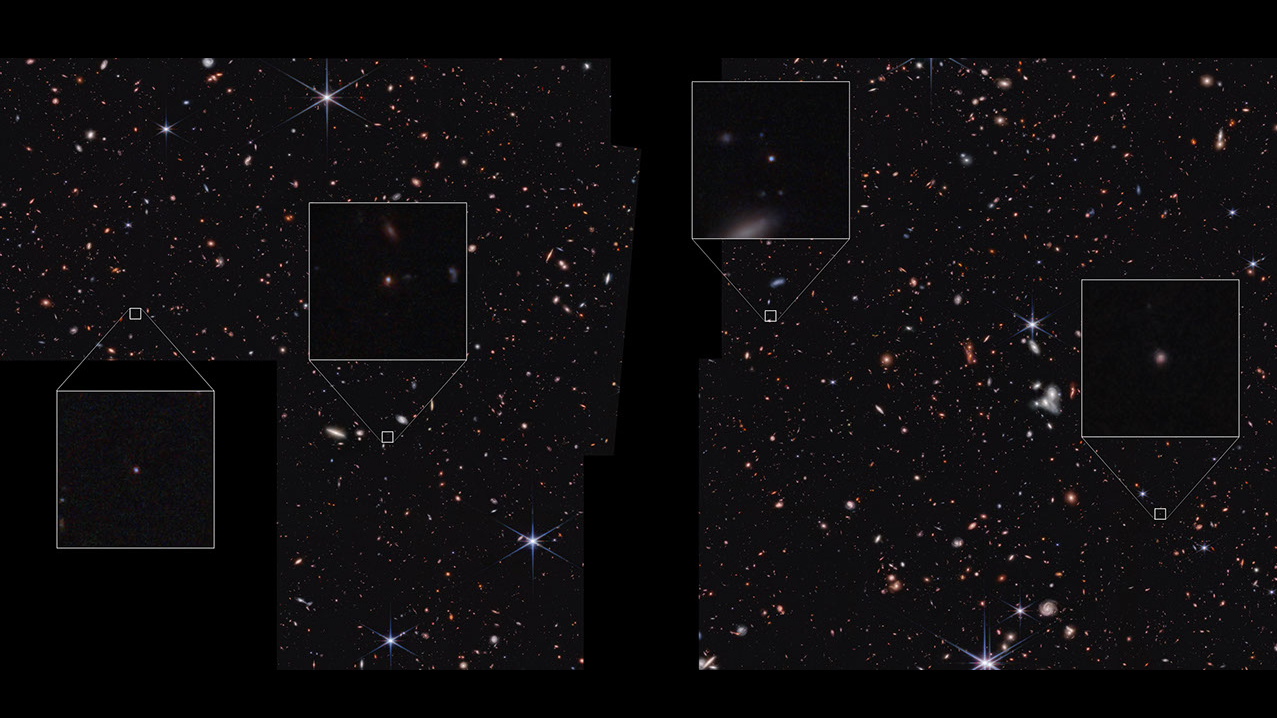
Four newly found galaxies (shown in the boxes) have a collection of unusual characteristics that remind scientists of the difficulty of classifying platypuses. The galaxies were spotted in archival data from the James Webb Space Telescope. (Image credit: NASA, ESA, CSA, Steve Finkelstein)
A new category of space objects dubbed "platypus galaxies" is defying explanation.
These nine strange cosmic objects, spotted in archival data from the James Webb Space Telescope, cannot easily be characterized by their features. They are small and compact, but they don't appear to host active supermassive black holes or to be quasars, enormous black holes that glow as brightly as galaxies, according to new research.
Researchers have dubbed the cosmic oddballs "platypus galaxies" because, like platypuses — rare egg-laying mammals — they are difficult to classify, Haojing Yan, an astronomer at the University of Missouri who led the team, said when presenting the findings at the 247th meeting of the American Astronomical Society in Phoenix this week.
"The detailed genetic code of a platypus provides additional information that shows just how unusual the animal is, sharing genetic features with birds, reptiles, and mammals," Yan said in a statement describing the research, which is available as a preprint via arXiv. "Together, Webb's imaging and spectra are telling us that these galaxies have an unexpected combination of features."
Looking at this collection of galaxy characteristics, he added, is like looking at a platypus. "You think that these things should not exist together, but there it is right in front of you, and it's undeniable," he said.
For example, typical quasars — which are extremely luminous and energetic objects — have emission lines in their spectra that look a bit like hills. The spectra also indicate that gas is circulating quickly around a supermassive black hole in the center.
Yet the nine newfound galaxies have narrow and sharp spectra, signaling that the gas is moving more slowly. Although some galaxies with narrow and sharp spectra have supermassive black holes in their centers, unlike that group, the new galaxies don't look like "points" in the images.
Get the world’s most fascinating discoveries delivered straight to your inbox.
So if the mysterious objects aren't quasars and they don't host supermassive black holes, what are they? One possibility is that they represent a newly found type of star-forming galaxy that populated the early universe, which is optimized to see.