Optimus Schmoptimus - Boston Dynamics' humanoid robot is already in mass production
CES 2026 Remember when Elon Musk predicted that there would be thousands of Optimus robots at Tesla factories by the end of 2025? Well, that didn't happen, but competitor Boston Dynamics has just announced that its humanoid robot, Atlas, is going to the big time.
Not only is Boston Dynamics beginning commercial production of the final version of Atlas, but it's also solidified plans to deploy tens of thousands of Atlas units at Hyundai Motor Group manufacturing facilities. Hyundai, Boston Dynamics' majority shareholder, will start with deployment of Atlas at its Robot Metaplant Application Center in the coming months. Boston Dynamics noted that Hyundai's $26 billion investment in US manufacturing announced last year will also include a robotics factory able to produce 30,000 bots a year, many of which will presumably be Atlas units based on its context in the Atlas press material.
In addition to its planned Hyundai deployments this year, Boston Dynamics also announced a partnership with Google DeepMind at CES that will see the pair working out how to integrate Gemini Robotics AI foundation models into Atlas to, according to Boston Dynamics, "give the robot greater cognitive capabilities."
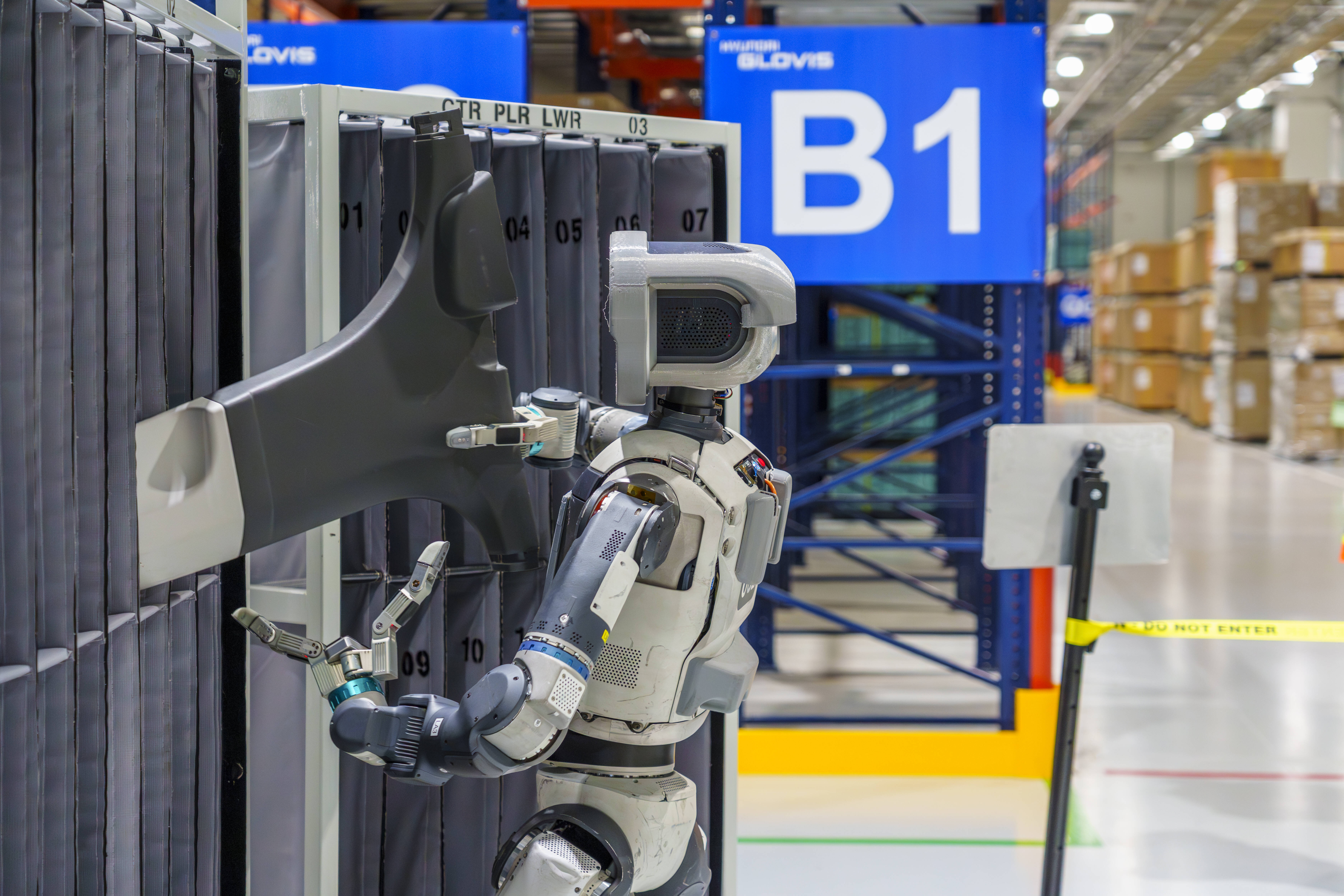
An Atlas prototype conducting part sequencing work at a Hyundai factory as part of earlier proof of concept work - Click to enlarge
Those two commitments mean that all the Atlas units slated for production this year are spoken for, but Boston Dynamics noted it's planning to add additional customers in early 2027. We asked if Boston Dynamics had any customers lined up for 2027, but it declined to name any.
We've known the all-electric, commercial version of Atlas was coming since 2024, when Boston Dynamics retired the old version in favor of a prototype that looks generally like what the robotics leader unveiled at CES this week.
Speaking of 2024, Boston Dynamics seemed to take direct aim at some other humanoid robot manufacturers when it cited its late entry into the game.
"Boston Dynamics only announced its intention to build a commercial humanoid in 2024, after it became clear that recent AI advances had accelerated the pace of how robots could be trained and deployed into real-world applications," the company said in a press release.
You may recall Tesla AI Day 2021, when Elon Musk embarrassingly trotted out a guy in a morph suit to demonstrate his dream of humanoid robots able to serve as replacements for human labor. By the following year, Optimus hadn't advanced all that much. Fast-forward to 2025, and Musk was predicting Optimus version 3 prototyped by the end of the year.
Not only did that not happen, but Musk's claim Tesla would produce 5,000 to 10,000 Optimus robots in 2025 butted up hard against the embarrassing reality that Optimus isn't only behind the curve, but likely doesn't have any autonomous capabilities at all.
Atlas, on the other hand, is now in production and has software that allows it to not only be tele-operated via VR or controlled by a tablet, but also lets it function autonomously.
- Musk deflects sluggish Tesla car sales with Optimus optimism
- Inventor who encouraged Elon Musk to make Optimus says most humanoid robots today are 'terrifying'
- Struggling to sell EVs, Tesla pivots to slinging burgers
- Tesla's Optimus can't roll without rare earth magnets, and Beijing ain't budging yet
"Atlas is going to revolutionize the way industry works, and it marks the first step toward a long-term goal we have dreamed about since we were children – useful robots that can walk into our homes and help make our lives safer, more productive, and more fulfilling," Boston Dynamics CEO Robert Playter said of the Atlas production launch.
The robot has two batteries that it's able to hot-swap on its own, it's able to operate in temperatures as low as -4° F to as hot as 104° F (-20° C to 40° C), is IP67 rated, has 56 degrees of freedom, is padded and has minimal pinch points to reduce the risk of injury to humans operating in the same space as it, and was designed with simple components that can be swapped out for field repairs with minimal time and effort.
Atlas is supposedly able to learn autonomously from its environment, and can push its newfound knowledge to other Atlas units in a company's fleet. Atlas also has 360-degree vision to help it spot people before they get too close to its working space, and is designed to pause whenever it could put a person in danger, then continue its work once they're clear.
As to it making a leap forward in humanoid robotics with this announcement, Boston Dynamics told us we shouldn't be surprised.
"Over a decade ago, we were one of the only companies on the planet putting real R&D into humanoid robots. Now it seems like every week a new company pops up with big plans to make humanoids," a company spokesperson told The Register. "We don’t take it lightly, and if we were going to make a commercial humanoid, we had to be convinced we have a solid plan not only to build something cool, but to build something useful."
The hydraulic version of Atlas that the company retired in 2024 had been under development since 2013, and by the end of its run, was capable of doing some impressive stunts.
"Our commercialization track record with Spot and Stretch gives us confidence that our commercialization with Atlas will be successful," the company added, noting that its customers are hungry for new Boston Dynamics robots "because they know what to expect."
Tesla didn't respond to questions for this story. ®