Patriot Viper PV593 4TB SSD Review — The Viper stays sleeping
The Patriot Viper PV593 is perfectly good on paper and delivers satisfactory marks but doesn’t quite close the deal.
The Patriot Viper PV593 is good on paper and delivers satisfactorily, but without a price cut it isn’t very compelling.
Pros
-
Fast PCIe 5.0 SSD
-
Power-efficient
Cons
-
-
Weaker relative performance
-
-
Unknown cost/availability
-
-
Nothing to set it apart
Why you can trust Tom's Hardware Our expert reviewers spend hours testing and comparing products and services so you can choose the best for you. Find out more about how we test.
Go to page:
Patriot Memory has been around a very long time, and we’re glad to see some newer, faster drives coming out of its halls. Known for its inexpensive and practical SSDs, the company is being a bit bolder with some of its latest products, like the Viper PV593. This is a high-end, PCIe 5.0 SSD that promises up to 14 GB/s of bandwidth for your newest build. At the same time, it’s positioned to be more affordable without any fanfare or extra flair. RGB drives have their place, but we’re glad Patriot took a more straightforward approach with this one.
Pairing “budget” and “high-end PCIe 5.0” seems like a combined misnomer, but in fact, the market is unexpectedly headed that way. When some of these drives were taped out, there were early warning signs of impending doom for AI memory demand, but in past years, SSDs have resisted price increases quite well. It’s therefore reasonable to assume that Patriot planned the PV593 at a time when it could get a drive like it out the door, and less-informed builders or prebuilt buyers would just assume it’s among the best. Its price savings would keep it attractive for those markets.
Now that we’re seeing much larger and swifter price swings than we have in a long time, the PV593 seems to make even more sense because you might need to save every dollar on storage with a lot of pressure to build early at hand. In fact, this market puts more stress on Patriot because many users will opt for a solid PCIe 4.0 drive or go all-in on the very best PCIe 5.0 drives without much exposure in between. That’s a psychological perspective because, in reality, the biggest costs are from the NAND flash, and that’s going to be a problem at all levels. This means that a drive like the PV593 needs to be priced very carefully, and, at the time of review, that’s just not the case, with the recently reviewed Adata XPG Mars 980 Blade handling that much better at the moment. The drive still makes sense for a system with multiple PCIe 5.0 SSDs, where it could slot in beneath your fastest primary drive. Still, the relative attractiveness very much depends on volatile price competitiveness.
Patriot Viper PV593 Specifications
Swipe to scroll horizontally
Product
1TB
2TB
4TB
Pricing
N/A
Form Factor
M.2 2280
M.2 2280
M.2 2280
Interface / Protocol
PCIe 5.0 x4
NVMe 2.0
PCIe 5.0 x4
NVMe 2.0
PCIe 5.0 x4
NVMe 2.0
Controller
Silicon Motion SM2508
Silicon Motion SM2508
Silicon Motion SM2508
DRAM
LPDDR4x
LPDDR4x
LPDDR4x
Flash Memory
Micron 232-Layer TLC
Micron 232-Layer TLC
Micron 232-Layer TLC
Sequential Read
14,000 MB/s
14,000 MB/s
14,000 MB/s
Sequential Write
10,000 MB/s
13,000 MB/s
13,000 MB/s
Random Read
1,650K
2,000K
2,000K
Random Write
1,650K
1,650K
1,650K
Security
N/A
N/A
N/A
Endurance (TBW)
700TB
1,400TB
3,000TB
Part Number
PV593P1TBM28H
PV593P2TBM28H
PV593P4TBM28H
Warranty
5-Year
5-Year
5-Year
The Patriot Viper PV593, or PV593 for short, is – on paper – available at 1TB, 2TB, and 4TB. At the time of review only the 1TB and 4TB were in stock at $159.99 and $399.99, respectively. These prices are high compared to the competition but they may be MSRP rather than street and, further, recent massive cost increases for SSD components has changed the pricing baseline. You may be able to find this drive available at a more reasonable price but we’re judging things based on current market conditions.
It’s a high-end drive capable of hitting 14,000 / 13,000 MB/s for sequential reads and writes and up to 2,000K / 1,650K random read and write IOPS. These numbers are pretty standard for a high-end PCIe 5.0 SSD but we have seen higher. The warranty is also standard at five years with up to 700TB of writes per TB capacity, which is higher than the 600TB baseline but not considerably so. However, if prices are equal with other drives in its class this might tip the PV593 into your favor.
Patriot Viper PV593 Software and Accessories
For more information about your drive we recommend the CrystalDiskInfo application which is free to download and use. Its partner application, CrystalDiskMark, is a solid baseline benchmark that’s also free. For cloning and data backup we recommend the free MultiDrive, although this is Windows-only at this time. For other operating systems or booting we suggest Clonezilla or SystemRescue.
Patriot Viper PV593: A Closer Look
Image
1
of
2
(Image credit: Tom's Hardware)
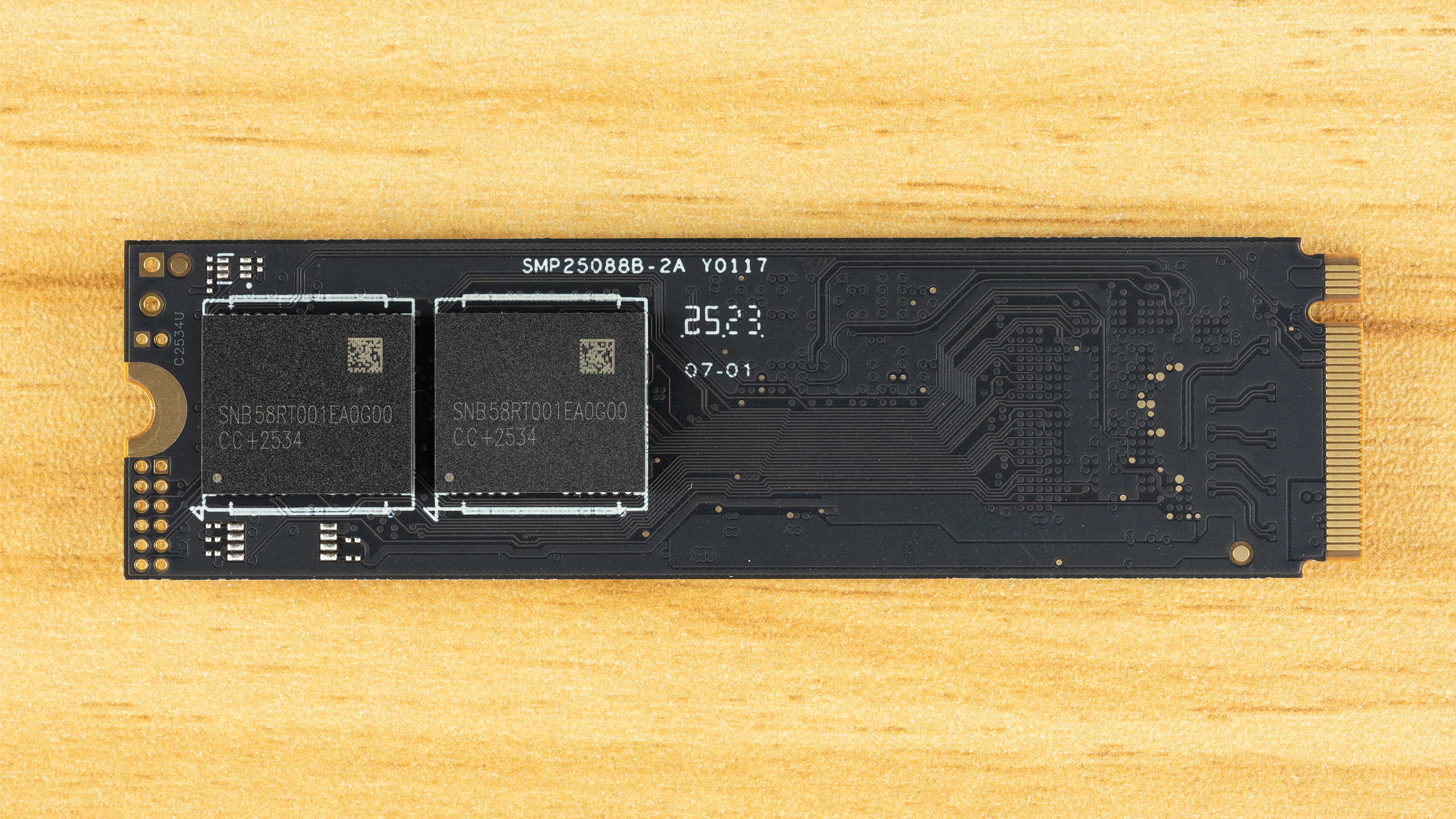
We’ll cut to the chase as this drive doesn’t have a fancy heatsink or heatspreader: it’s a double-sided drive with a full-fledged SSD controller, one DRAM package, and four NAND flash packages. We expected a double-sided drive at this capacity and the specifications from Patriot suggest that all capacities are double-sided. This is similar to the case in our recent Adata XPG Mars 980 Blade review, possibly done to save on cost.
Get Tom's Hardware's best news and in-depth reviews, straight to your inbox.
The form factor used for the flash packages also emphasizes the intent to minimize the use of space. A majority of the heat production will be on the top side so this drive should not be difficult to cool if you choose to do so. This is further helped by the fact that the PV593, unlike the 980 Blade, uses LPDDR4x in a single package for the DRAM.
Image
1
of
2
(Image credit: Tom's Hardware)
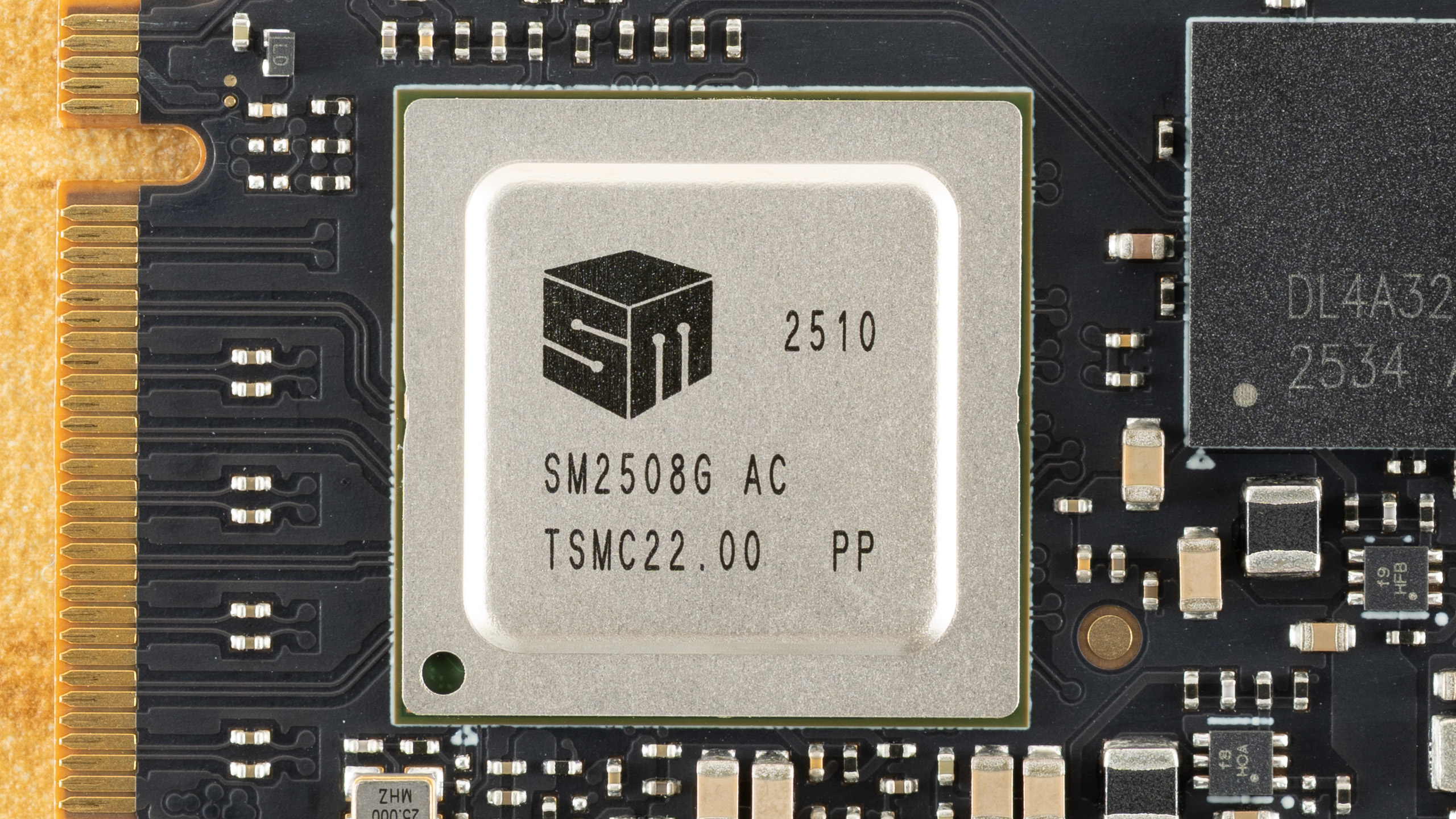
For full details on the Silicon Motion SM2508 SSD controller please see our original review where we discuss some of the technical aspects of the hardware. Now that the controller is out with a range of flash we can sum it up as being a high-end controller with eight flash channels and DRAM, making it one of the fastest consumer options out there. The exact height of its performance depends on the flash being used.
In this case, we can interpret the flash coding “B58R” part to indicate that this is Micron’s B58R 232-layer TLC flash. This flash has been very popular on a number of drives but is technically outdated by today’s standards. Micron’s 276-Layer TLC flash on the Crucial T710 and SanDisk’s BiCS8 TLC flash on the Kingston Fury Renegade G5, to name two leading drives, both have advantages over the older flash. Using older flash can reduce cost, however, which is becoming a more serious concern with challenges due to an emerging memory supercycle. When an entire class of products is seeing inflated costs any savings can be more impactful.
MORE: Best SSDs
MORE: Best External SSDs
MORE: Best SSD for the Steam Deck
Shane Downing is a Freelance Reviewer for Tom’s Hardware US, covering consumer storage hardware.