Plan first, invest later: Why choice between new & old tax regimes requires deep planning
SOURCE:Times of India|BY:MAHENDRA YADAV
Taxpayers are facing higher tax outgo due to incorrect regime choices, often stemming from misunderstandings of exemptions and documentation. Experts advise projecting liabilities under both regimes, with high HRA and rent payments favoring the old system, while low rent benefits the new.
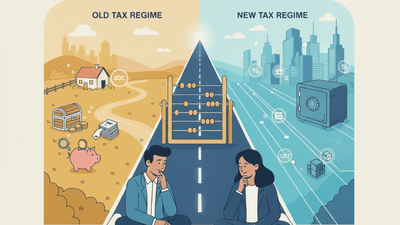
AI image
With the new tax regime now the default option, many taxpayers are discovering that the choice between the old and new regimes is no longer a routine filing decision but one that can significantly impact their tax outgo.Even as the government nudges taxpayers towards a simpler, exemption-light system, many taxpayers continue to opt for the old regime. Tax experts say that in the current environment, a wrong regime choice has led to higher tax payments for many taxpayers this assessment year, largely due to misunderstanding of exemptions, rent structures, and documentation requirements.So what should taxpayers check before choosing a regime, who paid more tax due to a wrong call, and what needs to change in your tax planning going forward?
The tax planning framework: What to consider first
According to Ashish Mehta, Partner at Khaitan & Co, the shift towards the new regime is visible in filing trends."The new tax regime is being increasingly pushed and made attractive with relaxed slab rates, higher standard deduction, and an enhanced rebate (as compared with the old scheme) effectively ensuring income up to about Rs 12–12.75 lakh is tax-free in case of salaried taxpayers," he said. "Tax filing trends reflect a steady migration towards the new scheme.""The new scheme's simplicity and lower compliance burden appeals especially to those without significant deductible exemptions / deductions as well as young salaried taxpayers who are not used to investing in tax saving products and who need higher disposable income in hand," Ashish Mehta explained.
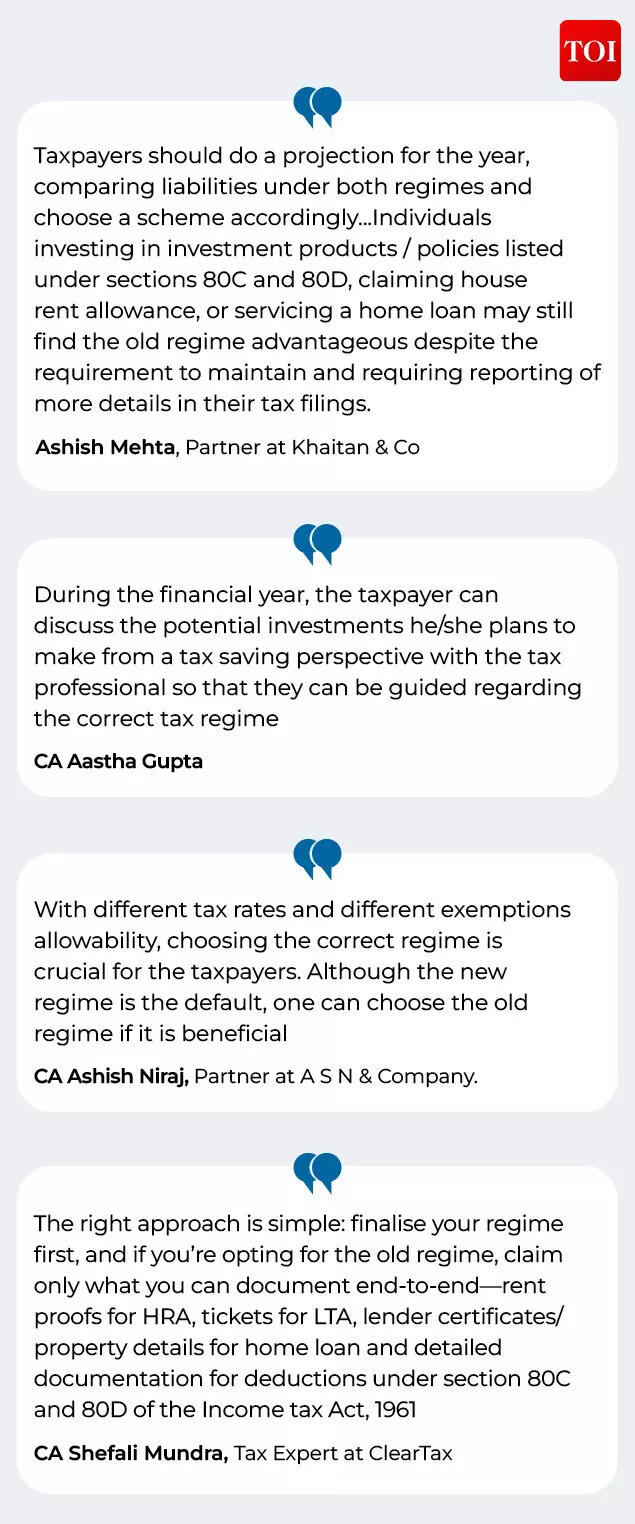
He added: "Higher disposable income fuels consumption and boosts the economy and departure from tax linked investments also helps the government as it reduces its burden of servicing interest, etc. under various products like PPF."From a planning standpoint, Ashish Mehta advised: "Taxpayers should do a projection for the year, comparing liabilities under both regimes and choose a scheme accordingly.”
Why the regime choice matters more now
According to CA Ashish Niraj, Partner at A S N & Company, Chartered Accountants, choosing the right tax regime has become critical."With different tax rates and different exemptions allowability, choosing the correct regime is crucial for the taxpayers. Although the new regime is the default, one can choose the old regime if it is beneficial," he said.Based on cases seen during filings for FY 2024-25, CA Ashish Niraj said the benefits varied sharply depending on rent payments and salary structure.CA Ashish Niraj said the government's intent is clear. "As the government has made the new tax regime the default regime, it seems they want more and more people to continue in the new regime," he said.
The HRA factor: Two scenarios that decide your choice
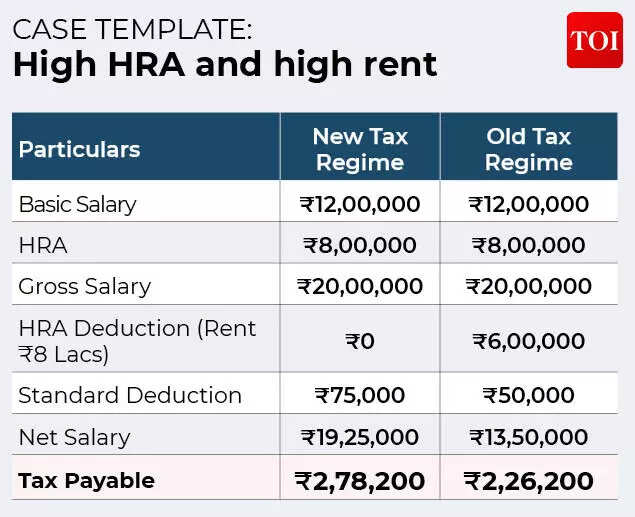
Taxpayers with high House Rent Allowance (HRA) and high rent payments benefited significantly from opting for the old regime, especially in cities where rents form a large portion of income."As per our experience this year, clients with high HRA as well as high rent payments got substantial deductions in the old regime," CA Ashish Niraj said. "In metros and cities like Bengaluru, Gurugram, Noida etc rent is usually high, so if clients' HRA component is high they will get more deductions, which will enable them lower tax liability."
Case template: High HRA and high rent
Case illustration - CA Ashish Niraj, Partner at A S N & Company
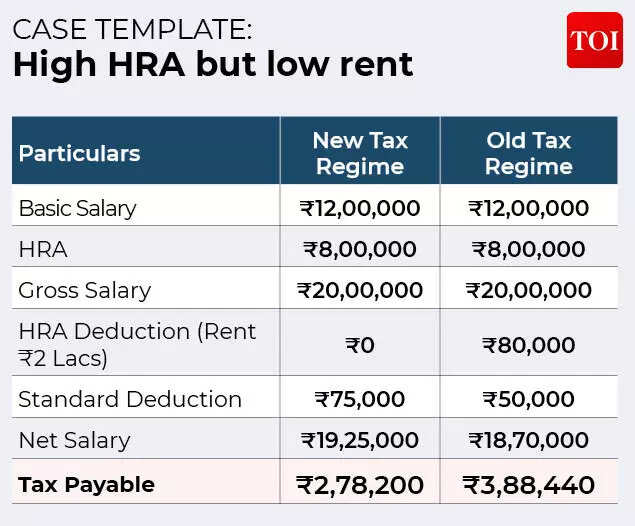
"So it's clear from the above table that HRA and rent payment of Rs 8,00,000 each is resulting in tax saving of Rs 52,000 in the old regime," CA Ashish Niraj said.However, the same logic does not apply where rent payments are low."Taxpayers with high HRA but low rent benefited if they had opted for the new regime," CA Ashish Niraj said.
Case template: High HRA but low rent
Case illustration - CA Ashish Niraj, Partner at A S N & Company
"As rent was Rs 2,00,000 only in the second case, taxpayers' tax liability was Rs 1,10,240 lower in the new regime," CA Ashish Niraj said.(Note: Above calculations are for FY 2024-25 for which ITR was filed this assessment year.)However, he added that taxpayers must understand which exemptions still apply. "Although there are limited exemptions available in the new regime, lower tax rate slabs in the new tax regime makes it attractive unless your HRA and rent payments are high as illustrated in the previous example," he explained.
Planning for deductions: What works under each regime
CA Aastha Gupta explained that while the new tax regime is favored by most taxpayers due to lower tax rates, certain deductions remain available only in the old regime."The new tax regime is favored by most of the taxpayers as the tax rates are lower across different slabs, in spite of allowance of deductions/exemptions in the old tax regime. On the top of it, the new tax regime allows certain high deductions in comparison to the old tax regime such as the standard deduction for salaried taxpayers is Rs. 75,000 in the new tax regime & Rs. 50,000 under old tax regime," she said.
However, she pointed out that certain deductions are available only in the old tax regime:
Deduction of house rent allowance under Section 10(13A) for salaried employees
Deduction of interest on housing loan under Section 24(b) in case of self-occupied house property
Deduction under Chapter VI-A like 80C (investment in PPF, life insurance premia etc.), 80D (medical premia & expenditure), 80G (donations), 80TTA & TTB (interest on saving bank account & fixed deposits)
Salary related deductions such as leave travel allowance, transport allowance, professional tax and other perquisites
Employee's contribution to National Pension Scheme
Key deductions still allowed in the new regime
CA Ashish Niraj pointed to several deductions that taxpayers often miss:Employment-related conveyance allowance: "If you receive any conveyance allowance for the purpose of travel expenditure for employment purposes then it can be claimed as deduction in the new tax regime," he said.
"In metros many employees travel long distances for employment. If presented well with supporting documents, employment purpose travel expenses can be claimed as deduction to save tax."Employer contribution to NPS: "An employer contributing to NPS account under Section 80CCD(2) is allowed as deduction under chapter VI up to 14% of the salary in the new regime," CA Ashish Niraj explained. "Many employers are giving the choice between PF or NPS.
Those who are in the new regime should opt for NPS as its employer contribution is allowed as deduction."Home loan interest for rental properties: "If you have given your house property on rent then you can claim that property's home loan interest as deduction under section 24," he said. "It is important to note that this deduction is not applicable on self occupied house property in the new regime."Agniveer Scheme benefits: "For defense personnel covered under Agniveer Scheme, amount paid or deposited in the agniveer corpus fund is allowed as deduction under Section 80CCH(2)," CA Ashish Niraj noted.Exit and retirement benefits: "Gratuity amount received under section 10(10), leave encashment received under 10(10AA), or monetary benefits on voluntary retirement can be claimed as deductions in the new tax regime," he added.
The comparison methodology that works
"We take into effect the above mentioned deductions (and more, wherever applicable), after seeking inputs from the taxpayers, share a comparison table of the tax computation as per new tax regime and old tax regime, so that the taxpayer is well informed of the decision he/she needs to take regarding the selection of the suitable tax regime.
Sometimes, due to the presence of such deductions, the old tax regime becomes favourable for the taxpayers," CA Aastha Gupta said.
Who should still consider the old regime
Despite the push towards the new regime, experts agree the old regime is not redundant."Individuals investing in investment products / policies listed under sections 80C and 80D, claiming house rent allowance, or servicing a home loan may still find the old regime advantageous despite the requirement to maintain and requiring reporting of more details in their tax filings," Ashish Mehta said.
Where most taxpayers went wrong this assessment year
According to CA Shefali Mundra, Tax Expert at ClearTax, confusion was widespread. "Even though exemptions continue to exist under the old regime, many taxpayers remain unclear about their actual benefit and documentation requirements," she said."This year, the biggest confusion came from HRA, LTA, home-loan benefits, 80C deductions, largely because many taxpayers either didn't realise they were filing under the new regime (now the default) or didn't have clean documentation to back claims under the old regime," Mundra explained.She highlighted common errors:
HRA claims: "HRA claims frequently went wrong due to missing rent agreement/receipts, lack of bank-payment trail, or landlord PAN details where applicable," she said.
LTA confusion: "LTA caused confusion because only eligible domestic travel fare qualifies (not hotel/food/local expenses) and it's limited by block rules (two journeys in a block of four calendar years)," she noted.
Home loan mistakes: "Home-loan claims were often misapplied due to mix-ups between self-occupied vs let-out property and interest vs principal deductions," she observed.
Unnecessary deduction chase: The most "unnecessarily chased" benefits were 80C and 80D-style deductions by taxpayers who were effectively in the new regime (where these generally don't apply), leading to last-minute investments/insurance purchases purely for tax reasons, she added.
"The right approach is simple: finalise your regime first, and if you're opting for the old regime, claim only what you can document end-to-end—rent proofs for HRA, tickets for LTA, lender certificates/property details for home loan and detailed documentation for deductions under section 80C and 80D of the Income tax Act, 1961," she advised.
Why incomplete disclosure led to higher tax
CA Aastha Gupta said many taxpayers lost out simply by not sharing full information.
"Taxpayers that do not share complete information regarding the deductions, exemptions etc. lose out on the benefit of the old tax regime over the new tax regime, if any," she said."Unlike AIS/TIS which gives us some inputs on the potential income of the taxpayer, the tax professionals do not have visibility of the deductions applicable to the taxpayer," CA Aastha Gupta explained.She also noted confusion around existing investments: "In my professional experience, the taxpayers are now confused regarding continuation of the deductions in spite of the selection of the new tax regime.
For example, if a taxpayer was investing in a public provident fund (PPF) to claim deduction under Section 80C for years. When the taxpayer realised that the new tax regime is more beneficial for him now, his/her requirement to invest in PPF from the point of saving tax no longer exists.
In such cases, we guide the taxpayer by showing them other benefits of such investments like the interest rate is lucrative, it's a risk free investment etc."CA Aastha Gupta recommended proactive consultation: "During the financial year, the taxpayer can discuss the potential investments he/she plans to make from a tax saving perspective with the tax professional so that they can be guided regarding the correct tax regime. This results in timely and correct payment of advance tax and no surprises at the time of filing the tax return and payment of the self assessment tax, if any.
"
Documentation and compliance: What you need to know
CA Ashish Niraj cautioned that documentation requirements have increased sharply. "From last year additional details are required to be filled in ITR to claim deductions," he said.Those opting for the old regime are required to enter policy numbers, insurer names, home loan account numbers, financial institution names etc for 80C/80D/Section 24 or other deductions."The government is also getting data from banks, insurance companies, registrar of properties, share depository, mutual funds etc directly.
Hence they can easily cross verify the details provided by you to claim deduction," CA Ashish Niraj explained. "Taxpayers should claim only genuine deductions and keep all proofs handy in case any scrutiny is opened by the department."Critical TDS requirement: "Those with high rent payments must keep in mind that if you pay rent more than Rs 50,000 per month then you are required to deduct 2% TDS under section 194-IB and deposit it in the Government's account.
Landlords can get benefit of this TDS at time of his ITR filing," CA Ashish Niraj said.
What compliance discipline now means
For those choosing to continue in the old regime, Ashish Mehta emphasized that compliance and document maintenance discipline is critical."With tighter verification, use of analytics and data matching, taxpayers should ensure accuracy and full disclosure in ITR schedules. Maintaining proper documentation in the form of investment proofs, payment proofs, loan statements, etc. and avoiding aggressive or unsupported claims can significantly reduce the risk of scrutiny by the tax authorities," he warned.(Disclaimer: Recommendations and views on the stock market, other asset classes or personal finance management tips given by experts are their own. These opinions do not represent the views of The Times of India)