Qualcomm expands Snapdragon on Windows with X2 Plus – 10-core ARM CPU boasts 35% single-core jump
SOURCE:Tom's Hardware|BY: Jake Roach
Qualcomm is expanding its second generation of Windows chips with the X2 Plus lineup, which claims a 35% jump in single-core and a 17% increase in multi-threaded performance.
(Image credit: Tom's Hardware)
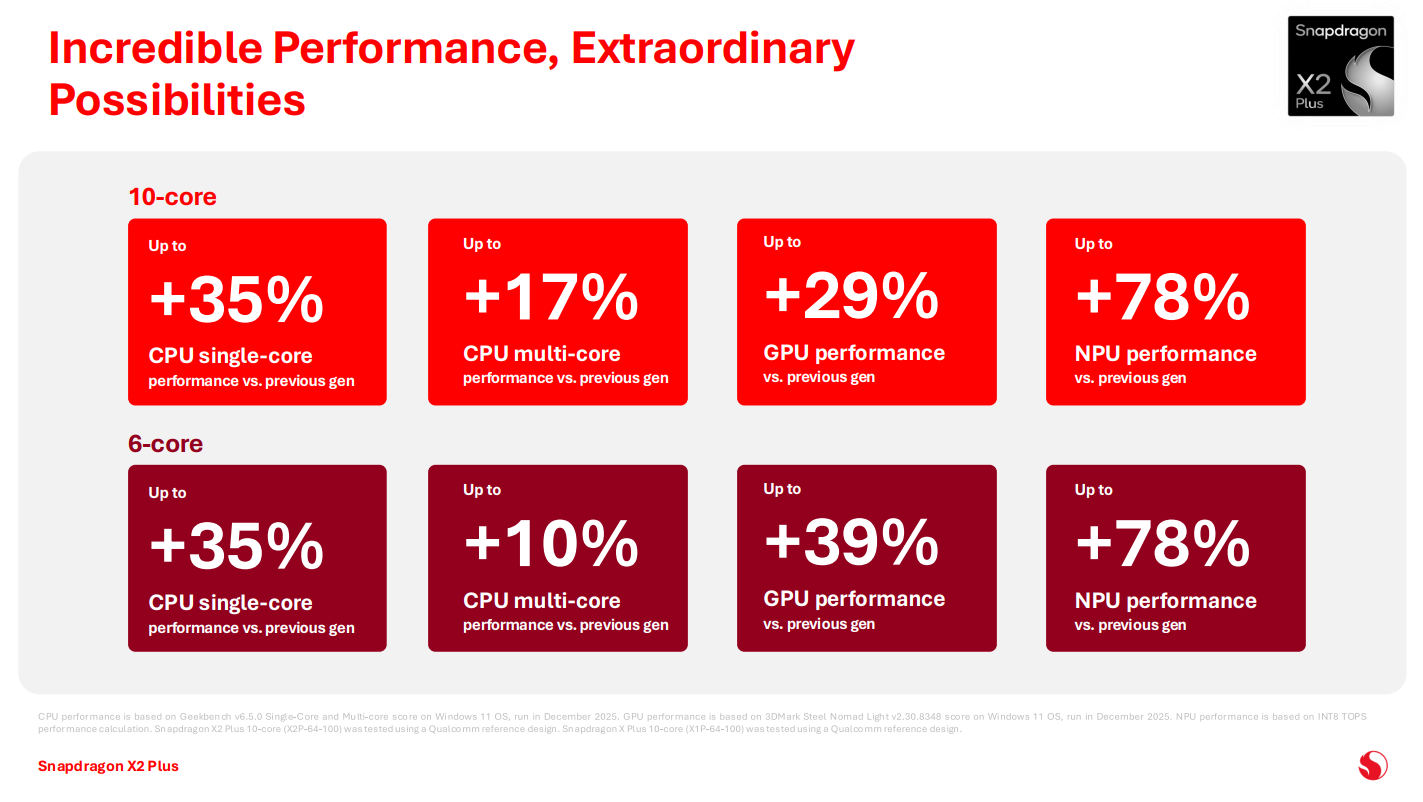
After rolling out Snapdragon X2 Elite chips last year, Qualcomm is expectedly expanding its lineup of Windows offerings with the Snapdragon X2 Plus range. Although we’re likely to see more variants in the future, Qualcomm made two SKUs official at CES 2026. There’s the X2P-64-100, which is a 10-core variant, which Qualcomm claims offers 35% higher single-core performance and 17% higher multi-core performance in Geekbench 6 than the prior-gen, and the X2P-42-100, which comes with six cores. Both sport boost speeds up to 4GHz, along with the X2-45 Adreno GPU and an NPU capable of 80 TOPS.
Compared to the first-generation Snapdragon X Plus, Qualcomm shook the specs around a bit. The two models still boost up to 4GHz, but Qualcomm went with a six-core variant for its lower-end X2 Plus SKU instead of the eight-core design we saw in the previous generation. Although Snapdragon hasn’t confirmed further variants yet, there’s a good chance we’ll see additional versions of these chips in the future.
Like X2 Elite chips, the X2 Plus range is manufactured on TSMC’s N3P node using Qualcomm’s Oryon architecture. Qualcomm has renamed the cores inside its heterogeneous architecture to Prime (performance) and Performance (efficient) cores, but the idea is the same: Prime cores boast max clock speeds, while Performance cores leverage space-optimized designs for better multi-threaded performance.
The top-end X2P-64-100 variant has 10 total Oryon cores, split across six Prime cores and four Performance cores. The X2P-42-100 comes with the same six Prime cores but no Performance cores.
(Image credit: Qualcomm)
Compared to the X1 Plus range, Qualcomm claims the 10-core X2P-64-100 offers 35% higher single-core performance and 17% higher multi-core performance in Geekbench 6 compared to the X1P-64-100. Critically, the X1P-64-100 is a downclocked version of the 10-core X1P offering, topping out at 3.4GHz. The X1P-66-100 is the highest-end X1P chip, boosting up to 4GHz.
The X2P-64-100 has 17% higher maximum clock speeds compared to the X1P-64-100, so although some of the extra performance comes from a clock speed increase, the updated Oryon architecture is contributing, as well. It’s possible that Qualcomm will release downclocked versions of these SKUs, but given the naming – and what we’ve seen from the X2 Elite lineup – variants with higher boost clock speeds seem likely.
Qualcomm claims the same 35% single-core boost with the X2P-42-100, though a smaller 10% multi-threaded jump. That’s not surprising considering the X2P-42-100 is a six-core part, while last-gen’s X1P-42-100 (and X1P-46-100) both came with eight cores. It appears Qualcomm cut the core count in order to achieve better efficiency, which was a weak point of the eight-core X1 Plus offerings in the previous generation.
Get Tom's Hardware's best news and in-depth reviews, straight to your inbox.
Image
1
of
2
(Image credit: Qualcomm)
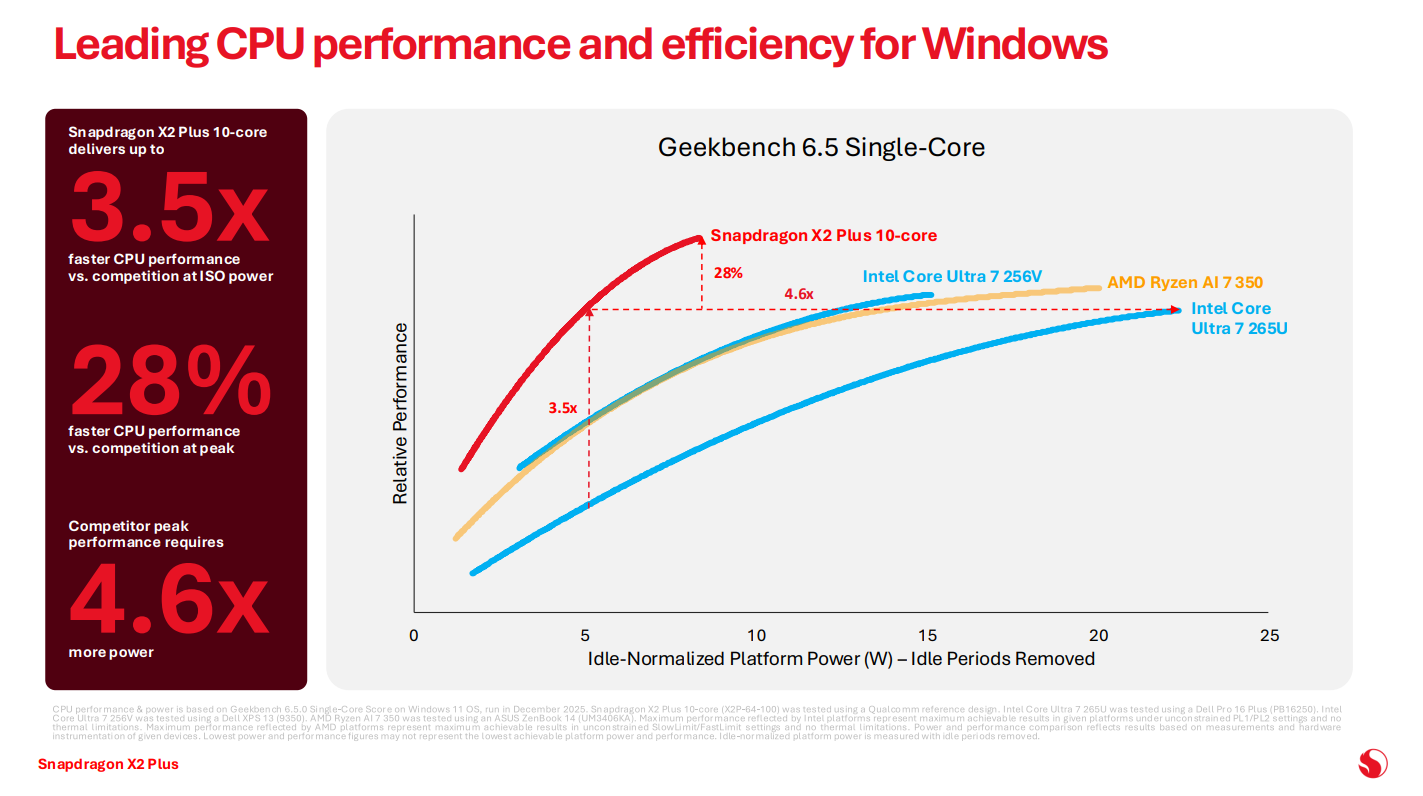
Efficiency is one of Qualcomm’s strongest selling points, which it looks to maintain with the X2 Plus lineup. Testing in Geekbench 6.5, Qualcomm claims the X2-64-100 offers a 3.5x single-core and 3.1x multi-core boost compared to the Intel Core Ultra 7 265U at ISO power (5W and 10W, respectively, in this case). At peak power, Qualcomm claims a 28% and 52% jump in single-core and multi-core performance, respectively, compared to the Core Ultra 7 265U.
(Image credit: Tom's Hardware)
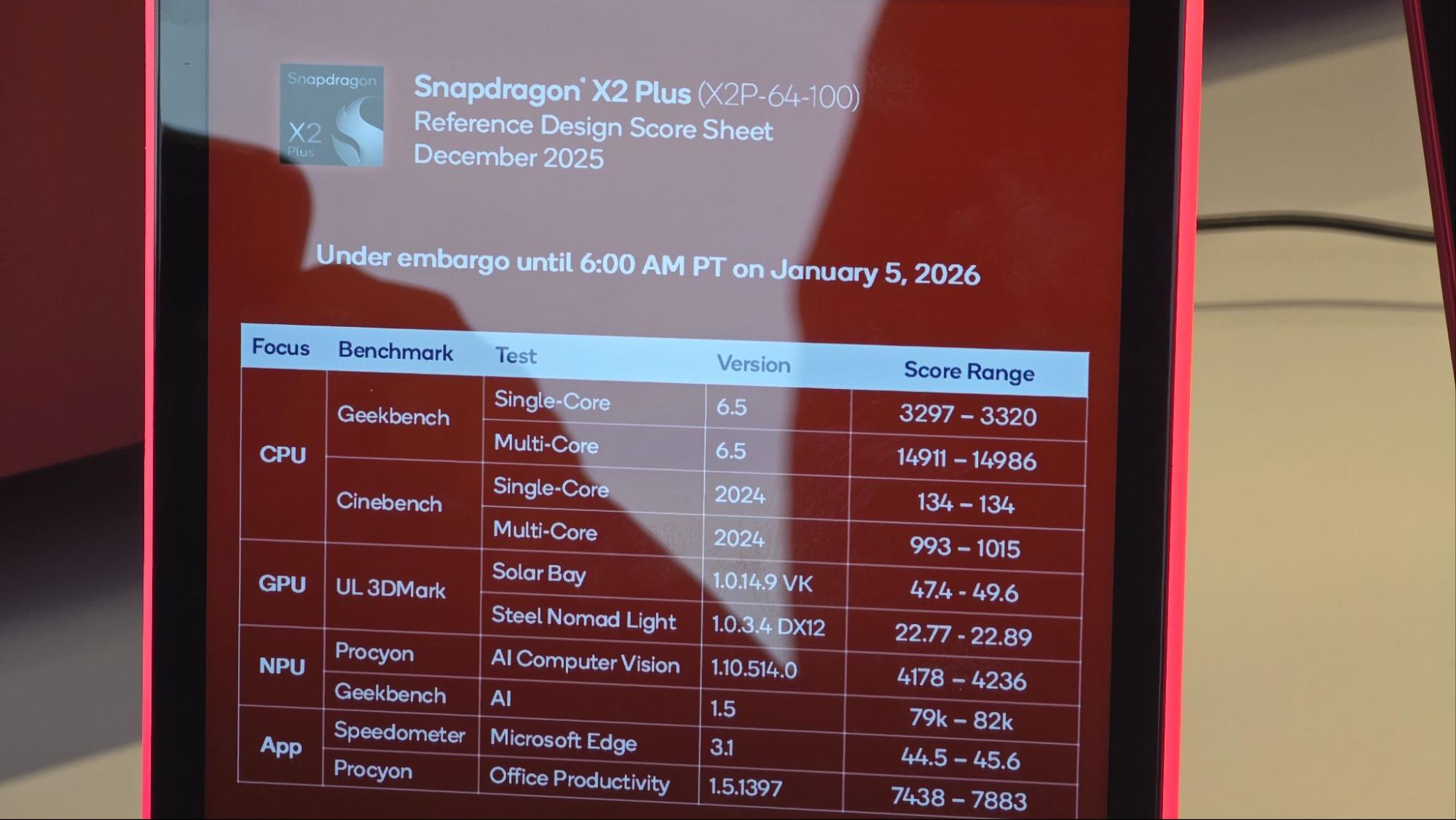
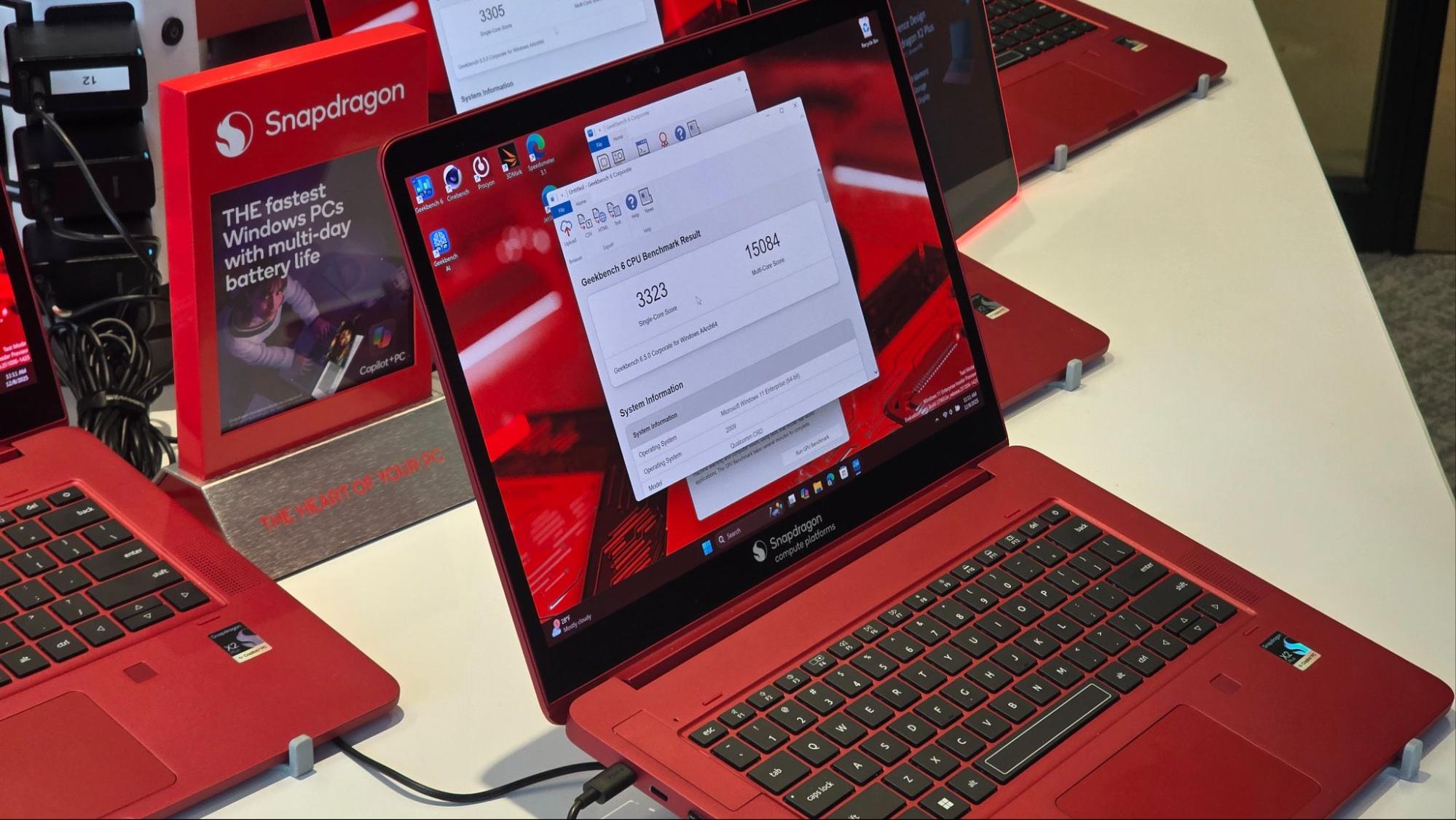
For hard numbers, Qualcomm provided a range of test scores for the X2P-64-100 in a spate of popular benchmarks, which you can see above. During a pre-CES event, we were able to see this chip in action in a Qualcomm reference design running Geekbench 6.5, and the results were slightly higher than the ranges Qualcomm shared.
(Image credit: Tom's Hardware)
In a test run during the event, the X2P-64-100 earned a single-core score of 3,323 and a multi-core score of 15,084 in Geekbench 6.5. For context, the Core Ultra 7 256V scores around 2,700 in single-core and 10,500 in multi-core tests, while the Ryzen AI 7 350 scores around 2,900 in single-core and 12,500 in multi-core tests. Don’t take these numbers as hard comparisons, however. Reference designs only tell part of the story, and specific laptops can post significantly different results, even when comparing identical chips.
Both models carry the updated X2-45 Adreno GPU, though with different clock speeds. The GPU is clocked at 1.7GHz on the X2-64-100 and 0.9GHz on the X2-42-100. Despite such a large difference in clock speed, Qualcomm claims up to a 29% boost in GPU performance for both chips compared to the previous generation.
(Image credit: Qualcomm)
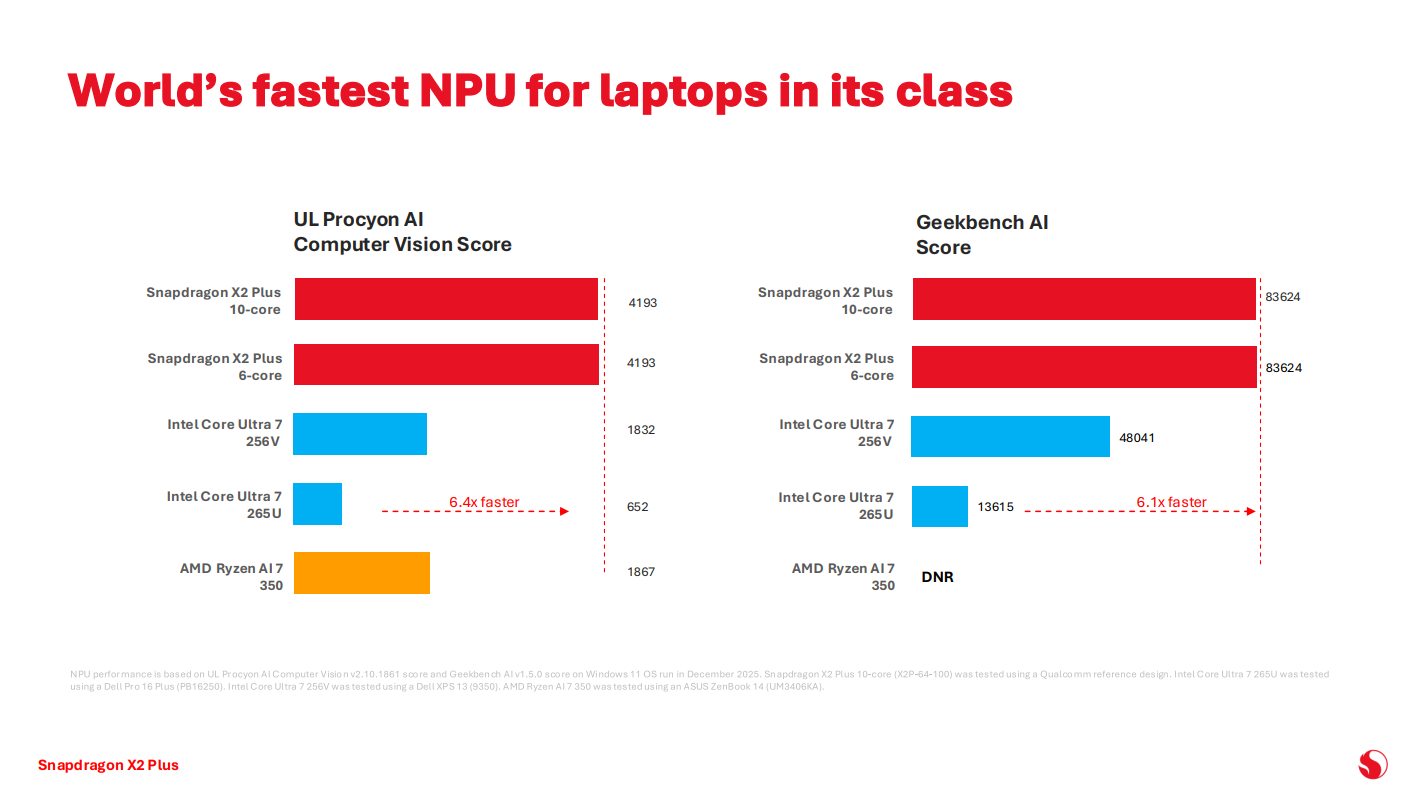
In addition, both chips come with Qualcomm’s updated Hexagon NPU – the same one available on X2 Elite and X2 Elite Extreme chips – which boasts up to 80 TOP of INT8 performance capacity. They come with the same memory system as the X2 Elite chips, as well, supporting up to 128GB of LPDDR5X running at up to 9,523 MT/s.
Qualcomm says you’ll be able to find X2 Plus chips in “select devices from leading OEMs” beginning in the first half of the year. We’ve already seen some of them at CES, such as HP’s OmniBook 5 14, which sports the X2P-64-100 with up to 32GB of memory.