Qualcomm is determined to cut a slice out of Intel's PC pie with latest Snapdragon chips
Qualcomm is trying to become a major player in the laptop processor space. Its Snapdragon X Elite and X Plus chips, along with a concerted effort to improve the Windows on Arm software ecosystem, have made it a credible alternative to Intel and AMD, although it's still stuck at below 1% market share. On Monday at CES in Las Vegas, the company showed the next step in this strategy: the next-gen Snapdragon X2 Plus chips, which are targeted at budget and mainstream systems.
Available in two SKUs – a 10-core model and a 6-core alternative – the Snapdragon X2 Plus boasts a maximum 4 GHz clock speed, support for high-speed LPDDR5x memory, and an NPU that achieves up to 80 TOPS (trillion operations per second) for local AI. Qualcomm claims that the new chips, based on a 3nm process, will provide multi-day battery life in laptops due to their improved power efficiency, requiring 43 percent less power than their immediate predecessors.
The perf improvements come as a result of the more effective cores built into the main CPU. Qualcomm claims that its third-gen Oryon CPU cores are up to 35 percent faster at single-core tasks than the prior-gen Snapdragon X processors and 17 percent faster on multi-core tasks. Its Adreno GPU is 39 percent quicker at GPU tasks, and its Hexagon NPU is 78 percent more performant than those in the original Snapdragon X Plus line.
In fact, in its own test of Geekbench 6.5 multi-core, Qualcomm claims that the X2 Plus 10-core chip is 52 percent more performant than Intel’s current-generation processors at around 25 watts of platform power. No word on how it will stack up to Intel’s upcoming Panther Lake CPUs, though.
Qually’s marketing team has really outdone themselves with this chart, which is clearly intended to make the X2 Plus look impressive. To our eyes, the line showing the 3.1x uplift in relative performance over the Core Ultra 7 265U is nearly the same size as the 52 percent uplift over Intel’s 265V. Not sure why they felt the need to present the figures this way, since they actually look quite good.
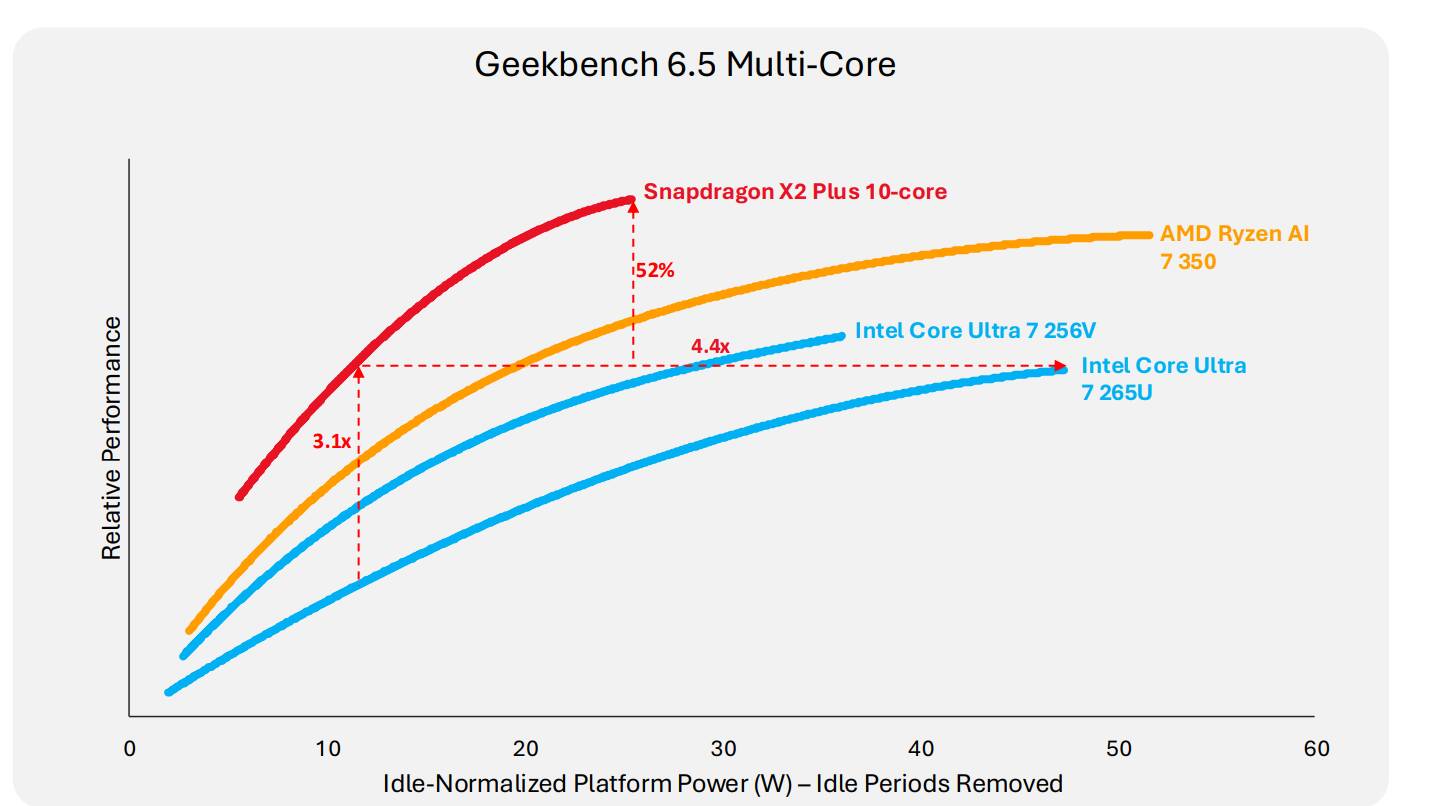
Geekbench 6.5 and Snapdragon X2 Plus vs competitors - Click to enlarge
That said, we do know that Qualcomm’s prior-gen Snapdragon X chips have offered some seriously low-power experiences. For example, when Tom’s Hardware tested Lenovo’s ThinkPad T14s with a Snapdragon X Elite chip inside, the laptop lasted through a whopping 21 hours of continuous web surfing, video playback, and 3D animation at 150 nits of brightness.
The Snapdragon X2 Plus chips follow closely on the heels of Qualcomm’s higher-end and more expensive Snapdragon X2 Elite chips, which were announced this past fall. Those processors are available in three SKUs, which range from 12 to 18 cores and carry a boost frequency up to 5 GHz, along with up to a 1.85 GHz GPU, and a generous amount of cache. The memory bandwidth on the highest end SKU, the X2 Elite Extreme, is higher, with a maximum speed of 228 GB/s versus 152 GB/s for the other two X2 Elite SKUs and the X2 Pluses. This could help with some local AI workloads where memory speed is critical.
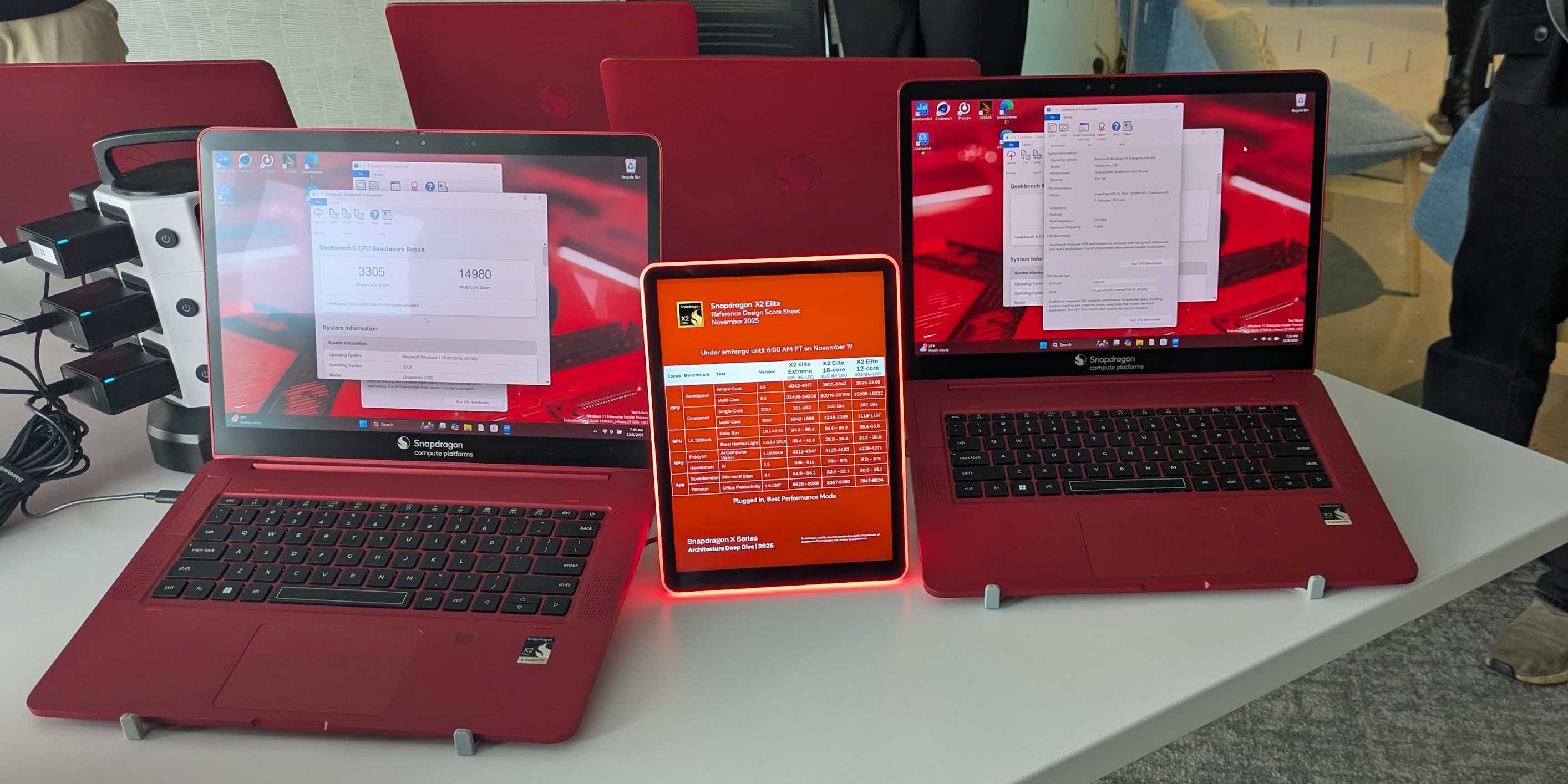
Qualcomm Snapdragon X2 Elite laptops - Click to enlarge
All of the Snapdragon X2 processors have the same 80 TOPS NPU, however. That means that any PC with a Snapdragon X2 chip will qualify as a Microsoft Copilot+ PC, and will get access to a handful of exclusive local Windows AI features including Microsoft’s controversial Recall app and Windows Studio Effects, which does background blurring, auto framing, and other special effects using the NPU.
X2 Plus
X2 Plus
X2 Elite Extreme
X2 Elite
X2 Elite
Cores
10
6
18
18
12
Cache
34 MB
22 MB
53 MB
53 MB
34 MB
Max Clock
4 GHz
4 GHz
5 GHz
4.7 GHz
4.7 GHz
GPU
1.7 GHz
0.9 GHz
1.85 GHz
1.7 GHz
1.7 GHz
Memory Speed
152 GB/s
152 GB/s
228 GB/s
152 GB/s
152 GB/s
Qualcomm has worked with a number of app publishers to build Snapdragon X hardware support into their AI-enhanced products. For example, reps showed us how Topaz Photo does picture enhancement tasks such as denoising and upscaling using a combination of the chip's NPU and GPU. They also showed a demo of a Nexa AI local LLM that uses the NPU to query data from folders on your local drive. As an example, a rep asked the software to find a GitHub password from a file on the laptop. We really hope Qualcomm doesn’t actually store passwords in plain text.
While Qualcomm has not disclosed pricing for systems based on the Snapdragon X2 Plus or Snapdragon X2 Elite chips – that will be determined by the OEMs that use them – we can guesstimate that those based on the X2 Plus will likely be just a little bit cheaper than configurations with the X2 Elite. That being said, right now, neither X2 chip is out and the price difference between last-gen X Plus and X Elite chips seems to be minimal – in fact, in some cases, systems with the better chip are cheaper.
As of this writing, Microsoft is selling the Surface Pro (13-inch) with Snapdragon X Plus for $1,099, but the one with Snapdragon X Elite starts at $999. Lenovo.com actually charges $173 more to have a Snapdragon X Plus chip on a ThinkPad T14s than it does for an X Elite chip with more cores and higher clocks. Perhaps Microsoft and Lenovo are just cleaning out inventory, as we would expect the price differential to favor the lesser chip by at least $100 when the new models come out.
Qualcomm has big ambitions for the entire Snapdragon X series and the software ecosystem that works with Windows on Arm. Since the original Snapdragon X laptops came out in 2024, there’s been a surge in apps that run natively under Snapdragon, and most others run under emulation. Even though Snapdragon laptops are not sold as gaming machines, you can play a number of games on them, including Minecraft, Roblox, Fallout and GTA V.
At Computex in June 2024, Qualcomm CEO Cristiano Amon claimed that Arm-powered laptops would account for 50 percent of the Windows PC market within five years. (Qualcomm is currently the only Arm-powered Windows laptop CPU maker.) Five years haven’t passed yet, but enterprises are not impressed so far, if sales numbers are any indication.
According to analyst firm IDC, 153 million commercial PCs were sold worldwide between Q4 of 2024 and Q3 of 2025, but only a million of those, or 0.65 percent, were powered by Qualcomm chips.
- Qualcomm takes RISC on Arm alternative with Ventana acquisition
- Makers slam Qualcomm for tightening the clamps on Arduino
- Qualcomm working on datacenter CPU and in 'advanced discussions' with hyperscaler
- Qualcomm bets on inferencing in the cloud, which Arm says can't run it all it forever
“There's a reluctance to change from the Enterprise side of things to going to Arm-based,” IDC analyst Jean Philippe Bouchard told The Register in an interview. “Everyone is kind of geared towards x86.”
However, Bouchard pointed out that Qualcomm may see more business come its way both as a result of its long battery life and some helpful security features. Snapdragon X2 Elite chips will have Snapdragon Guardian, which allows IT departments to manage remote devices even if they are powered off and unbootable, using 5G or Wi-Fi 7 connectivity.
“Tough to say what the future holds,” Bouchard said. “But they're doing everything that they need to do right in terms of performance and in terms of future.” ®